Get Full Government Meeting Transcripts, Videos, & Alerts Forever!
Get email alerts on the Education Higher Performing Schools topic
No spam. Unsubscribe anytime.
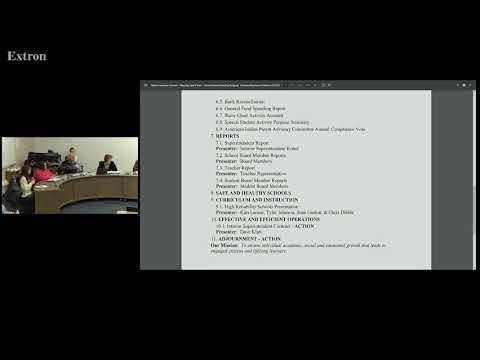
Albert Lea presenters outline High Reliability Schools work, urge districtwide consistency
Summary
District staff and building leaders summarized takeaways from a High Reliability Schools (HRS) summit, described current certification progress at local schools and urged board-level support to embed HRS as a lasting district framework.
Albert Lea Public School District staff and building leaders on Monday summarized work using the High Reliability Schools (HRS) framework developed by Marzano Research, described how buildings are progressing through HRS certification levels and urged board support to make HRS a durable, district-wide system.
Presenters said HRS emphasizes research-based “leading indicators,” matching those measures with each school’s “lagging indicators,” and building common instructional tools so teachers can focus on priority standards and student proficiency rather than broad coverage of every standard.
Tyler Johnson, Kim Larson, Sean Gaston and Chris Dibble led the presentation. They described HRS as a multi-level certification process (levels 1–5) in which schools submit evidence via an online platform to demonstrate they meet the prior level’s requirements before moving up. The district, they said, has been working on levels 1 and 2 for several years; the high school recently achieved level 2 prior to winter break and other buildings are at various points in the process.
The presenters described practical tools developed at the district level: an instructional model that lists 43 research-based classroom elements, a searchable library of artifacts and videos for teacher learning, student and parent surveys used as lagging indicators, and curriculum maps that identify “priority standards” to give teachers more time to deepen instruction on the most critical learning goals.
Presenters emphasized that HRS is intended to be adapted by each school rather than implemented identically across buildings. They said some schools can advance more quickly than others — the minimum pace for a certification cycle is five years — but that the platform’s evidence-based approach creates common expectations and helps sustain improvement when staff or leaders change.
District staff highlighted three practical benefits observed during seven years of the district’s HRS work: 1) ongoing accountability through regular, measurable indicators rather than waiting for end-of-year test results; 2) growing teacher buy-in—teachers now host peer rounds, share strategies and use proficiency scales; and 3) program compatibility and sustainability, which presenters said helps preserve instructional continuity when principals or other leaders turn over.
Presenters noted the HRS emphasis on aligning HRS work with the district’s existing Multi-Tiered System of Supports (MTSS), bundling and vertically aligning standards, and creating proficiency scales that inform instruction and assessment at each grade level. They described level 3 as the point at which a guaranteed and viable curriculum is documented and schools move further into individualized supports for students.
Presenters credited Marzano Research (and named authors referenced during the summit) for the framework’s research base and said the district has modified the work to fit local needs. The presenters recommended the board consider formalizing district-level commitment to HRS — for example by resolution — to protect the work during leadership transitions.
The presentation included examples of classroom artifacts, survey excerpts and a discussion of how the district’s instructional coach collects videos and materials for an internal library to support new teachers. Presenters said the library is a work in progress but already used to help teachers find classroom strategies tied to the 43 instructional elements.
The board asked clarifying questions about certification timelines and whether outside reviewers still participate; presenters said certification is now handled primarily through an online submission platform though pre-pandemic external reviews sometimes occurred. The discussion closed with the presenters asking for continued board support as the district completes remaining building certifications.
District staff and building leaders framed HRS as a long-term instructional and organizational framework rather than a short-lived initiative; they urged the board to prioritize the work during the superintendent search so future leadership continues the effort.