Get Full Government Meeting Transcripts, Videos, & Alerts Forever!
Get email alerts on the Infrastructure Sewer topic
No spam. Unsubscribe anytime.
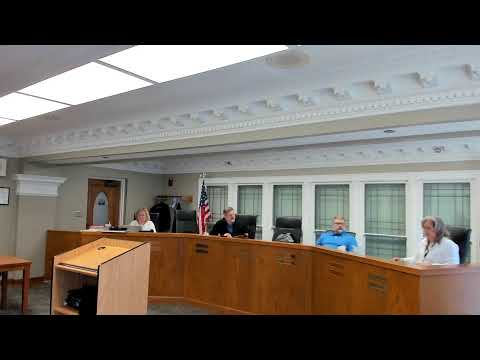
Commissioners receive update on regional sewer project financing and disadvantaged-community eligibility
Summary
County staff updated the Dubois County Board of Commissioners on recent meetings with the Indiana Finance Authority, City of Jasper and consultants about financing a regional sewer project and explained how disadvantaged-community rules and census tracts affect grant eligibility.
County staff gave a progress update on a regional sewer project and recent discussions with the Indiana Finance Authority (IFA), City of Jasper, the IFA representative Clark Deats, Baker Tilly and other consultants.
Staff said the county reiterated its commitment to the project, emphasized environmental necessity of addressing failing systems, and expressed willingness to provide funding to help reduce customer rates. The IFA representatives discussed financing options and noted separate funding "buckets" that include forgivable loans or grant-like funds targeted to disadvantaged communities.
Staff described how the IFA uses measures tied to area median income and census tracts: to qualify as a disadvantaged community for certain IFA funding, an area typically must meet an 80% AMI threshold. "For this purpose, it's basically you have to have 80% of the impact through the annual median income," a county official said. Staff observed that the county likely does not qualify in full on that measure and that household-income differences across small jurisdictions can reduce grant opportunities.
Commissioners discussed considering a conservative financing assumption that the county would be in the higher-interest pool if grant funds are not available, and noted the county will pursue multiple funding sources including USDA programs and IFA rounds. Staff said a designer-level estimate will be sought and that the application for the next funding round is forthcoming.
Staff emphasized affordability concerns for residents if the project cost is high; as an illustration, they said a hypothetical $20 million project serving 200 locations would be expensive on a per-location basis. No formal action or vote was taken; the update was informational.