Get Full Government Meeting Transcripts, Videos, & Alerts Forever!
Get email alerts on the Electronic Positive Response topic
No spam. Unsubscribe anytime.
Workshop reviews electronic positive response codes, seeks clearer communication between operators and excavators
Summary
The Office of Energy Infrastructure Safety convened stakeholders to review electronic positive response (EPR) codes, discuss recent code removals effective Jan. 1, 2025, and identify implementation problems including code mapping, missing contact information and lack of a dispute mechanism.
The Office of Energy Infrastructure Safety convened a workshop in Sacramento to gather feedback from utility operators, excavators and one-call center representatives on electronic positive response (EPR) codes used to communicate locate status under the DigSafe Act, Office policy analyst Henry Salim said.
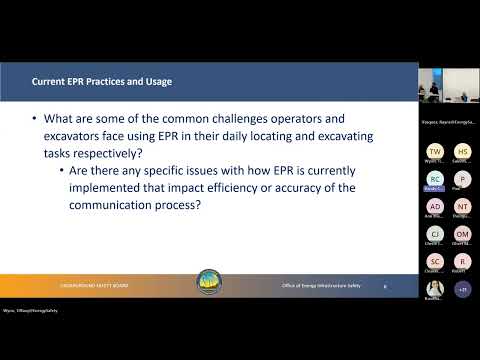
The workshop focused on whether current EPR codes clearly tell excavators when it is safe to begin work, how internal utility ticketing systems map to standard EPR codes, and whether proposed removals and revisions to the code list improve field communication. Stakeholders said mapping mismatches, removed codes that formerly flagged safety or field-meet needs, inaccurate contact information on tickets and the absence of a timely dispute mechanism are common problems that delay work and sometimes create unsafe conditions.
"The term that I'm hearing nationally is what they're calling excavation readiness," said James Wingate of USA North 811, describing a proposed metric that would show whether a ticket is ready to be excavated compared with its legal start date. "How long until the excavation is ready compared to the legal start date." Wingate said such a metric could help distinguish delays caused by ticket size or location from operator response problems.
Operators described a range of implementation practices. "We don't use all of the codes that are available to us for EPR," said Steve Cleaver of PG&E, who explained PG&E limits field responses to a small set of mapped internal responses and reviews mappings annually. Other operators said national companies must propagate any code changes across many systems, which raises implementation cost and complexity.
Participants discussed several categories of concern that came up repeatedly during the meeting: the removal or consolidation of some codes, the need for a clearer way to indicate whether a response is final, safety-related flags such as traffic-control delays, and problems when a utility's internal ticketing system does not forward a final status to the 811 center.
Several speakers urged restoring or clarifying codes that communicate safety or field-meet requirements. Representatives said field meets and standby requirements can be important for certain installations even when those facilities do not meet a high-priority definition. Steve Cleaver offered an example from gas distribution practice in which a field meet and a staffed standby are used to manage regulator stations and prevent overpressurization risks.
Excavators raised procedural pain points. Enrique Miranda and other contractors described instances where operators selected codes that contractors then disputed — for example, "negotiated marking schedule" used when the excavator said no negotiation occurred — and said current remedies take too long. "If there was a dispute button where we could do something like that where it forces the locators to come out there and remark or set something up, that would be really helpful," one excavator said.
Stakeholders described recurring technical causes of apparent EPR failures: operators whose internal systems use a narrower set of responses than the public EPR list; utilities that forward responses to 811 through an intermediate utility system and lose mapping fidelity; and incorrect contact phone numbers on tickets, which frustrate attempts to resolve differences in real time. Britney Brandman of the Office advised stakeholders to use the agency complaint process for systemic issues and said the board reviews complaint patterns when setting policy priorities.
Panelists noted that the ticket continuity committee (TCC) of the one-call centers and TCC member boards developed the original code list and that Dig Alert and USA North 811 implemented a set of changes effective Jan. 1, 2025. Anne Diamond (Dig Alert) and James Wingate (USA North 811) said many proposed removals cited in staff briefing materials had already been removed by the centers in fall board action and were effective Jan. 1, 2025.
No formal regulatory votes were recorded during the workshop. The ticket process committee will use the discussion to refine recommendations, and the Office will accept written follow-up comments. The workshop closed with notice that the next board meeting is scheduled for April in Riverside and with written-comment instructions and an email contact on the record.