Get Full Government Meeting Transcripts, Videos, & Alerts Forever!
Get email alerts on the Pensions topic
No spam. Unsubscribe anytime.
Commissioners weigh retiree pension increases as fund remains above 100% funded
Summary
Board discussed options to restore buying power for retirees after a 25-year pause in post‑retirement adjustments; proposals range from 1% to 1.5% compounded annually or 1% per three years. Commissioners asked for detailed cost and sustainability analyses before any action.
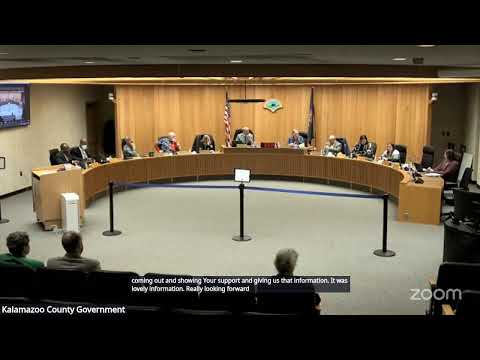
Kalamazoo County commissioners spent part of the March 4 meeting reviewing proposals to increase retiree pension benefits after more than two decades without automatic adjustments. Administration and the retirement-investment committee presented funding scenarios and actuarial implications; no final vote was taken.
The nut graf: Commissioners acknowledged a tension between restoring retirees’ lost purchasing power and preserving the long-term funded status of the county’s defined-benefit plan. Staff and trustees recommended further study and a defined schedule for recurring review.
County administration outlined three illustrative approaches raised by retirees and board leadership: a 1% compounded annual post-retirement adjustment, a 1.5% compounded annual adjustment, and a one-percent increase for every three years retired (roughly a 0.33% annual equivalent). As of the latest valuation for the fiscal year ending Dec. 31, 2024, the plan’s funded ratio decreased slightly from about 109.8% to 108.2% because of increased retirements and lump-sum payouts. Administration said a 1.5% annual increase would raise employer contributions materially (administration estimated a multi-hundred-thousand-dollar to million-dollar annual effect) but would keep the fund above 100% funded in the short term; the board was cautioned that the effect compounds and would affect future employer contribution rates.
Vice Chair Taylor (who chaired the discussion) and other commissioners said the county should act to avoid repeating the 20‑plus years without adjustments but were reluctant to adopt an option that would immediately raise employer contributions by an amount difficult to sustain in annual budgets. Multiple commissioners suggested a middle path (for example, the 1% every three years proposal) and asked staff and the retirement-investment committee to produce precise cost estimates and simulations of contribution-rate pathways under each option.
Retirement attorney and staff materials provided to the board included historical context: small ad hoc adjustments were made in the 1970s and up to early 2000s, but no automatic post-retirement increases have been applied since 2001; advocates estimated retirees who left in 2001 had lost substantial buying power due to inflation. Commissioners also discussed retention and recruiting considerations for current employees and noted that some retention levers (for example, vesting periods) could be reviewed separately.
Administration and the retirement-investment committee committed to returning with the requested cost simulations, scenario modeling on employer contribution impacts over a multi-year budget horizon, and legal/actuarial recommendations for a recurring review cadence so retiree benefit adjustments are revisited at regular intervals rather than left unchanged for decades.