Get Full Government Meeting Transcripts, Videos, & Alerts Forever!
Get email alerts on the Public Art topic
No spam. Unsubscribe anytime.
Public Arts Advisory Commission highlights 39 permanent works, $1.2M in collection value
Summary
The West Des Moines Public Arts Advisory Commission presented its annual report to the City Council on March 3, listing recent installations, program metrics and a planned 2025 commission; commissioners and council members emphasized community engagement and said the program is funded largely through the hotel‑motel tax and outside grants.
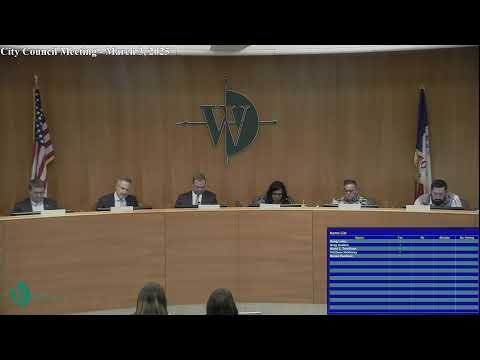
Mahesh Mathurbootham, chair of the Public Arts Advisory Commission, and Ryan Penning, West Des Moines parks and recreation director, presented the commission’s annual report to the West Des Moines City Council on March 3.
The report said the city’s permanent public art collection includes 39 works valued at more than $1,200,000, and outlined recent and planned projects including a sensory wall at Raccoon River Playground (2024) and a Legacy Woods Public Art Project slated for 2025. “Public art shapes our city, our city's identity, turning everyday spaces into places of inspiration and connection,” Mathurbootham said.
The commission described the program as a mix of permanent installations and rotating exhibits: 152 rotating sculptures since 2013, 43 murals since 2021, and a variety of temporary exhibits on the city campus. The 2025 Legacy Woods commission was quoted at $170,000 in the presentation and cited support of $50,000 from an external grant (name not specified in the presentation). The commission noted it has worked with artists from nine states and that 93 community members have served on selection committees and work groups.
Council members praised the program. Councilman Hudson said residents notice the works and that public art contributes to a community that values “artistic expression.” Councilman Trevelyan and others thanked the commission for stewarding the program’s funding, noting the council in 2011 designated hotel‑motel tax as a principal funding source. “We put that money to such good use…you are good stewards of that money,” Trevelyan said.
Penning and Mathurbootham described the program’s goals as improving accessibility and engagement. Mathurbootham noted the Raccoon River Playground sensory wall was designed with neurodivergent children in mind: “This interactive installation provides a calming, yet stimulating environment, offering a space where every child can explore and play and connect, in the way that they want to.”
The presentation also included a brief financial overview: the collection valuation and an explanation that the public art fund balance fluctuates as projects are completed and new commissions are planned; the commission said it leverages grants and partnerships alongside city funds. Council members pointed to the economic benefits of arts and culture cited in the report for the greater Des Moines region.
Mathurbootham closed by thanking the council and city staff for ongoing support and offered to take questions; no formal council action was recorded on the presentation.
The report and program documentation were made available as part of the council packet.