Get Full Government Meeting Transcripts, Videos, & Alerts Forever!
Get email alerts on the Transit topic
No spam. Unsubscribe anytime.
MBTA outlines ridership gains, microtransit expansion and funding needs for Rosemount
Summary
Luther Weidner of MBTA updated the Rosemount City Council on ridership trends, growth of on‑demand Connect service, electric bus demos, and the agency's push for a clearer regional sales‑tax allocation to expand service to Rosemount.
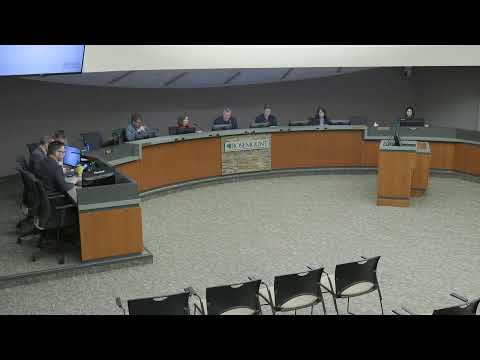
Luther Weidner, executive director of MBTA, briefed the Rosemount City Council on March 4 on recent ridership trends, microtransit growth and funding uncertainty affecting future service to Rosemount.
The update centered on ridership metrics from 2023 to 2024, the expansion of MBTA's Connect on‑demand service, a recent electric‑bus pilot that MBTA moved into revenue service, and the agency's legislative push for a statutory allocation of regional motor‑vehicle sales tax to transit providers. "Our goal as an organization is our wait time to be about 20 minutes or less," Weidner said, describing current Connect average wait times of about 26 minutes and average daily bookings of roughly 434.
Why it matters: MBTA serves Rosemount on several fixed routes and through microtransit; changes in funding and service design will affect how often and where residents can travel without driving.
MBTA told council the system had a roughly 10% year‑over‑year increase in total ridership for 2023–24 and that express services rose sharply, while local fixed routes declined after staff reallocated about 15% of local service to Connect microtransit. Weidner said Connect handled more than 50,000 bookings in 2024, a 44% increase over 2023, and that demographic and trip‑purpose surveys show many riders use the service to commute to work and that lower‑income households rely on Connect in lieu of Lyft or Uber because of cost.
Weidner highlighted a recent demonstration and limited revenue deployment of an electric Connect vehicle and said MBTA used one‑time state capital funds to procure five such buses. He also said the heavier battery weight helped vehicle traction in winter conditions: "We actually had to pull service off the road," he said of a severe 2023 ice storm, "and [the demo bus] performed ... spectacularly."
On funding, Weidner described a 2023 state transportation bill that created a regional motor‑vehicle sales tax targeted for transit but said MBTA and other suburban providers have not yet received a final allocation. MBTA is pressing the legislature for a statutory dedication and an investment floor; Weidner said MBTA is seeking roughly a 10% minimum of the regional sales‑tax pool for suburban providers as part of proposed allocation language.
Council members asked about a proposed pilot stop near Pilot Knob and direct express service to downtown Minneapolis and St. Paul. Weidner said the agency is planning services where it can reasonably sustain them and that proposals remain contingent on securing stable funding: "We want to put service out where we know we're going to have the funding to maintain it," he said.
The presentation closed with council praise for MBTA's outreach and event service work. MBTA said it will continue working with Rosemount staff on route planning, pilot stops and legislative advocacy during the current session.
MBTA presentation accepted by the council as an informational item; no council action was required or taken on service changes or funding authorizations at this meeting.