Get Full Government Meeting Transcripts, Videos, & Alerts Forever!
Get email alerts on the Solid Waste Landfill topic
No spam. Unsubscribe anytime.
Residents press county on landfill expansion as solid-waste staff present transfer-station update
Summary
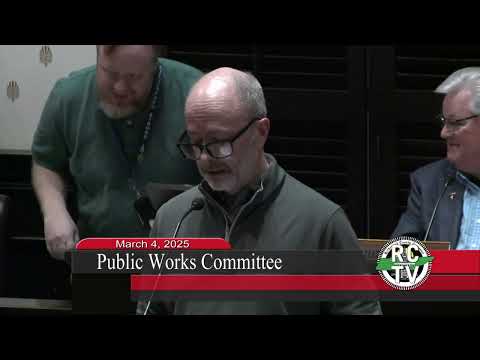
At the Rutherford County Public Works and Planning Committee meeting March 4, residents urged commissioners to reject further landfill expansion and to stop accepting out‑of‑county trash while Solid Waste Director Bishop Wagner outlined diversion figures and progress on a new transfer facility.
At the Rutherford County Public Works and Planning Committee meeting on March 4, 2025, a string of residents urged commissioners not to approve any expansion of Bridal/Middle Point landfill and to stop accepting out‑of‑county residential trash, while Rutherford County Solid Waste Director Bishop Wagner presented monthly tonnage and progress on a new transfer and management facility.
The public comments drew repeated references to alleged environmental problems and long-term liability. “I do know that since 02/2018, Middlepointe has had 33 TDEC violations, of which 11 were major, and there have also been 2 fires at the landfill,” said Sean McGowan, a North Murfreesboro resident who opposed expansion. McGowan said Republic Services’ proposal discussed last month would extend capacity by about 50 years, a span he said would outlast current residents.
Those comments were countered by other citizens who supported keeping waste local. “We have the room. What we need to do is stop taking Nashville's household waste,” said Kennedy Holloway, who identified himself as a lifelong Rutherford County resident and said keeping local waste helps keep taxes low.
Bishop Wagner, the county’s solid‑waste director, provided data from February and an update on county plans to handle waste as Middle Point approaches post‑closure. He told the committee the county received 90.58 tons of brush in February for $2,717 in revenue, and that the county managed 3,024.61 tons of waste from all sources that month. Wagner said 2,232.17 tons came from county convenience centers and 513.92 tons from schools; the county reported diverting 278.52 tons and gave a diversion rate of 9.21 percent for February. He said Rutherford County recycled 4,344.08 tons from convenience centers, schools and county facilities in 2024 under a single‑stream model.
Wagner also said the county has “nearly completed the monumental task of planning, designing, and constructing a new solid waste transfer and management facility at 6000 Landfill Road.” He said the facility is intended to allow Rutherford County to manage county‑generated waste when Middle Point Landfill enters post‑closure, and to offer a local option for businesses and contractors that would generate revenue for county waste operations. “This project will allow us to manage Rutherford County's waste once Middle Point Landfill enters its post closure phase of life,” Wagner said.
Multiple commenters raised concerns about Republic Services and Waste Management. Michael Harris, a Christiana resident, said the county currently has a five‑year hauling contract with Waste Management and warned that declining local capacity could leave Rutherford County reliant on outside haulers. Christy Miller and others cited a pending Murfreesboro lawsuit and alleged leachate and “forever chemical” (PFAS) concerns; Miller said some economic‑impact and fiscal reports paid for by Republic contained inaccurate statements.
Opponents pointed to past county action. Susan Allen recalled the county commission’s April 2018 votes and urged commissioners not to rescind them; she summarized a 2018 commission finding that prohibited future mergers with Republic or similar access agreements.
The committee unanimously approved a motion to accept the three Solid Waste reports Wagner presented (typical operations report, an update on G Street site controls, and the annual progress/data submission to the Central Region Solid Waste Planning Board). The motion was made and seconded and approved by voice vote.
Discussion vs. decision: public commenters repeatedly pressed commissioners to reject expansion and to stop accepting out‑of‑county residential trash; those are policy requests. The committee’s formal action at the meeting was to accept Wagner’s operational and planning reports. Wagner said central‑region approval and other regional steps remain: he noted one item will be considered by the Central Region Board on March 24.
The committee did not decide on any contract with Republic Services or on an expansion permit; commenters’ allegations about TDEC violations, odors, fires, and long‑term tonnage were presented as claims by residents and are reported here as such.
What happens next: Wagner said the county’s transfer‑station project will enable local handling of county waste when the Middle Point site is closed, and the Central Region board will consider an item on March 24 that relates to the regional plan and approvals the county is following.
Ending: The committee scheduled no formal vote on any landfill expansion at this meeting; public comment and the director’s operational update framed a debate that the county and regional boards may confront in coming weeks.