Get Full Government Meeting Transcripts, Videos, & Alerts Forever!
Get email alerts on the Transit topic
No spam. Unsubscribe anytime.
Syride projects ridership rebound, adds electric buses while warning federal funding could shift
Summary
Syride officials told the Ames City Council during budget hearings that ridership is recovering toward pre‑pandemic levels, planned federally funded bus replacements will increase the agency's electric fleet, and the agency is preparing contingency plans if federal transit dollars are cut.
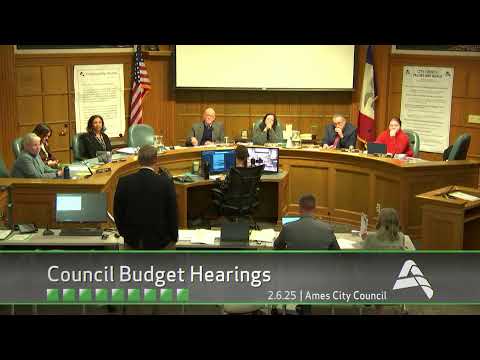
Barb, presenting for Syride, told the Ames City Council that the transit agency expects ridership to continue recovering and is planning vehicle and facility upgrades supported by federal grants.
Syride’s presentation said ridership is about 85% of pre‑pandemic levels and the agency estimates roughly 5,100,000 passenger boardings in the coming year, or about 30,000 passengers a day. “Ridership is trending upward. We are currently about 85% of pre pandemic levels,” Barb said.
The agency reported it received about $2,000,000 in federal funding tied to the small transit‑intensive cities program and said that discretionary grants will finance key capital projects. Barb said Syride secured two federal grants that will allow the agency to replace seven diesel buses with five battery‑electric buses and two new articulated buses, bringing the battery‑electric fleet to seven vehicles and expanding its 60‑foot articulated bus fleet to 10. Delivery of those buses is expected in FY25–26. Syride also completed a shop rehabilitation project in December to improve safety, air quality and workspace.
Syride is also running a B100 biodiesel pilot on five buses, testing year‑round performance with the potential to expand B100 if the trial succeeds. The presentation noted fixed‑route parts and lubricants costs rose 5.3% and that property insurance costs have increased partly because some vehicles are parked outside while the agency seeks grant funding to bring more vehicles indoors.
The council pressed Syride on staffing and the reliance on federal revenue. Barb said hiring remains a challenge—recruiting and training can take two to four months—but that recent pay increases, sign‑on bonuses and new authority to perform third‑party commercial driver’s license testing on site have reduced open runs. She also said Dial‑A‑Ride, the agency’s paratransit service, projects about 15,500 passenger trips next year and that roughly 80% of Dial‑A‑Ride’s operating costs are federally funded.
On the council’s question about federal funding volatility, Barb said Syride has run scenarios and has cash reserves that could be used short‑term. “Those cash reserves are really one‑time dollars,” she said, noting that reserves can cover shortfalls temporarily but that long‑term adjustments would require discussions with local funding partners. Barb added that a portion of Syride’s funding comes from a performance‑based small transit‑intensive cities program that has historically had bipartisan support, but she declined to promise stability if federal priorities change rapidly.
Councilmembers and staff said they plan more federal and state outreach, including trips to Washington, D.C., and meetings with the state later in the spring to advocate for transit funding.
The presentation concluded with an emphasis on continuing efforts to attract and retain drivers, expand customer information technology (real‑time monitors and signage), and pursue discretionary grants to lower local costs and preserve a state of good repair.
Syride’s requests in the operating budget include a 2.5% increase for local funding partners — roughly $54,000 for the city — and a transit tax levy similar to last year at 59.9¢ per $1,000 of taxable value. No formal council vote on Syride appropriations occurred during the hearing; budget adoption is scheduled in a subsequent meeting.