Get Full Government Meeting Transcripts, Videos, & Alerts Forever!
Get email alerts on the Public Works Infrastructure topic
No spam. Unsubscribe anytime.
Public Works budget review covers water mains, stormwater, sewer CCTV, resource recovery and transportation tools
Summary
Interim Public Works Director Justin and staff reviewed the department’s operating programs including water main break response, sanitary sewer inspection and laterals, stormwater MS4 permitting, a remote survey boat for detention basins, resource recovery growth and planned pavement‑management tools.
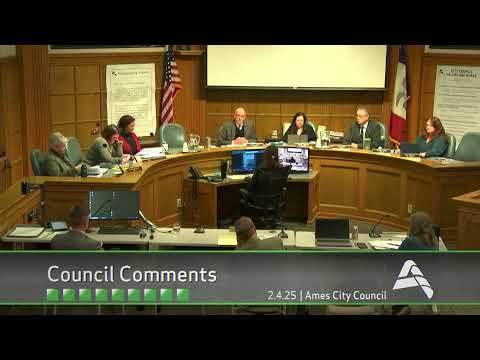
Interim Public Works Director Justin briefed the Ames City Council on Feb. 4 about the department’s operating budget and asset-management priorities, describing current performance data, equipment needs and planned investments.
Justin said the city’s water main breaks are tracking “right in line with our historical averages,” though January had an unusual cluster that required extended crew work. He described the utility response vehicle used for first response at breaks and said the vehicle in service is being replaced because of age and corrosion. “Part of that is using our video camera system or our jet truck to do that,” he said when describing the sanitary‑sewer condition-assessment program; staff noted the current camera system is eight years old and slated for replacement.
Stormwater work includes compliance with the MS4 permit, improved tracking for post‑construction inspections, expanded rebates for rain gardens and rain barrels and a planned remote survey (sonar) boat to map detention‑basin silt depths more safely and accurately than manual probing. Justin also described the inspection program for 8,000 storm‑sewer intakes, manholes and outfalls and said crews inspect at least 10% annually.
Resource recovery staff reported growth in voluntary drop‑off programs and new streams (cardboard, clothing/textiles, glass and household hazardous waste): staff said clean source‑separated cardboard collection jumped (the budget shows increases from prior years) and that more space, equipment and hauling capacity will be needed as volumes grow. Staff said they collected over 130 tons of source-separated paper, plastic and cardboard in the first year of that program and noted an increase in household hazardous waste and glass tonnage.
The transportation program covered engineering tools and operational improvements including a three‑dimensional scanning tool for surveys and an upgraded pavement‑management system that will score streets and help target capital and maintenance funding. Justin said traffic operations will adopt wider (6‑inch) lane markings following recent national guidance, increasing paint demand.
Parking operations will continue installing credit‑card capable meters and gather occupancy data; the immediate budget includes about 20 meter heads to add or replace and some dual‑space meters in the 100 block of Main Street. Airport operations updates include fuel‑farm and hangar maintenance, terminal drive reconstruction and potential public‑private lease discussions.
Council members asked about stormwater rebate goals and promotion; Justin said the city will continue outreach (EcoFair, school events) but has not yet set numeric recruitment goals. Council members also discussed recycling/diversion benchmarks and asked for comparisons with peer cities. Resource recovery staff said infrastructure (space and containers) and transport costs limit capacity and the program is in a phase of building capacity to aggregate and bale material rather than hauling small loads.
No formal council votes were taken on the Public Works items at the meeting; staff answered questions and will return with continued budget and program detail.