Get Full Government Meeting Transcripts, Videos, & Alerts Forever!
Get email alerts on the City Budget topic
No spam. Unsubscribe anytime.
Ames council reviews FY25–26 budget, directs staff to draft a county auditor mailing addendum and to evaluate one‑time project timing
Summary
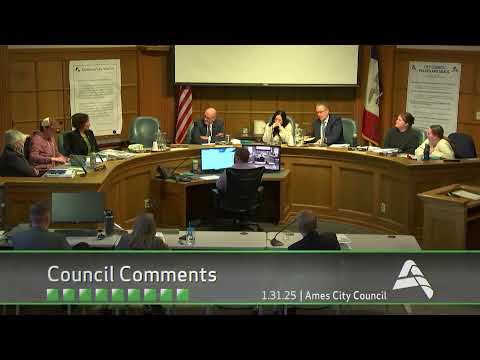
City of Ames officials spent much of a special meeting on Jan. 31 reviewing the recommended FY2025–26 budget, hearing staff presentations on property valuations and levy calculations and approving several staff follow‑ups intended to clarify taxpayer communications and to prioritize one‑time spending.
City of Ames officials spent much of a special meeting on Jan. 31 reviewing the recommended FY2025–26 budget, hearing staff presentations on property valuations and levy calculations and approving several staff follow‑ups intended to clarify taxpayer communications and to prioritize one‑time spending.
The city’s recommended property tax package would raise the combined city levy by 16 cents (about 1.59%), increasing the recommended overall levy to roughly $10.25 per $1,000 of taxable valuation and generating about $1.5 million in additional property tax revenue, city staff said. Staff told council the proposed general‑fund requirement for operations rises by roughly $1.0 million year‑over‑year and that part of the requested revenue increase reflects $1.1 million in additional operational property‑tax receipts and a recommended increase in debt service of about $458,000.
City finance staff said the recommended levy change reflects a roughly 2.6% year‑over‑year growth in taxable valuation for Ames, the effects of the state residential “rollback” and other state replacement payments that partially offset levy need. The presentation showed how a $100,000 assessed residential property would see a tax‑bill change of about $18–$19 under the proposed levy and rollback calculations, while noting individual bills will vary by school district and other levying authorities.
Why it matters: Council members emphasized that the county auditor’s mandated taxpayer notice—sent statewide—uses a standard example that may alarm residents (showing a large percentage increase driven by reassessment assumptions rather than a household’s actual tax bill). Councilors said that the statewide form is likely to cause confusion unless paired with a city‑level explanation or a personalized calculator that reflects a resident’s actual assessed value and the city’s rollback and levy.
Council directions and votes - County letter and personalized calculator: Council member Tim moved and the council approved (motion passed) directing staff to draft a letter for the county auditor packet that would explain the differences between the statewide taxpayer notice and a resident’s expected bill and to develop a web‑based calculator residents can use to estimate individual impacts. The council instructed staff to explore whether the county auditor could include the city’s explanatory letter in the same mailing or, if not, to identify alternate mailing or outreach options timed to the auditor’s distribution (staff reported the auditor’s window is mid‑March). The motion passed by recorded voice vote with an announced tally of four in favor and two opposed.
- One‑time projects and timing: Council asked staff to examine the list of proposed one‑time expenditures derived from FY2024–25 savings and to report back on (a) which projects realistically could be completed in the next six months and (b) which projects are highest priority. The intent is to identify items that can be funded with current one‑time balances rather than increasing the FY2025–26 tax base. That motion also was approved by council (recorded voice vote; majority in favor).
- Council priorities capital fund and transfers: Council reviewed a recommendation to transfer $3,000,000 from the current year’s excess general‑fund balance into a council priorities capital fund to provide cash for upcoming capital projects (animal shelter, parks, other priorities) and to reduce the need for future bond borrowing. Staff said the plan would leave a projected council priorities fund balance of roughly $5.0 million by the end of FY2025–26 after planned transfers and anticipated revenue (including a pending penalty payment). Council approved the transfer into the council priorities fund; members debated but did not adopt a formal, detailed policy on allowable uses at this meeting.
Discussion highlights and budget context - Staff (Corey and Nancy) walked council through levy components (general levy, debt service, transit levy), the role of state replacement payments, and the composition of taxable valuation by property class (residential is roughly 70% of taxable valuation). They explained how taxable valuation growth tiers enacted in recent state legislation can require automatic reductions to a city’s allowable growth and why cities with high TIF values sometimes time valuation recognition strategically.
- Councilors asked staff to provide more detail about: TIF schedules and remaining durations for existing TIF districts (to support planning), which one‑time projects could be delayed, and clarifying notes on slides that identify portions of debt service paid by non‑city partners (for example, staff noted Iowa State University pays a portion of fire apparatus and some airport debt service in specific agreements).
What council decided not to do at this meeting - Council debated whether to adopt a standing policy on permissible uses of the council priorities fund (to create formal constraints). A motion to place a specific policy item on a future agenda for consideration did not pass; several members asked that staff nevertheless return with suggested policy language and options for council deliberation.
What’s next - Staff will return with: (1) the draft explanatory letter and options for including it with the county auditor mailing or, if not possible, an alternate postcard/outreach plan and a web calculator; (2) a prioritized list of the one‑time projects that can be completed within six months and the tax‑levy impact if projects are deferred into FY2025–26; and (3) additional TIF schedule detail and donation/pledge timing for major projects (for example, the indoor aquatic center donations and how those receipts align with project cash flow). The council scheduled further budget review and departmental presentations at subsequent meetings.
Meeting context: this was a special meeting focused on the budget overview; public comment on the budget was not a prominent part of this session and the meeting included multiple staff presenters. No formal final budget adoption occurred at this meeting.