
Council asks Skanska/OPM/Perkins Eastman to explain phase‑3 delays, contingency use on Lowell High project
Get AI-powered insights, summaries, and transcripts
Sign Up Free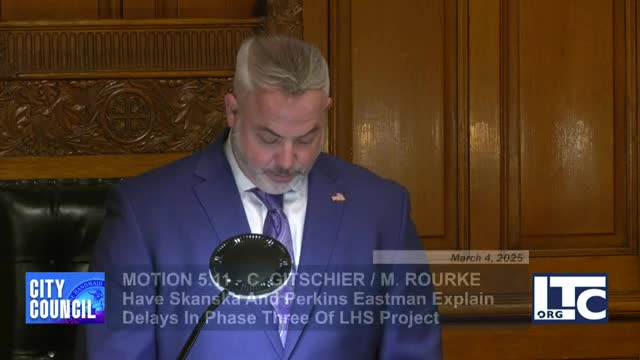
Summary
Councilors pressed the city manager about unanticipated problems in phase 3 of the Lowell High School renovation — water infiltration, floor voids and structural surprises — and voted to have the project team explain projected delays, out‑of‑scope work and cost impacts.
Lowell City Councilors on March 4, 2025, voted to request that the school construction team — including Skanska (construction manager), the owner's project manager (OPM) and Perkins Eastman (designer) — appear before the council to explain projected delays and out‑of‑scope costs in phase 3 of the Lowell High School renovation.
The request follows a February site tour where councilors and staff observed unexpected structural and subsurface conditions in the 1922 building that are affecting work in phase 3. Councilors said sections of floor were removed, voids and differing floor thicknesses were discovered, and there is debate about whether water penetration originated from a canal or from city storm/wastewater systems. Councilors also flagged the potential depletion of contingency funds and asked whether MSBA reimbursement is possible for some overruns.
Why it matters: the project is a multi‑hundred‑million‑dollar school renovation; unforeseen conditions in existing historic mill buildings can materially change costs and timelines and may affect where tax dollars and state reimbursements are needed.
What councilors heard: multiple councilors described shock at the condition seen during the tour of the 1922 building and raised questions about prior investigations and inspections. Councilor Getchia and others asked why the canal had been lowered to perform work and whether geotechnical borings or prior tests had detected subsurface issues. Councilor Belanger and Councilor Dakota said the city must consider legal recourse if design or inspection oversights left taxpayers exposed to higher costs.
Staff and manager updates: the city manager said staff and the school‑building team are working to quantify additional costs and hoped to have clearer estimates in early April; he said the city would ask the full project team to brief the council in April. Councilors were told that the project’s contract value referenced by the mayor is $381,000,000; a councilor reported a remaining contingency balance of about $2,000,000 in one fund and said the program still has other phases (including the 1895 portion) to address.
Reimbursement and liability: councilors asked whether the Massachusetts School Building Authority (MSBA) could be asked to cover some overruns; staff said prior requests had sometimes succeeded but any additional funding is not guaranteed and would require documentation and negotiation. Councilors asked the solicitor and manager to explore all options, including potential claims or additional state assistance.
Outcome: councilors voted to invite Skanska, the OPM and Perkins Eastman to a council meeting in April to brief members on the phase‑3 schedule, contingency usage, and any out‑of‑scope work that might affect the overall project budget.
Ending: councilors emphasized caution about cost overruns and urged that the team present detailed cost estimates, geotechnical findings and a timeline for addressing the 1922 building conditions when it reports back to the council.