Get Full Government Meeting Transcripts, Videos, & Alerts Forever!
Get email alerts on the Cannabis Permits Liability Taxation topic
No spam. Unsubscribe anytime.
Lake County treasurer urges listing property owners and major financial interests on cannabis permits to reduce tax-collection burden
Summary
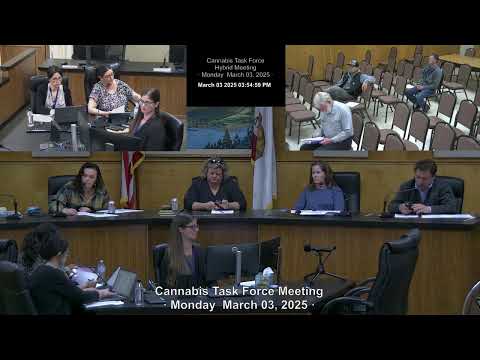
Lake County Treasurer-Tax Collector Patrick Sullivan told the Cannabis Ordinance Task Force on March 3 that the county’s current cannabis permit structure is creating recurring enforcement and tax-collection problems because permits “run with the land,” and ownership or financial-interest changes after permits are issued can leave the county unable to identify who is liable for unpaid taxes or compliance problems.
Lake County Treasurer-Tax Collector Patrick Sullivan told the Cannabis Ordinance Task Force on March 3 that the county’s current cannabis permit structure is creating recurring enforcement and tax-collection problems because permits “run with the land,” and ownership or financial-interest changes after permits are issued can leave the county unable to identify who is liable for unpaid taxes or compliance problems.
Sullivan said staff repeatedly encounters foreclosures, bankruptcies and multilayered corporate arrangements that make it difficult to determine who controls a permit after the original applicant loses the property or the business changes hands. “This is a permit that runs with the land,” Sullivan said. “We are regularly running into issues where properties are tax defaulted” and the county lacks reliable information about later holders of the permit or secured financial-interest holders.
The treasurer used a local example to illustrate the problem: permits and filings tied to a site called Diamond Jay Ranch involved multiple entities — Titan Valley Land Holdings (the recorded property owner), Terra Firma LLC (a parent entity), Great Kind Farms (a cultivation permit holder), Valhalla Legacy Holding Corporation (manager of the applicant), and a separate lienholder identified as Heart Consciousness Church. Sullivan said staff had to trace public records across several entities to understand who might ultimately control the permit and who could be liable if taxes went unpaid.
Sullivan asked the task force to consider requiring the county permit application to include the property owner and ‘‘financial interest’’ holders in a way similar to existing Department of Cannabis Control (DCC) and State Water Board rules. He told the group that adopting language aligned with the DCC and the state water board — with small technical changes because the county issues land-use permits rather than DCC licenses — would resolve many of the tax-collection and liability questions currently consuming county staff time.
Task force members and members of the public pressed a series of related questions about who would be listed, what levels of ownership would create liability, how landlord-tenant operating agreements would affect responsibility for taxes, and what this would mean for current permittees. Sullivan said the county already requires property-owner authorization on permit applications, but that the county’s experience shows multiple, undisclosed financial-interest holders can still exist outside the application package. He and staff recommended the county consider mirroring the state approach, which requires listing owners and certain financial-interest holders and treats landowners as potentially liable in many cases.
Several speakers urged a practical approach that would not immediately disqualify existing permittees. Task force staff and the treasurer described using new or amended application fields for new applicants and collecting updated information during the county’s annual monitoring so existing permittees can be brought into compliance over time. Sullivan said the change would be informational in many cases rather than an automatic revocation: it would help county staff identify who to contact and who could be responsible for taxes if a property later goes to auction.
The task force also debated several related administrative and regulatory items that would affect how the county manages its cannabis program. Members voted or instructed staff on multiple measures intended to improve clarity and reduce enforcement workload, including voluntary permit withdrawal procedures, farm labor housing rules, a site-reclamation surety, canopy calculation alignment, and codifying the county’s existing opt-out/reduced-canopy practice. Several of those actions were passed by voice vote; where recorded tallies were available the task force noted them.
Votes at a glance — the task force recorded or approved the following actions during the meeting: the task force voted to support developing regulations that would allow a permittee to voluntarily withdraw an approved cannabis use permit (motion passed by voice vote); it approved allowing commercial cannabis permittees to apply for farm labor quarters or farm labor camps under existing county rules (motion passed 4-0); it voted to require a $5,000 site-reclamation surety bond as part of permit conditions (motion passed by voice vote); it directed staff to align the county’s canopy calculation with the state Department of Cannabis Control’s method (motion passed by voice vote); and it directed staff to research and align the county’s opt-out/reduced-canopy procedures with state rules and to codify the June 1 opt-out deadline and inspection/fee requirements (motion passed by voice vote). The transcript records voice votes in several cases and a 4-0 recorded vote on the farm labor quarters motion.
Members of the public and task force participants raised ancillary concerns about implementation: whether nonprofit lienholders or churches (Sullivan referenced a nonprofit associated with Harbin Hot Springs in the example) should be treated differently for tax liability, whether landowners would face disproportionate liability and therefore avoid leasing to cultivators, and whether proof of insurance and bonding markets are available to cannabis applicants. Staff and several public speakers recommended a phased approach for current permittees — requiring additional disclosures for new applicants and collecting updated ownership/financial-interest data during annual monitoring and renewal cycles rather than immediate compliance deadlines that could jeopardize existing businesses.
What’s next — staff committed to return with draft language and citations for the DCC and State Water Board rules Sullivan cited (DCC sections referenced in the meeting included 15007 and 15004; the water board guidance referenced the cannabis general order and the concept that “dischargers and/or landowners remain responsible for any water quality degradation … whether coverage … has been terminated or not”). Staff also said they would prepare recommended code amendments and a short packet showing how proposed changes would affect new applicants and existing permittees. Mary (planning staff) and Patrick Sullivan said they would work to present the specific draft language for the task force and for broader public review before any formal action by the Board of Supervisors.