
Federal Way staff, nonprofit and consultant outline plan to formalize PAC 'collaborative' to boost fundraising and community engagement
Get AI-powered insights, summaries, and transcripts
Sign Up Free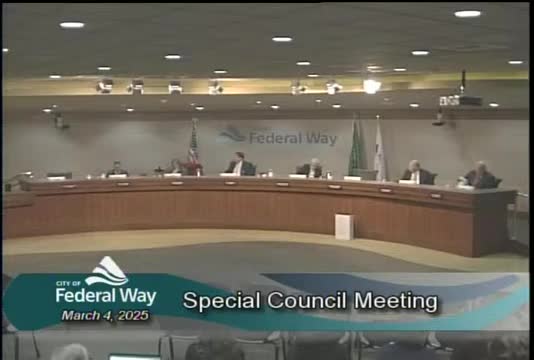
Summary
City staff, the venue manager and Arts Foundation Federal Way discussed forming a formal Memorandum of Understanding to increase private fundraising, deepen community programming and reduce the Performing Arts & Events Center(PAC) subsidy. No formal agreement or council vote took place; the foundation has not yet committed to negotiate.
Autumn Gressett, the Performing Arts and Events Center community relations liaison and contract administrator, and consultant Joe McElwain presented a plan March 4, 2025, to formalize a three-way "PAC Collaborative" intended to strengthen fundraising, programming and community engagement at the city-owned Performing Arts & Events Center in Federal Way.
The proposal would align three entitiesthe city (the facility owner), OVG 360 (the contracted venue management company), and Arts Foundation Federal Way (a nonprofit supporter)under a shared memorandum of understanding (MOU). McElwain, of JM Arts Consulting, told the City Council study session that many municipal performing arts centers nationwide either delegate operations to a nonprofit or have a formal partnership with a nonprofit because that structure typically strengthens fundraising and audience development.
Why it matters: Federal Way is operating and underwriting the PAC while private contributed revenue remains small. McElwain said a typical balanced revenue mix for a successful center is roughly one-third ticket sales, one-third rentals and one-third fundraising; the original pro forma projected contributed revenue could reach about $750,000 by year five. At the time of the meeting, Arts Foundation Federal Way was contributing primarily to education programs, at roughly $60,000 to $100,000 annually, and the city continues to subsidize operations (council discussion referenced roughly $1 million annually plus about $700,000 for the facility payment).
McElwain and Autumn Gressett described the collaborative as a negotiated, formal partnership in which roles and legal requirements would be clarified, communications would be regular and transparent, and at least one paid staff position (a professional fundraiser) would likely be needed to lead donor development and audience work. McElwain estimated the negotiation and implementation of a formal MOU would take "at least six to nine months, maybe even another year" if all parties agreed to proceed.
Representatives from the Arts Foundation Federal Way spoke in favor of deeper participation. Cindy Panett, a long-time foundation board member, said the foundation helped raise funds to build the PAC and highlighted recent Arts for Youth programming that brought about 1,500 students to PAC shows. Erica Rudnicki, described in the meeting as a foundation board member and executive director of Teaching for Learning in Federal Way Public Schools, said district music and choir programs recently used the PAC and that more than 600 students participated in a district music festival there.
Council members pressed for specifics. Councilmember McDaniel asked whether the MOU would include OVG 360; Autumn Gressett replied that OVG would participate and act as the city's representative but would not be a signatory to the city-to-foundation MOU. McDaniel also asked whether funds raised by a foundation would remain with the foundation; Gressett said initial plans assume funds would stay with the nonprofit and that the legal and financial details would be worked out during negotiations.
Other questions included the scale and cost of fundraising operations. Councilmember Redovey and others asked about numerical goals; city staff and the consultant said no specific citywide fundraising target has been set and that any goal would be identified during MOU negotiations. McElwain and staff estimated startup costs to hire a professional fundraiser and cover initial materials could be in the neighborhood of $150,000 to $200,000, but they described that as an illustrative ballpark rather than a negotiated or committed figure.
Councilmember Walsh and others called the initiative a "heavy lift" that would require sustained volunteer and paid staff work. Staff and foundation speakers said the collaborative model would spread responsibilities across the city, the management company and the nonprofit, and that other citiesincluding Edmonds, cited by McElwainhad used nonprofit engagement to close operating gaps over several years.
City staff and the consultant repeatedly emphasized that Arts Foundation Federal Way had not yet committed to negotiate the full partnership. Gressett said the foundation had been "very generous" in participating in the planning process and helping identify focus areas but that a foundation vote or decision was still required before formal negotiations would proceed.
No action or vote was taken at the March 4 study session; the discussion closed with council questions and staff confirmation that the next steps would be to continue outreach and, if the foundation and other parties agree, begin drafting a more comprehensive MOU. Council members asked staff to bring more-detailed plans and metrics if the city moves toward formal negotiations.
The council and presenters also discussed program-level priorities raised by residents and commission members, including expanding school and family programming, exploring more affordable ticketing strategies through sponsorships and contributed revenue, and outreach to seniors and private schools. Presenters said some programming and sponsorship work is already underway and that staff plan to begin reporting sponsorship and contributed-revenue details in 2025 financial reports.
Ending: The study session was informational; the city did not direct a negotiated MOU to begin at the meeting. Staff, the consultant and the Arts Foundation indicated further work and a formal decision by the foundation would be required before any MOU is signed.