Get Full Government Meeting Transcripts, Videos, & Alerts Forever!
Get email alerts on the Agriculture Predator Control topic
No spam. Unsubscribe anytime.
House Ag committee advances bill allowing goat producers to opt into county predator-control assessments
Summary
The House Agriculture Committee voted to pass House Bill 767, which would let goat owners opt into existing county predator-control funding schemes used by sheep and cattle producers. Supporters said predation — especially by coyotes — causes major livestock losses; the bill does not create a mandatory tax.
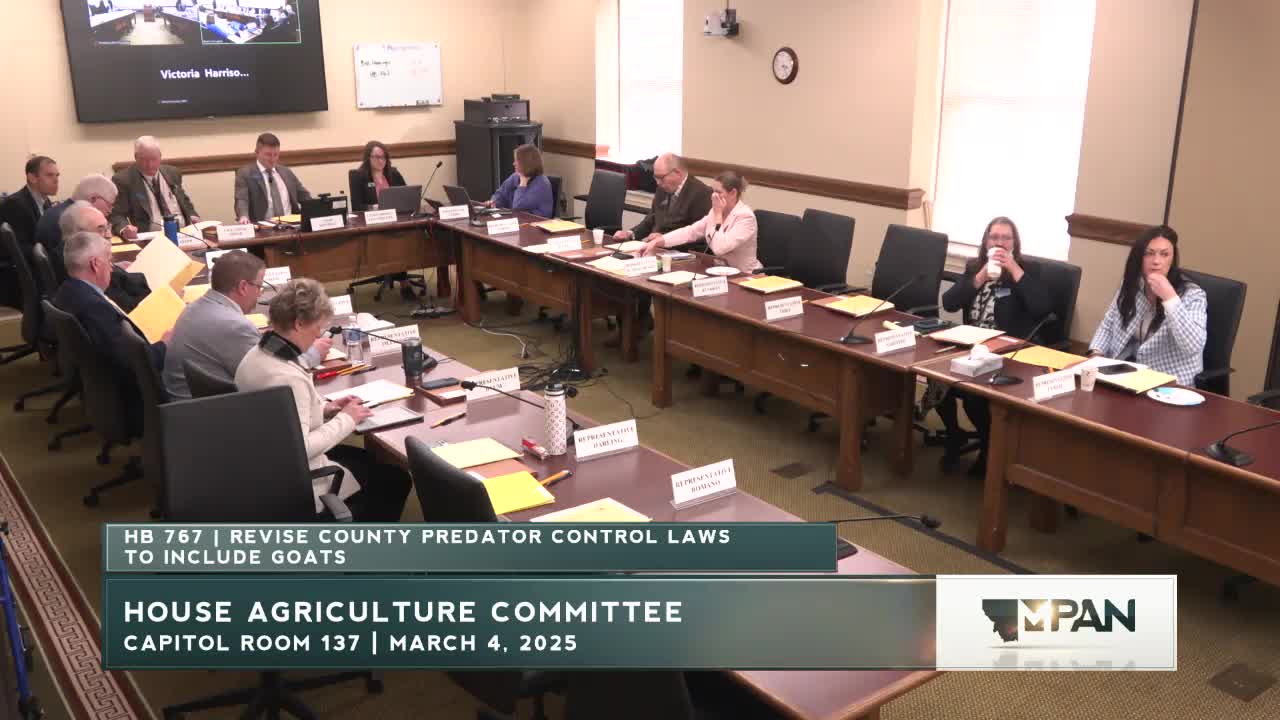
The House Agriculture Committee advanced House Bill 767 on a voice vote, a measure that would allow goat producers to opt into county-level predator-control assessments that currently apply to sheep and cattle.
Representative Julie Darling, sponsor of the bill, told the committee she brought the measure at the request of livestock producers. "This bill is…seeking additional sources for predator control funding," Representative Julie Darling said, noting the proposal would add goats into current statute covering predator control assessments.
Supporters framed the bill as a tool for producers to finance predator-control programs that reduce livestock losses. "Working with sheep and goat producers, you'll hear the same thing over and over. We need more predator control," Ms. Michaels of the Montana Wool Growers Association told the committee. She summarized producer data saying about 50% of all lamb losses in Montana are from predation, that coyotes account for roughly 80% of predation on lambs, and that more than 10,000 sheep and lambs are killed by coyotes each year, totaling "more than $2,000,000 in losses in an average year."
Karli Johnson of the Montana Farm Bureau Federation said the bill simply gives goat producers the option to participate in the county petition process used to raise predator-control funds. "To impose this tax on goats, it requires that 51% of the goats are voted for in the county," Johnson said, emphasizing the county-level vote requirement.
Mike Honeycutt, executive officer for the Department of Livestock, appeared as an informational witness and said the department could answer questions; he noted the bill adds goats within the predatory-animal control statutes the department helps oversee.
Testimony described how predator-control funding is structured in Montana: counties commonly use contracts with USDA Wildlife Services and local producer-funded petitions and per-capita fees. Witnesses said most predator-control funding is raised locally by livestock producers; they gave Powder River County as an example where producers pay per-capita fees and county petition assessments and where 100% of predator-control funding is producer-funded. The Department of Livestock's per-capita fee revenue was cited as about $4,700,000 in 2024, with roughly 12% returned to predator control; witnesses clarified that county petition money — not the per-capita fees — is the mechanism HB 767 affects.
Committee staff summarized the bill during executive action and Vice Chair Minor moved that House Bill 767 do pass. The committee conducted a voice vote; proxies were recorded for Representative Plaquen (aye) and Representative Romano (aye). The committee reported the bill out of House Agriculture.
Supporters asked the committee to advance the bill so goat producers could participate in local funding that producers say is necessary to control predators and reduce livestock losses. The bill’s proponents stressed the proposal is optional for goat owners and is not a statewide tax; it enables local petition-based assessments only where goat owners vote to adopt them.
Votes at a glance: House Agriculture Committee — House Bill 767, motion to report do pass; voice vote; proxies recorded for Representative Plaquen (aye) and Representative Romano (aye); no opposing votes recorded in the transcript.
The committee closed the hearing on House Bill 767 and moved to executive action on the same day.