Get Full Government Meeting Transcripts, Videos, & Alerts Forever!
Get email alerts on the Elections topic
No spam. Unsubscribe anytime.
Senate State Administration advances election and rulemaking bills, tables lobbying restrictions
Summary
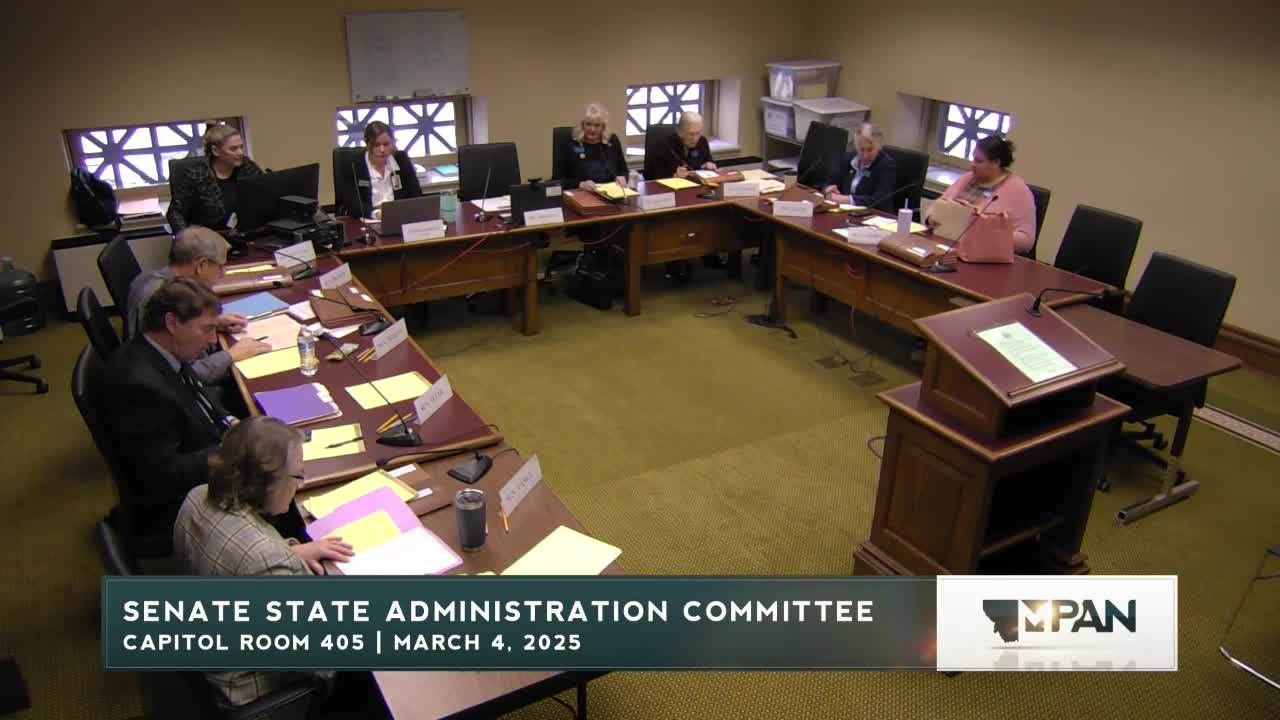
In executive action, the Montana Senate State Administration Committee approved several bills addressing election administration and agency rulemaking, discussed fiscal and logistical concerns, and voted to table a contentious measure restricting public funds for lobbying.
The Montana Senate State Administration Committee, in an executive-action session, approved a series of bills on election administration and agency rulemaking and tabled a high-profile proposal to restrict use of public funds for lobbying.
The measures that moved forward include changes to election-judge procedures and several bills affecting primary-election preparation and administrative rulemaking. Committee members debated logistics for counties that use central-count voting machines, the workload agencies would face under tighter rulemaking restrictions and whether state agencies should be required to adopt written tribal-consultation policies and designate tribal liaisons. The committee tabled a bill that would limit certain lobbying expenditures by political subdivisions and other public entities after extended opposition from members representing local governments.
The committee’s actions matter because they affect how Montana runs elections (including selection and removal of election judges and ballot handling), how state agencies adopt definitions and rules, and how state–tribal consultation is formalized. Several bills carry potential implementation costs that committee members and agency representatives said could be substantial.
Senators emphasized implementation and administrative concerns during debate. On election-related bills, members from counties with central-count machines described long-standing local practices that may not align with statutory language requiring separated ballots or different handling. On rules legislation, members and staff noted that no fiscal note had been requested and that any change could shift substantial workload to agencies or to Legislative Services. Supporters of the tribal-consultation bill said formal policies and designated liaisons would reduce misunderstandings between state agencies and tribal governments.
Votes at a glance: Senate committee executive action outcomes
- SB 470 (Zolnikoff) — Revises provisions related to election judges (notification after removal, complaint process for county central committees, selection process). Outcome: approved; reported to Senate floor; committee tally reported as 6 yes, 3 no.
- SB 379 (Weber) — Requires state agencies to adopt written tribal-consultation policies, designate a tribal liaison and revise reporting to the governor. Outcome: approved on roll call; committee tally reported as 5 yes, 4 no.
- SB 498 (Vice Chair McCamey) — Revises procedures for primary election preparation. Outcome: approved; committee tally reported as 6 yes, 3 no. Members representing counties with central-count machines said some statutory steps would not fit their current practices.
- SB 254 (Hertz) — Prohibits use of public funds for certain lobbying activities by political subdivisions, judicial officers and school districts. Outcome: motion to table carried by voice vote; committee recorded the item as tabled.
- SB 399 (Bogner) — Moves the date of the primary election to May, provides for separate ballots and ordering/counting changes. Outcome: failed on roll call (committee tally reported as 3 yes, 6 no) and then tabled.
- SB 401 (Lens) — Amends the Montana Administrative Procedure Act to restrict adoption of definitions in agency rulemaking, and would require agencies to recommend legislation if a statutory definition is needed. Outcome: failed on roll call (committee tally reported as 4 yes, 5 no); committee subsequently moved to table the bill.
- SB 419 (Boldman) — Revises pension laws related to service credit for legislative members. Outcome: failed on roll call (committee reported 0 yes; majority no) and then tabled by the committee.
- SB 492 (Hertz) — Relates to appointments to fill certain positions. Outcome: approved by voice vote; reported to Senate floor (committee announced it passed 9-0 including proxies).
- SB 496 (Dunwell) — Provides a use policy for an executive residence when the governor has an alternate residence; includes rulemaking authority and definitions. Outcome: failed on roll call (committee tally reported as 3 yes, 6 no) and then tabled; committee discussion referenced a possible fiscal estimate in the millions (a department representative cited an approximate $8,000,000 fiscal magnitude) and past bids around $2.3 million and $3.65 million.
- SB 529 (Kasmeier) — Revises laws related to campaign contributions from certain tax-exempt organizations, including limits when the entity received foreign-national donations. Outcome: motion to table carried on roll call (committee reported 9 yes, 0 no); committee closed executive action on the bill.
Committee discussion and clarifying details
- Election administration: Members repeatedly noted that counties using central-count voting machines do not separate ballots in the way some statutory language presumes; one member said she served 18 years as a clerk and recorder and acknowledged local practice diverged from the statute. Concern centered on practical ballot handling and voter confusion if ballots or timing are changed.
- Tribal consultation (SB 379): Supporters, including Senator Morgeau and a transportation director referenced in committee comments, argued that requiring each agency to designate a tribal liaison and adopt written consultation policies would reduce miscommunication between state government and tribal governments.
- Administrative rulemaking (SB 401): Members raised questions about fiscal impacts and implementation workload; staff reported no fiscal note had been requested. The lieutenant governor’s office had signaled opposition during hearing testimony that the measure could be burdensome for agencies.
- Lobbying restriction (SB 254): Several members opposed the bill on the grounds that local governments and associations rely on lobbyists and subject-matter experts to represent local interests at the Capitol; opponents argued restricting expenditures could hamper local governments’ abilities to be represented. The committee ultimately tabled the bill.
What’s next
Bills that were reported out of committee will go to the Senate floor for further consideration. The committee tabled several controversial or fiscally uncertain measures; tabling keeps those bills in committee rather than advancing them to floor debate. The committee adjourned after completing its executive-action agenda.