Get Full Government Meeting Transcripts, Videos, & Alerts Forever!
Get email alerts on the Public Safety Median Ordinance topic
No spam. Unsubscribe anytime.
Residents urge Pittsfield City Council to reject proposed ‘median safety’ ordinance, cite constitutional and health concerns
Summary
Two residents used the public-comment period to ask the council to disavow Chapter 14, Section 14-12.1, arguing the proposed “median safety” ordinance would criminalize panhandling and protests and that mental-health interventions, not policing, should be prioritized.
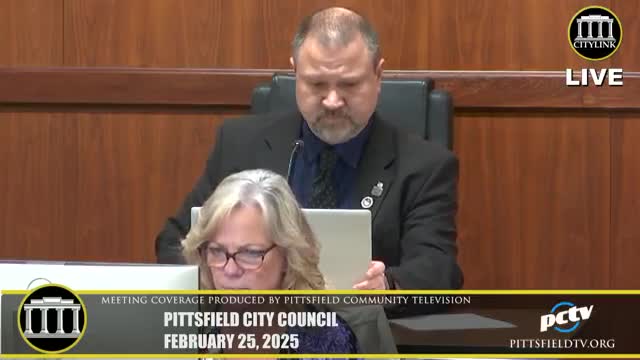
At the Pittsfield City Council meeting, held in a session recorded for public broadcast, two residents urged councilors to disavow a proposed municipal rule they identified as Chapter 14, Section 14-12.1 — described by speakers as a “median safety” ordinance that would penalize people who stand on medians to panhandle or protest.
Why it matters: Residents said the ordinance would criminalize vulnerable people and risk constitutional problems while diverting resources from mental-health responses. Both speakers asked the council to pursue alternatives such as mental-health interventions and housing support rather than additional policing.
Ephraim Alexander Schwartz, who gave his address as 11 Second Street, told the council that Pittsfield has handled past neighbor disputes with “a human touch” and urged the city not to adopt the ordinance. “That is why I ask you all to show the strength I’ve already seen in you and disavow wasting more time on the constitutional disaster that is Chapter 14, Section fourteen-12.1,” Schwartz said during the public-comment period.
Marietta Repetikoz, of 132 Kittridge Road, also spoke against penalizing people who stand on medians. “It is unconstitutional. They deserve to be recognized for their freedom of speech,” she told councilors, and added that she would prefer the city invest in mental-health services and housing solutions rather than criminal penalties.
Both speakers framed their remarks as appeals to both legal and public-health considerations. Schwartz warned the ordinance would create “new problems instead of fixing old ones” and estimated that cuts to social funding could produce a “one‑third” increase in street homelessness — a projection he presented as context for why punitive measures would worsen outcomes.
No formal council action on Chapter 14, Section 14-12.1 was recorded during the meeting. The comments were entered during the open-microphone public-comment portion; councilors did not bring the ordinance to a vote that evening.
The exchange underscored a recurring tension in municipal policy debates: whether to address visible street activity through law enforcement and fines or through social-service and public‑health interventions. Speakers asked the council to prioritize the latter.