Get Full Government Meeting Transcripts, Videos, & Alerts Forever!
Get email alerts on the Childcare Reform topic
No spam. Unsubscribe anytime.
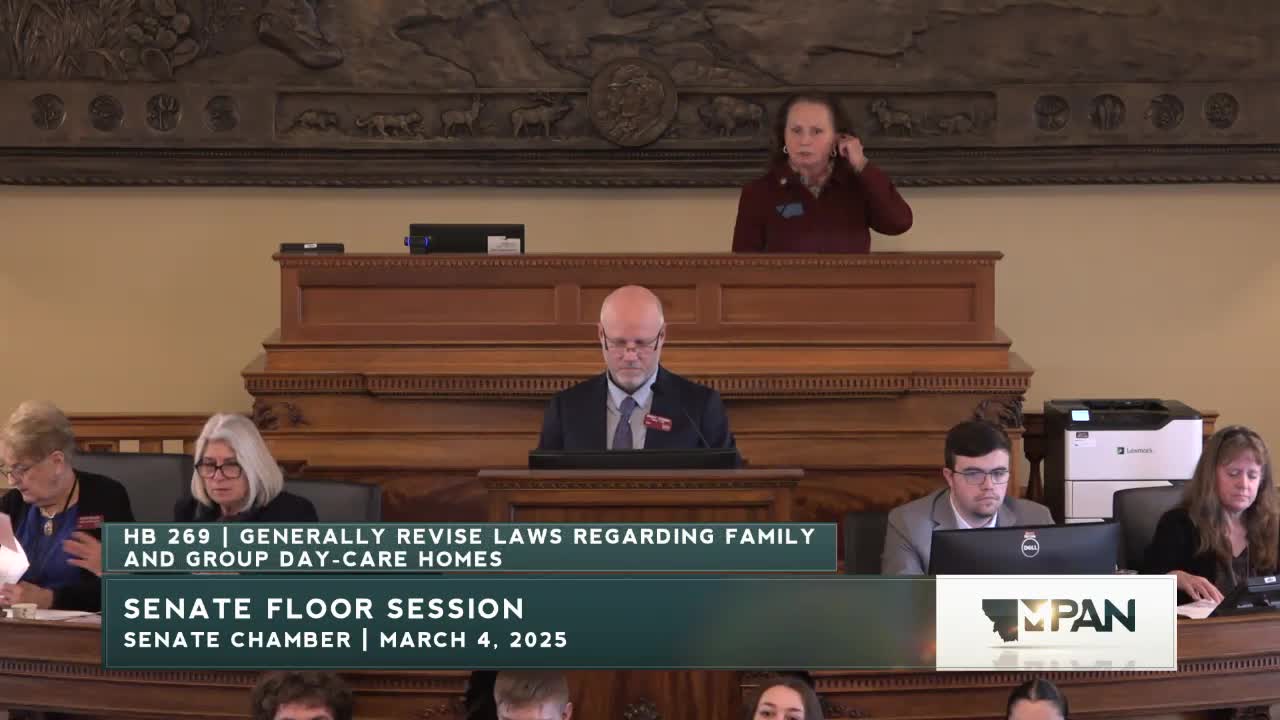
Senate rejects bill to revise day‑care rules, citing fiscal and federal‑funding concerns
Summary
Senators voted down a measure to revise Montana’s family and group day‑care law after lengthy debate over fiscal impacts and federal funding risks.
Senators voted down legislation (Senate Bill 269) that would have rewritten Montana’s statutory rules for family and group day‑care operations and incorporated certain federal rules for child‑care funding.
The proposal, introduced by Senator Lehi, would have revised requirements for family day‑care homes, group day‑care homes and provider qualifications and included compliance language referencing 45 CFR 98.41–98.43. Lehi told the committee the intent was to align statute with federal drivers so Montana could preserve federal dollars for child care.
Supporters argued the bill offered a “Montana solution” to stabilize funding and avoid losing federal support. Lehi said the draft aimed to avoid an onerous fiscal note and to “provide some parameters but not be overly onerous” for small providers.
Opponents, including Senator Kirk Carpenter and Senator Windiboy, said the measure undercut a lengthy interim rulemaking process in which the Department of Public Health and Human Services and more than 700 providers developed rules. Concerns centered on a missing, updated fiscal note and language in the current fiscal note indicating the potential loss of federal funding and a reduction of up to 25 FTEs if federal funds were lost. Carpenter urged a “do not pass” vote and said providers testified against the bill at the hearing.
Senators questioned the fiscal impacts. Windiboy pointed to a fiscal note entry he summarized as requiring reductions of 25 FTEs if federal funding were lost and noted other line items referencing contractor hours and a $150 per hour project manager rate. Lehi responded that if unresolved fiscal issues remained when the bill reached Finance and Claims, he would not move the bill forward or would table it.
After debate, the motion that the committee recommend the bill do pass failed on second reading, 23 yeas and 27 nays. Majority Leader McGillivray then moved to indefinitely postpone the bill; that motion passed 30 yeas to 20 nays, and Senate Bill 269 was indefinitely postponed.
The record shows the bill was discussed largely as a funding‑and‑rule alignment measure rather than a detailed licensing rewrite; the transcript records sponsors and committee members repeatedly noting the missing updated fiscal note and the bill’s reliance on federal requirements.
Votes at a glance: Senate Bill 269 — Second reading vote: 23 aye, 27 nay (failed). Motion to indefinitely postpone: 30 aye, 20 nay (indefinitely postponed).