Get Full Government Meeting Transcripts, Videos, & Alerts Forever!
Get email alerts on the Public Safety topic
No spam. Unsubscribe anytime.
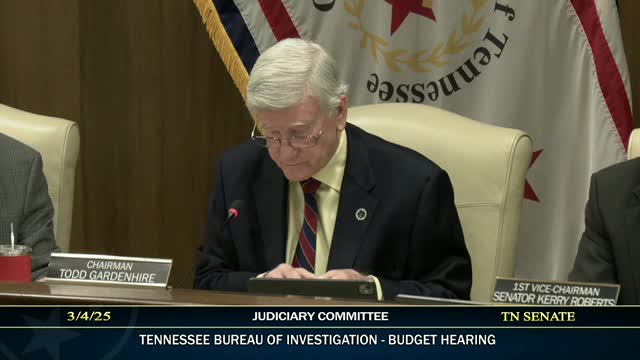
Tennessee Bureau of Investigation seeks $6.7 million, new staff and $3 million wastewater pilot; committee refers request to finance
Summary
TBI Director David Rausch asked the Senate Judiciary Committee to approve a $6,677,000 increase for FY25–26 that would add 22 positions and a one‑time $3,000,000 wastewater testing pilot; the committee voted to send the request to the Finance Committee.
David Rausch, director of the Tennessee Bureau of Investigation, told the Senate Judiciary Committee the agency is seeking a $6,677,000 cost increase for fiscal 2025–26 that would fund 22 full‑time positions and a one‑time $3,000,000 pilot to test wastewater for drug trends. The committee voted to refer the request to the Finance Committee.
Rausch said the TBI’s request groups seven categories: four victim‑services positions; seven intelligence analysts; four aviation crew positions; two police officer positions to staff Memphis and Chattanooga facilities; two Medicaid‑fraud data‑analytics positions; three administrative support positions; and the wastewater testing pilot. He told the committee the total includes a one‑time $3,000,000 allocation for the pilot project and 22 personnel positions for recurring costs.
"These analysts are able to get them the background information that they need in order to be more effective in their work," Rausch said of the proposed intelligence analysts, describing them as a "game changer" for investigations. He also described the aviation unit as one of TBI’s "key resources," saying fixed‑wing aircraft provide overwatch, rapid transport of agents and evidence, and capabilities that unmanned systems currently cannot match.
Rausch said the two Medicaid fraud analytics positions would be largely federally funded — the federal government would pay 75 percent of their cost — and the state would cover the remaining 25 percent. He described the victim‑services positions as intended to bridge a gap between crime occurrence and the point at which district attorneys' victim coordinators typically provide services.
The proposed wastewater pilot would be funded from opioid‑abatement dollars, Rausch said, and would place sampling around high schools, some middle schools and campus housing to detect presence, types and levels of drugs in wastewater. He said the goal is to provide earlier, near‑real‑time intelligence so public health and prevention partners can respond faster to emerging drug trends.
Senators questioned parts of the request: Senator Rose asked about the condition of the aircraft and whether TBI expects to purchase another fixed‑wing in the future; Rausch said the current plane is in good shape after an engine replacement but acknowledged the agency may return with a future single‑aircraft purchase request as needs grow. Senator Taylor pressed about embedding Memphis‑funded technicians at the Jackson crime lab as an alternative to a new Memphis lab; Rausch said TBI would welcome locally funded technicians to be embedded at the Jackson facility.
On backlog and lab staffing, Rausch told the committee that a multi‑year effort to hire forensic scientists and raise pay has reduced evidence backlogs. He said the number of unworked individual evidence items fell from 17,281 in January 2024 to 8,771 in January 2025 and gave DNA turnaround averages by lab: kit‑only testing statewide averaged 10.5 weeks, with Nashville at 5.4 weeks, Knoxville at 11.9 and Jackson at 12.8 weeks. Rausch said the bureau hired 50 scientists under recent pay changes and expects training to take about a year for those new hires.
Rausch also reported a supplemental request related to delayed crime‑scene vehicles, a $1,133,600 ask tied to equipment procurement delays.
Committee action: a motion to approve the TBI request and refer it to the Finance Committee passed on a roll call; the secretary reported eight ayes and no nos or abstentions. The Judiciary Committee therefore forwarded the TBI request to the Finance Committee for consideration.
Why it matters: The request would expand TBI’s investigative and support capacity across victim services, intelligence analysis, aviation support and forensic operations while launching a pilot that aims to inform prevention and public‑health responses to changing drug threats.
What’s next: The Judiciary Committee referred the request to the Finance Committee for budgeting and appropriation decisions.