Get Full Government Meeting Transcripts, Videos, & Alerts Forever!
Get email alerts on the Beach Management topic
No spam. Unsubscribe anytime.
County staff to begin public-education campaign on half-cent sales tax for beach management
Summary
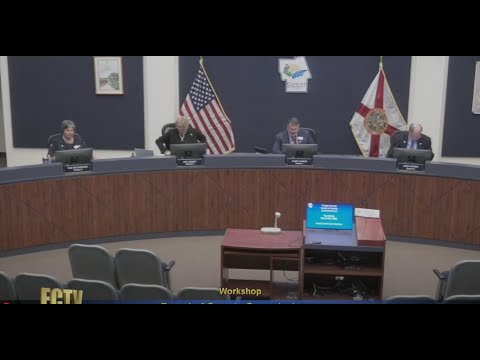
At a March 3 workshop, Flagler County administrators presented a countywide beach-management funding plan and commissioners gave staff consensus to begin a public-education campaign and pursue interlocal agreements for a proposed half-cent sales tax and other funding options to pay for periodic beach renourishment and maintenance.
Flagler County commissioners at a March 3 workshop directed staff to develop and begin a public-education campaign on a proposed countywide funding package to pay for beach renourishment and long-term coastal maintenance.
The county administrator, Heidi Petito, outlined a funding gap and a multi-year strategy to cover initial construction and recurring nourishment across the county’s 18 miles of coastline. Petito said staff will seek interlocal agreements with municipalities and pursue a mix of funding tools — including a proposed new half-cent local option sales tax, Tourist Development Council (TDC) funds, grants and a potential MSBU (municipal services benefit unit) — and begin outreach now. “If you direct me and staff to move forward with the campaign… Protect our beaches, strengthen our future,” Petito said during the workshop.
Why it matters: County staff presented a planning-level estimate that the full construction cost to address coastal erosion countywide is just over $120 million, with a local share of roughly $42.4 million. Staff said recurring maintenance on a six‑year nourishment cycle could require an annual equivalent of about $12 million. Without local funding for periodic nourishment, staff warned the county risks erosion that could affect tourism, property values and school funding.
Details and next steps - Scope and cost: Staff described four renourishment reaches along the Flagler coastline. Reach 1 (an Army Corps project completed last fall) cost about $29 million. Reach 2 was estimated at about $35 million (roughly 1.8 million cubic yards of sand over about 5.5 miles). Staff said the county’s planning-level, coast‑wide construction estimate is just over $120 million and that ongoing maintenance was modeled on a six‑year renourishment interval. - Current funding gap: Petito told commissioners the county has roughly $15 million in grant applications/program funding pending and has set aside $5 million in the FY25 budget; that still leaves an approximate shortfall in the low‑tens of millions for the initial local match the county would need to secure federal or other partner funding. Staff reported a confirmed $4.3 million in grant funding and described a potential FDOT contribution of about $500,000 per year for sand placement in front of state seawalls. - Proposed funding package: Staff’s draft strategy includes (a) a short-term use of TDC capital funds to help pay initial construction, (b) a new half‑cent discretionary local sales tax (requiring a supermajority of the board to impose) allocated in-part to beach maintenance, (c) continued use of TDC funds already dedicated to beaches, (d) pursuit of grants and FEMA CAT-G/CAT-B reimbursement where applicable, and (e) an MSBU for properties that receive direct benefit on the barrier island; staff used a placeholder MSBU figure of about $160 per parcel on the barrier island for planning illustration. - Governance and municipal participation: The county cannot impose assessments inside incorporated cities without interlocal agreements. Petito told the board she expects those interlocal agreements and the TDC conversations to be necessary steps if the county pursues a countywide funding approach.
Public and commissioner reaction Commissioners and other elected officials in the workshop repeatedly urged robust public education. Commissioner Pam (surname not stated in the transcript) said the county must “heavily, heavily market the benefit of that half cent, and what it saves you personally,” and asked for clear charts showing household impact. Petito and other staff said the objective of the outreach would be to explain the mix of funding and the extent to which visitors (tourists) would bear a share of the cost through sales taxes.
Formal direction The board, in workshop session, gave staff consensus to move forward with developing the public-education campaign and continuing negotiations on interlocal agreements and funding options. Petito and staff will return with more detailed proposals and budget impacts for later board consideration. No formal ordinance or tax levy was adopted at the workshop.
What remains unresolved Staff emphasized the numbers are planning-level and subject to change with final engineering, permitting, and grant awards. Several implementation details remain to be resolved: final MSBU structure and rates, precise TDC reallocations, interlocal participation by Palm Coast and other municipalities, and the timing and mechanics of any new half‑cent sales‑tax adoption. Petito said staff will return with recommended language and budget impacts during the county’s FY26 budget process.
Ending note: Commissioners said the topic will require continued public engagement and interlocal coordination. The board’s direction at the workshop was unanimous consensus to begin outreach and planning; it was not a formal vote to adopt taxes or assessments.