Get Full Government Meeting Transcripts, Videos, & Alerts Forever!
Get email alerts on the Property Taxes topic
No spam. Unsubscribe anytime.
Dubuque council sets March 25 public hearing on proposed FY2026 property tax rate
Summary
The Dubuque City Council on March 3 voted 7-0 to set a March 25 public hearing on a proposed fiscal year 2026 maximum property tax rate of $10.0637 per $1,000 and proposed tax dollars of $29,861,901.
The Dubuque City Council on March 3 voted 7-0 to set a March 25 public hearing on a proposed fiscal year 2026 maximum property tax rate of $10.0637 per $1,000 of assessed value and proposed tax dollars of $29,861,901. Council member Farber moved to receive and file, adopt the resolution and set the public hearing; Council member Sprank seconded, and the motion passed by roll call.
City manager Mike Van Milligen and Chief Financial Officer Jennifer Larson presented the revenue and rate recommendation, saying the proposal would raise property tax revenues to support the general fund from $28,233,757 in FY2025 to a proposed $29,861,901 in FY2026. Larson and Van Milligen said that change corresponds to a 1.38% increase in the property tax rate (from $9.09264 to $10.0637) and would increase the average residential city portion of property tax by about 3.9 (roughly $33.33), commercial property taxes by about 1.9% (approximately $60.91) and industrial property taxes by about 1.73% (about $81.55).
Why it matters: Staff and several council members said the recommendation balances rising costs for city operations, employee compensation and capital needs while limiting the impact on homeowners. Van Milligen noted Moody's Investor Services upgraded the city's general obligation bond rating to Aa2 in July 2023 and reaffirmed that Aa2 rating in January 2025, which staff said reduces borrowing costs. The administration also told the council the city's FY2026 reserves are projected at about $26 million, roughly one-third of projected revenue.
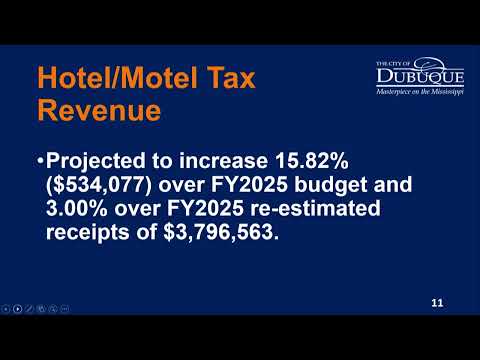
Staff and council detailed revenue changes and pressures behind the request. Van Milligen and Larson said state reimbursement (backfill) for commercial and industrial property tax reductions will decline (estimated at $646,000 in FY2026 versus $808,000 in FY2025), and a two-tier assessment limitation backfill is projected at $387,000 (down from $576,000). Interest income is projected to rise from about $1.7 million to about $2.3 million; local option sales tax revenue is projected to decrease modestly; hotel-motel and riverfront lease revenues are projected to increase; and ambulance fees are projected to fall. Larson said other expense increases, including negotiated employee wage changes and higher insurance costs, factor into the recommendation: "Not all expenses and revenues were in Mike's presentation," she said.
Van Milligen read a staff-prepared media release and warned that a taxpayer statement mailed to property owners by the Iowa Department of Management will show substantially higher percentage increases than the city's proposed rate because the state calculation assumes a 10% increase in property valuations for 2025-26. "The taxpayer statement will also indicate a 15.5% increase in the city of portion taxes for commercial property when the proposed increase is actually 1.9% for commercial property," Van Milligen said while reading the release. Staff said the mailer is required by state legislation enacted in 2023 and that the city will publish its own explanatory release and push corrections through social media and the news media; staff said sending a city-prepared mailer to every property owner would cost roughly $10,000.
Council members spoke in support of setting the hearing and urged outreach to correct the state mailer. Council member Jones said: "The citizens of Dubuque deserve accurate information...they're going to get fabricated misinformation that's harmful to what we're trying to do here and it's going to upset people unnecessarily." Several members echoed concern about the state mailer and urged residents to follow the city's budget process; the council also discussed the budget hearing schedule staff outlined (departmental hearings in April and a final budget hearing April 28, with budget adoption required by May 1).
Formal action: Council member Farber moved to adopt the resolution and set the public hearing for March 25; Council member Sprank seconded. Roll call votes in favor were: Wethal, Sprank, Roussell, Mayor Cavanaugh, Jones, Resnick and Farber. The motion passed 7-0.
The special session was limited to setting the public hearing; public input was not accepted at the March 3 meeting. The council's March 25 meeting will be the opportunity for residents to comment on the proposed FY2026 tax rate and proposed tax dollars. Staff indicated at the March 3 session that at the March 25 hearing the council may either approve the amount established at the March 3 meeting or decrease it, but not increase it under state law.
Ending: The council adjourned the special session after the roll call; the budgeting process will continue with staff presentations and public departmental hearings in April and final action by May 1.