Get Full Government Meeting Transcripts, Videos, & Alerts Forever!
Get email alerts on the Climate Emissions topic
No spam. Unsubscribe anytime.
Dubuque reviews 2022 greenhouse‑gas inventory and options for targets beyond 2030
Summary
At a Feb. 17 special session, Dubuque officials reviewed the city’s 2022 greenhouse‑gas inventory and discussed options for targets beyond 2030, including a 2050 science‑based pathway to net‑zero.
DUBUQUE, Iowa — At a Feb. 17 special session of the Dubuque City Council, sustainability staff and outside consultants reviewed the city’s 2022 community greenhouse‑gas inventory, discussed methodologies and proposed options for extending climate targets beyond the city’s existing 2030 goal, including a science‑based trajectory that reaches net‑zero by 2050.
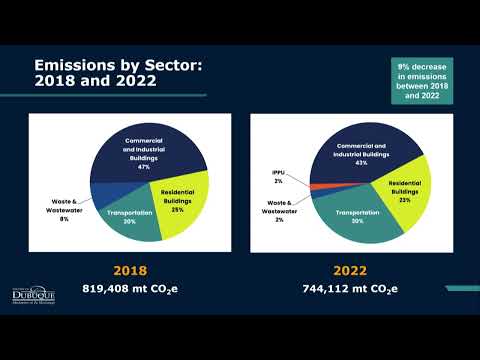
The discussion centered on where Dubuque’s emissions come from today and what would be required to meet deeper reductions. Rachel Meyer, senior associate at Lotus Engineering and Sustainability, said the city’s 2022 inventory shows total community emissions of about 744,112 metric tons of carbon‑dioxide equivalent and that Dubuque’s totals are down roughly 9% from 2018 and roughly 34% from the 2003 baseline. “The largest source of emissions is natural gas use in homes and buildings at 32%, followed by electricity at 31%, and then on‑road gasoline and diesel use at 29%,” Meyer said.
Meyer explained the inventory used the Global Protocol for Community‑Scale Greenhouse Gas Inventories for methods and the Intergovernmental Panel on Climate Change’s global‑warming‑potential values from the 2021 assessment. She said data sources included Alliant Energy and Interstate Power and Light for electricity, Google Environmental Insights Explorer for on‑road vehicle miles traveled and EPA landfill reports for landfill emissions. Meyer summarized scope definitions used in the inventory and noted that 2022 added several sources not previously included — propane and backup generators, transmission‑and‑distribution losses, fugitive natural‑gas emissions, separate transit/rail/aviation and port fuel use, composting, wastewater treatment and refrigerant leakage.
Why it matters: the consultants provided a “science‑based” modeling approach that translates global guidance into local targets. Using 2018 scope‑1 and scope‑2 baselines, Lotus estimated a 2030 science‑based reduction target of about 62.4% below 2018 scope‑1 and scope‑2 emissions (roughly a 308,000 metric‑ton reduction). Meyer said a business‑as‑usual projection that includes expected utility decarbonization and modest electric‑vehicle adoption yields only about a 12% reduction by 2030 and about a 38% reduction by 2050 without additional policy or programmatic action.
Council discussion focused on feasibility, costs and equity. Councilman Resnick thanked presenters but asked for an estimate of the cost to reach a science‑based goal; Meyer replied, “I don't have an exact figure. We haven't done that math yet,” and said costs depend heavily on which actions are chosen — building electrification can be expensive while outreach, transit electrification or targeted fleet replacements can be less costly. Resnick also noted the difference between voluntary and mandatory approaches.
Council members asked technical questions. Councilwoman Roussell asked how refrigerant leakage is estimated; Meyer said the inventory used the protocol’s default calculations (a leakage assumption applied to building square footage and an assumed share of air‑conditioned units) and recommended collecting HVAC recharge data from local contractors to improve accuracy. Councilman Jones and others raised concern that federal and state funding volatility could make aggressive near‑term targets difficult; Jones observed that several major emissions reductions have resulted from external changes (utility fuel‑mix shifts and landfill‑gas capture) and cautioned against overreaching with a five‑year 2030 deadline without costed plans.
Options and actions discussed: presenters and council members identified specific strategies the city could use or encourage, including municipal leadership projects (electrifying city buildings and fleets), energy‑efficiency programs, incentives or rebates for electric bikes and vehicles, electric‑vehicle charging infrastructure, single‑hauler waste ordinances with required recycling/composting, expanded compost collection, sustainable building codes, landfill‑gas utilization for CNG/LNG vehicles, and continued support for the Sustainable Dubuque community grants and youth climate action grants. Meyer emphasized outreach and equitable program design: “We need the community to take part and take their own actions,” she said, and urged centering disproportionately impacted communities in resilience planning.
No formal action or vote was taken during the special session. Mayor Cavanagh opened the meeting and noted that because of the topic public input was not accepted at the session, though council contact information is available via the city website. Council members said they will use the inventory and the options presented to reassess local targets and priorities; several members described the work as ongoing and recommended bite‑sized, sequenced steps that match available funding.
Clarifying details presented in the session include: 2018 community emissions near 820,000 metric tons CO2e (scope‑1/2 reported as 819,408 metric tons), 2022 community total of about 744,112 metric tons, 2022 scope‑1/2 of about 734,531 metric tons, and a modeled 62.4% scope‑1/2 reduction target to meet a 2030 science‑based benchmark (estimates and methods were explained as part of the protocol‑based analysis). Meyer noted that if Alliant Energy reaches its planned decarbonization goals, the electricity emissions portion of Dubuque’s inventory would shrink substantially by mid‑century, shifting focus to building fuel use, transportation and refrigerants.
Next steps recorded in the discussion: council members asked staff to evaluate costs and implementation pathways (questions to be refined by email from one council member), to consider partnerships with utilities and community organizations for outreach and targeted assistance programs, and to return with more detailed cost estimates and implementation options before making any change to the city’s formal target.
(Reporting note: quotes and attributions come from the special session transcript. No ordinances, resolutions or formal motions were introduced or voted on during the Feb. 17 special meeting.)