Get Full Government Meeting Transcripts, Videos, & Alerts Forever!
Get email alerts on the State Legislation topic
No spam. Unsubscribe anytime.
Committee advances dozens of bills; votes include trade-school tax credit, college-testing change and veterans' vehicle exemption
Summary
The Oklahoma House committee reported out multiple bills including a rural physician tax credit, a trade-school tuition tax credit, a college-testing measure adding the CLT, and a sales-tax exemption expansion for disabled veterans. Several items drew extended debate on implementation and verification; most measures were reported out as do pass.
The House committee met on multiple bills that the chair said were being moved through efficiently; most measures were approved for further consideration.
The panel advanced a range of proposals including a residential roofing consumer-protection measure, a rural-physician tax credit, an expanded mechanism for setting statewide-elected-official compensation, a trade-school tuition tax credit, a sales-tax exemption change for disabled veterans that adds a vehicle purchase allowance, and a bill to add the Classical Learning Test (CLT) as an accepted college test. Several bills drew extended questioning about implementation, verification and fiscal impacts.
Why it matters: the committee stage is the first major policy gate. Measures reported out as do pass are eligible for additional floor consideration; technical and statutory clarifications raised in committee may reappear as amendments later in the process.
Key debates and clarifications
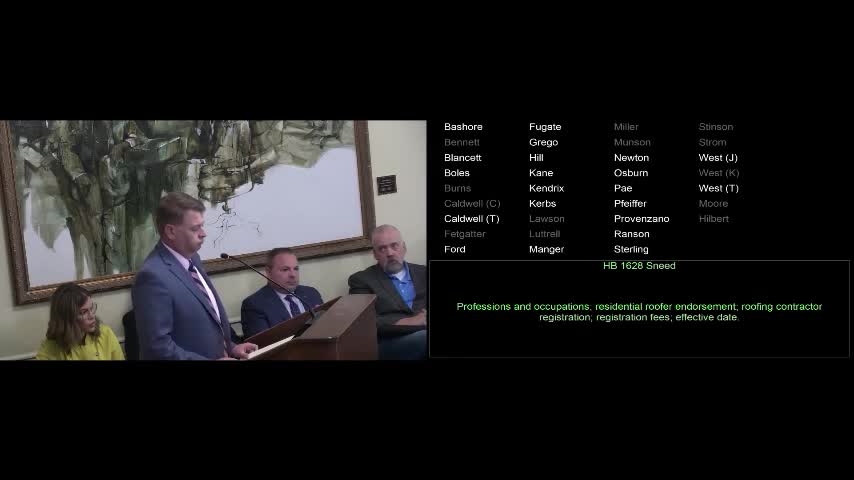
Residential roofing consumer protection — enforcement Representative Snead presented a working draft requested by the Oklahoma Roofing Association and described the measure as aimed at protecting residential consumers after storms by giving enforcement authority to an agency identified in the bill. Snead said the bill “adds the enforcement piece for CIB to come in and enforce and protect our constituents from … bad actors” who may come in after disasters. The committee voted to report the measure out as do pass; the committee recorded 29 ayes and 0 nays on the motion as shown in the transcript.
Rural physician tax credit (House Bill 2645) Speaker Hilbert presented House Bill 2,645 as “a tax credit for rural physicians.” The measure was reported out as do pass; the transcript records a 29–0 tally.
Statewide official compensation structure (House Bill 2674 — working draft) Speaker Hilbert described a bill to create a compensation-review structure for statewide elected officials modeled on the existing Legislative Compensation Commission. Members questioned the objective, how the commission would set pay, and whether recommendations would be binding. The sponsor said the change would use the constitutional Legislative Compensation Commission in a statutory role for statewide officials and that the commission makeup is five gubernatorial appointees plus two appointees from the House speaker and two from the Senate pro tem. Committee discussion emphasized the limited reach of the change (it would not affect term-limited officials currently in office) and noted the legislature ultimately controls funding through the budget. The bill was reported out as do pass (transcript indicates it was reported out; a full roll-call tally was not clearly stated in the record excerpt).
Trade-school tuition tax credit (House Bill 1092) House Bill 1092 (Oklahoma Trade School Tuition Tax Credit) would create a nonrefundable income tax credit up to $7,500 for taxpayers who complete a certification program at a qualified trade or vocational school in Oklahoma. The sponsor said qualifying programs would include HVAC, plumbing, automotive mechanics, electrical work, carpentry, welding and construction; CareerTech institutions and private schools such as the Tulsa Welding School were cited as examples. The sponsor and members discussed program costs: the sponsor said the average cost to obtain certain trade certifications (welding was used as an example) can run about $19,700 and noted many programs can be completed in months to a couple of years. The credit is nonrefundable with a three‑year carryforward. Members raised concerns about ensuring students complete certification and about whether the credit will mainly benefit those already eligible for other programs (for example, Oklahoma’s career-technical scholarships). The committee reported the bill out as do pass; the transcript records a 27–3 tally.
Disabled veterans: vehicle purchase sales-tax exemption (House Bill 1864) Representative Roberts presented a bill to add a sales-tax exemption for a vehicle purchase for disabled veterans once every five years, adding an additional $20,000 exemption for the vehicle purchase on top of the existing annual exemption (the record notes a $25,000 annual exemption in current law for disabled veterans). Members asked how 100% disability would be verified. Jessica Groges, deputy executive director of the Oklahoma Tax Commission, explained the current process: after a veteran receives a 100% disability determination from the U.S. Department of Veterans Affairs (the VA office in Muskogee), the Oklahoma Department of Veterans Affairs (ODVA) registry is used and the Tax Commission issues a sales‑tax exemption card that the veteran presents as proof. The committee reported the bill out as do pass; the transcript records 27 ayes and 0 nays.
Senior SNAP simplification (House bill reported) A bill described as simplifying SNAP certification for seniors (changing recertification from annually to every three years if income is unchanged, and adding a standard medical deduction) was presented as a targeted administrative change to reduce hurdles for older adults. That bill was reported out as do pass with a 29–2 recorded vote.
College-testing change: adding the CLT (K. Floyd College Testing Program) A bill to add the Classical Learning Test (CLT) as an accepted examination for certain state purposes (the transcript refers to it as the K. Floyd College Testing Program bill) drew prolonged debate over test security, correlation with the ACT and SAT, and which higher‑education institutions currently accept the CLT. The sponsor and others discussed that the CLT score range is 0–120 (compared to the ACT’s 1–36 scale) and that some studies and out‑of‑state pilots have been used to support equivalency claims; opponents raised that not all major public universities accept the CLT and expressed concerns about independent validation and test‑security protocols. The committee passed the measure; the transcript records a 21–6 tally.
Other measures reported out The committee also reported out a range of statutory cleanups, extension of sunset dates, pilot incentives for live audience episodic television (a rebate program), an Inhofe disaster savings account (HSA‑style accounts for disasters), GRDA‑related measures (bonding capacity and an exemption request), an auditor revolving fund from withheld gas tax dollars, and other agency technical or cleanup requests. Many of those were reported out as do pass; where the transcript shows an explicit roll-call tally the count is included in the Votes at a glance list below.
Votes at a glance (committee actions recorded in the transcript) - Residential roofing consumer-protection (working draft; request by Oklahoma Roofing Association): reported out as do pass — 29 ayes, 0 nays (tally recorded in transcript). - House Bill 2,645 (rural physician tax credit; Speaker Hilbert): do pass — 29 ayes, 0 nays. - House Bill (compensation structure for statewide officials; Speaker Hilbert, working draft): do pass — reported out as do pass (tally not clearly specified in the transcript excerpt). - House Bill 2,140 (property-assessment change; Representative Kennedy): do pass — recorded as 29 ayes, 1 nay. - House Bill 1,543 (Conservation Commission cleanup): do pass — reported out as do pass (tally in transcript excerpt unclear). - House Bill 1,864 (veterans vehicle sales-tax exemption; Representative Roberts): do pass — 27 ayes, 0 nays. - House Bill 1,205 (repeal obsolete wind tax credit): do pass — 30 ayes, 0 nays. - House Bill 10,65 (extension of Oklahoma Quality Events program): do pass — (tally recorded in committee record; transcript excerpt ambiguous). - House Bill 10,92 (Oklahoma Trade School Tuition Tax Credit): do pass — 27 ayes, 3 nays. - House Bill 12,005 (SNAP senior simplification): do pass — 29 ayes, 2 nays. - House Bill 16,04 (vehicle excise tax exemption for transfers to grandchildren/legal guardians): do pass — 31 ayes, 0 nays (tally recorded in transcript excerpt). - House Bill 18,34 (Inhofe disaster savings account): do pass — 31 ayes, 0 nays. - House Bill 18,49 (childcare industry relief): do pass — 31 ayes, 0 nays. - House Bill 21,10 (pilot incentive program for live-audience episodic television): do pass — 27 ayes, 2 nays. - K. Floyd College Testing Program (adds CLT for some state purposes): do pass — 21 ayes, 6 nays. - Multiple other agency technical, bonding and appropriation‑related bills were likewise reported out as do pass; the record shows most were approved without extended debate. Tally details for a few reports are not explicitly clear in the transcript excerpts.
What committee members pressed for Members repeatedly asked for implementation details where the bills rely on agency processes: how a veteran’s 100% disability would be verified (answered by the Oklahoma Tax Commission), how a compensation commission would present recommendations and the legislature’s role in funding, how qualifying trade schools would be certified, the nonrefundable nature and three‑year carryover of the trade-school credit, and testing security / independent validation for the CLT.
Meeting context and next steps The chair signaled the committee would have an even larger agenda the following day and adjourned after reporting the bills out. Bills reported out as do pass now proceed to additional House or floor consideration steps per chamber rules; several measures that raised technical or verification questions in committee may be subject to amendments at later stages.
Ending The transcript records committee members frequently asking for follow-up information and for staff or agency representatives to supply implementation details; the committee’s actions move a wide set of policy changes into the next legislative stages while leaving some technical questions to be resolved later in the process.