Get Full Government Meeting Transcripts, Videos, & Alerts Forever!
Get email alerts on the Homelessness Shelter Policy topic
No spam. Unsubscribe anytime.
Worcester providers warn state changes to emergency shelter rules could send some families out of region; city groups set working group, short-term hotel plan
Summary
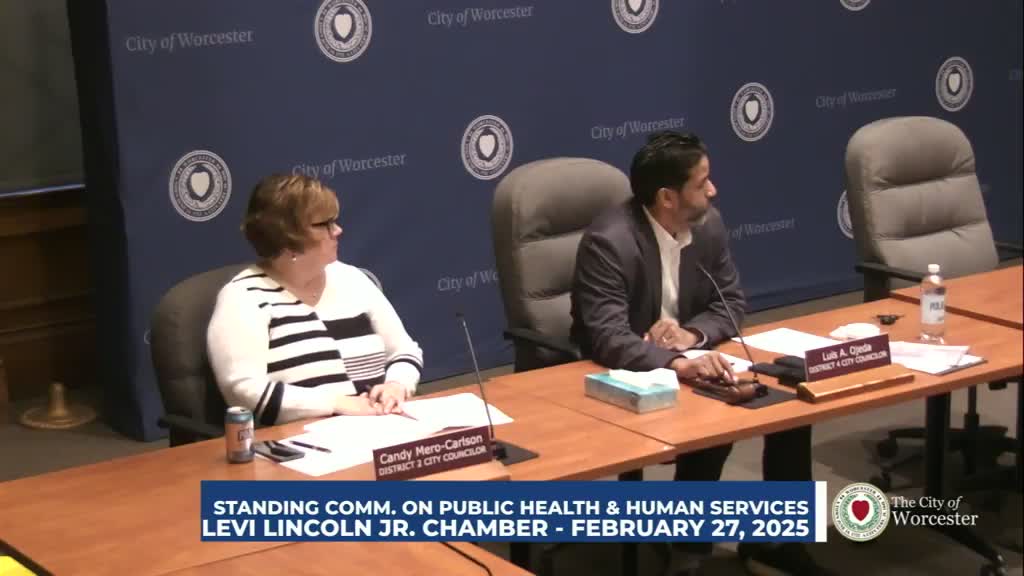
WORCESTER, Mass. — Leaders of Central Massachusetts housing providers told the Worcester City Council’s Public Health and Human Services Committee on Feb. 27 that proposed state changes to emergency assistance could reduce how long families may stay in bridge shelter from nine months to six months and, if enacted, could push some families out of the city to temporary respite centers in the eastern part of the state.
WORCESTER, Mass. — Leaders of Central Massachusetts housing providers told the Worcester City Council’s Public Health and Human Services Committee on Feb. 27 that proposed state changes to emergency assistance could reduce how long families may stay in bridge shelter from nine months to six months and, if enacted, could push some families out of the city to temporary respite centers in the eastern part of the state.
The providers said the current system places families who meet “priority 1 through 3” criteria into shelter or a clinical assessment center immediately, and that the bridge shelter now allows nine months with some three-month extensions. “When the governor signs the supplemental budget, that will change to six months with no extensions, with a hardship waiver,” said Leah Bradley of the Central Massachusetts Housing Alliance, describing language in the proposed state changes.
Why this matters: Providers and city officials said shortening shelter stays and narrowing eligibility could disrupt children’s schooling and family stability if families are relocated out of Worcester. Local agencies described steps they are taking now to reduce the chance that people will be discharged to the street, and to coordinate resources if the state changes take effect.
What providers described
Leah Bradley said agencies are not seeing priority 1–3 families who need shelter currently being turned away. “Heading Home … has said that they have not discharged anyone to homelessness as of now,” she told the committee. Bradley described two tracks in the proposed changes: families meeting the higher-priority criteria who go into bridge shelter, and a “rapid track” for priority 4 households that would send people to temporary respite centers for up to 30 business days.
Bradley and Trish Eppert of Friendly House said Central Massachusetts providers have set up a weekly case-conferencing working group to coordinate responses for families who are unsheltered or at immediate risk, verify unsheltered status when necessary, and avoid duplication of services. Eppert said the group has used short-term hotel and motel placements funded in part by the city and ARPA dollars as a last-resort option to keep people off the street during cold weather.
Local funding and capacity
Trish Eppert told the committee Friendly House has “probably close to $70,000 remaining” in ARPA hotel-motel funds that must be spent by December; she said additional federal Emergency Food and Shelter Program (EFSP) funding is expected. Bradley said none of the current providers has full case-management capacity for people who are not eligible for Emergency Assistance, and that Central Mass Housing Alliance is applying for HOME-ARP funds to support case management.
Women’s shelter, other short-term capacity
Dr. Matt Castillo, the city’s commissioner of public health and human services, told the committee a women’s shelter will open March 1 with capacity for about 15 women and is expected to operate through May as an interim site. “We will be opening up a women's shelter March 1,” Castillo said. He and providers noted the shelter supply remains constrained, and that projects being planned — modular housing and hotel conversions — are years away.
Concerns about out-of-region placements
Committee members pressed how out-of-region placements would affect children’s schooling. Bradley noted Department of Elementary and Secondary Education guidance about long school bus rides and said relocation outside Worcester can force school transfers and disrupt children’s education, potentially requiring parents to arrange long bus commutes or change schools. “We’ve heard of kids that have been in 11 schools in a year,” Bradley said.
City coordination and next steps
Committee members proposed a series of follow-ups: inviting Inspectional Services to discuss how officials will approach doubled-up households, requesting a report from inspectional services and the public health department about inspection protocols and tenant rights, and a chairman’s order to invite inspectional services to a joint meeting with providers. The committee voted to hold agenda item 3A (the order to meet with shelter providers) for further work and to return with those reports.
What providers and officials said they do not know
Providers cautioned that some details remain unclear until state budget language is finalized and signed. Bradley cited uncertainty about the final effective date and exact prioritization, and said the state’s hardship waiver language is still being clarified. Dr. Castillo and Bradley also said the local impact will depend on capacity and funding changes that have not been finalized.
Ending note
Committee members emphasized the city’s limited control over state shelter rules but said they will press for local coordination, preserve short-term hotel options while funds are available, and seek reports from inspectional services and other departments to prepare for potential increases in need.