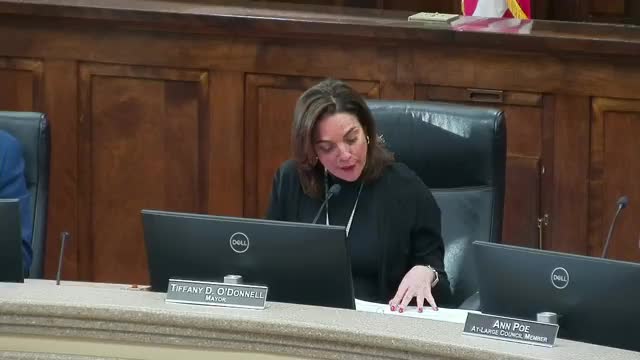
Cedar Rapids council approves urban renewal action and approves QTS development agreement for Big Cedar data center campus
Loading...
Summary
The City Council approved a resolution establishing an urban renewal/TIF area tied to the proposed Google data center and approved a development-agreement resolution with QTS Cedar Rapids 1 LLC for a $750 million data center campus in Big Cedar Industrial Park; councilors discussed utility capacity, jobs, and community betterment funds.
The Cedar Rapids City Council approved a resolution creating an urban renewal area tied to a proposed Google data center and, separately, approved a development agreement with QTS Cedar Rapids 1 LLC to build a multi‑phase data center campus in the Big Cedar Industrial Park.
The actions, taken at the Jan. 28 regular meeting, move the two projects forward under tax‑increment financing rules: the council adopted the urban renewal resolution for the Google area and approved the first reading of a TIF ordinance; it then adopted the resolution approving the QTS development agreement. Council Member Scott Olson recused himself from consideration of the QTS matter, noting a conflict before debate began.
Why it matters: City officials described the two projects as major economic development opportunities. City Manager Jeff Pomerantz and economic development staff said each data center represents a multi‑phase commercial investment that could total hundreds of millions of dollars, create construction jobs, and provide funds for community programs through a company-funded betterment account.
Scott Mather, with the City Manager’s Office, summarized the urban renewal timeline for the Google site and said the council would hold the second and third readings of the TIF ordinance on Feb. 11. Pomerantz, the city manager, and Bill Michael of Economic and Development Services outlined QTS’s commitments for the development agreement and the project’s phasing.
Key details from staff presentations and council discussion - Project scale and phasing: The QTS agreement describes a multi‑phase campus with a capital investment stated in staff materials as $750,000,000; construction of an initial phase must start within three years of the agreement’s effective date and be completed within six years of commencement. Additional phases carry similar timing requirements and any further phases must be finished within 25 years of the agreement’s effective date. - Jobs: The development agreement sets a minimum of 15 permanent data‑center jobs per phase (30 jobs for the first two phases). City staff and QTS representatives emphasized that the immediate employment effect is larger in construction: staff estimated roughly 500 construction jobs over an extended build‑out for a single building and said stacked phases could sustain long construction activity. - Community betterment funds: QTS will provide annual community betterment payments of $300,000 per project phase for up to 20 years, with a maximum of $6 million per phase and a combined maximum of $18 million across phases. Staff said those funds would be directed by the city to community projects, nonprofits and local infrastructure under council‑approved guidelines. - Utilities and rate impacts: Council members asked about electric and water capacity. Pomerantz and others said Alliant Energy and local utility partners have reviewed capacity and that the utility regulatory framework in Iowa can allow expansion while protecting existing customers; staff also explained that some data‑center designs use closed‑loop (recirculating) cooling systems that use far less fresh water than other designs. Alliant Energy’s role and prior statements were discussed during council remarks.
Council debate and public comment Resident Myrna Lorline spoke at the public hearing and asked council to consider the long‑term costs and the project’s cost‑per‑job calculation; she said she had reviewed public reporting and asked for ongoing transparency. Council members responded to concerns about costs and water/electric reliability, highlighting potential local hiring, construction work, contractor interest, and the community betterment fund as mitigation for residents.
One councilor noted that, historically, Cedar Rapids has prepared infrastructure in Big Cedar to be “shovel‑ready” to attract projects and said existing planning anticipated growth in the area. Pomerantz emphasized that construction and supplier opportunities have already been generated locally.
Votes and next steps - Urban renewal resolution for the Google area: adopted (motion carried by voice vote; mover: Council Member Poe; seconder: Council Member Van Orni). The council also approved the TIF ordinance on first reading (mover: Council Member Scott Olson; seconder: Council Member Todd). - QTS development agreement: council adopted the resolution approving the development agreement (mover: Council Member Poe; seconder: Council Member Overland). Council Member Scott Olson recused himself from the QTS item prior to consideration.
The council directed staff to continue work on the accompanying ordinances, infrastructure coordination with utilities, and guidance for use of community betterment funds. Second and third readings on the Google‑area TIF ordinance are scheduled for Feb. 11.