Get Full Government Meeting Transcripts, Videos, & Alerts Forever!
Get email alerts on the Flood Control topic
No spam. Unsubscribe anytime.
Council authorizes Revision 10 to Cedar River flood control system plan; staff cites $300–$500M funding gap and Army Corps feasibility study
Summary
The council adopted Revision Number 10 to the Cedar River flood control system plan, updating maps, project sequencing and cost estimates and requesting incorporation of West Side projects into an Army Corps of Engineers feasibility study that staff said could be completed in late 2026.
The Cedar Rapids City Council on Jan. 28 authorized Revision Number 10 to the city’s Cedar River flood control system plan, updating project maps, cost estimates and sequencing and reaffirming the city’s long‑term approach to completing projects on both the east and west sides of the river.
Rob Davis of the Public Works Department, who presented the revision, told council the update reflects recent design decisions and clarifies elements the Army Corps of Engineers will evaluate in an expected feasibility study. He said the revision includes a substantial change in approach to the Vinton Drainage Way (the “vent drainage way” in staff materials) that aims to reduce the size and operational reliance on new pump stations while preserving existing neighborhoods.
Key points from staff presentation: - Cost and funding: staff presented an updated estimated program cost of roughly $1.1 billion to $1.3 billion (end‑of‑2024 dollars, including inflation assumptions) and said about $780 million in funding is currently secured. Davis said that leaves an approximate funding gap of $300 million to $500 million depending on inflation and final scope. - Army Corps feasibility study: the federal Water Resources Development Act directed the Corps to include the Cedar Rapids feasibility study in its work plan; staff said the city hopes the Corps’ feasibility work will be completed in the second half of 2026. Any federal participation would typically require a local match (staff noted a customary 65/35 local/federal split). - Vinton Drainage Way approach: staff described a revised plan that would use pressure piping and separate street storm sewers to avoid building very large pump stations that staff said would rarely be used; certain improvements between Sixteenth and Eighteenth Streets were described as major investments the city wants the Corps to consider for potential federal participation. - Project sequencing: the revision adds a detention basin in the Czech Village/White Line Loop area that will reduce flood risk pending pump‑station construction; other map changes clarified festival grounds and riverfront pump‑station locations and refined cost tables to reflect the later‑stage design work.
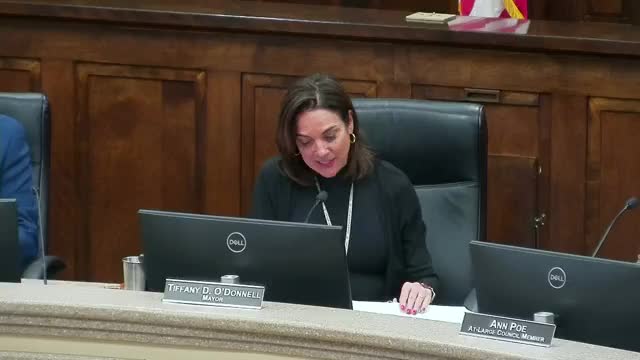
Council members praised staff’s progress and asked timing and feasibility questions. Council member Poe commended staff work and asked about specific elements such as raising Ellis Boulevard; Davis said portions will be constructed this year but full closure or overtop of the levy at Ellis Boulevard remains to be scheduled and depends in part on coordination with the Army Corps and Union Pacific Railroad agreements. Council member Olson noted the council’s prior long‑term funding commitment and said the city’s delivery record strengthens its case for federal partnership.
Action: Council member Tyler Olson moved to adopt the resolution authorizing Revision Number 10; Council member Poe seconded the motion and it carried by voice vote.
What this does not do: The revision updates planning documents and priorities; it does not commit additional new local funding in the meeting itself. Davis said staff will continue to pursue grants, work with the Corps and present options for local match if federal funds become available.
Ending: Davis said staff will continue to refine designs with the goal of reducing operations and maintenance costs, minimizing property impacts and preserving neighborhoods while advancing federal funding opportunities.