Get Full Government Meeting Transcripts, Videos, & Alerts Forever!
Get email alerts on the Lcap Accountability Metrics topic
No spam. Unsubscribe anytime.
Bear Valley Unified executive director reviews midyear LCAP, highlights state dashboard metrics and growing compliance burden
Summary
The district’s executive director presented the midyear Local Control and Accountability Plan update, discussing changes in state reporting metrics, progress and shortfalls on targets for graduation, chronic absenteeism, suspensions and English learner outcomes, and the district’s plan to pursue MTSS and other interventions.
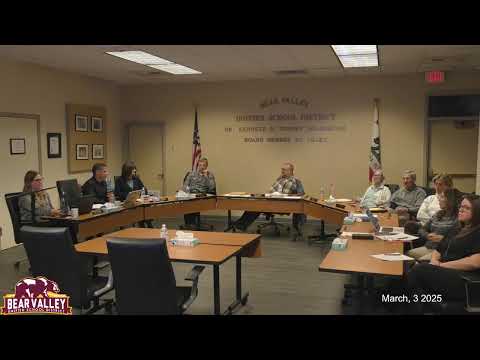
Mr. Marquez, the district’s executive director, presented the midyear update on the Local Control and Accountability Plan (LCAP), reviewing progress on state and local performance metrics and describing how new state reporting requirements have increased LCAP complexity.
Marquez said the LCAP now requires more detailed reporting across many indicators and noted the district is evaluating tools, including a county AI-assisted product and a commercial product, to streamline compliance. "It keeps growing and growing and growing," Marquez said of LCAP requirements; he described the reporting burden as a recurring issue for small districts that have limited administrative capacity.
The presentation summarized several performance indicators: the district reported declines and improvements depending on the metric — for example, a districtwide chronic absenteeism figure that staff said has declined from earlier estimates, a reported suspension rate at about 5.6 percent (above the district’s prior desired target of 2.5), and an expulsion rate reported at approximately 0.6 percent (district target 0.1). Staff emphasized that some targets were recalibrated to be more realistic under the new three-year baseline approach the state now requires.
English learner (EL) outcomes and reclassification were a specific focus. The district reported reclassification rates that staff said showed modest year-over-year improvement but remained below desired targets; staff identified long-term EL (LTEL) students as a continuing area of concern. Marquez described planned actions that include a district EL coordinator at each site, supplemental instructional supports, and bilingual aides.
Other items discussed included the district’s emphasis on dual-enrollment and CTE pathways as alternatives to AP for some students, investments in instructional materials and STEM/CTE programs, and the district’s plan to implement a Multi-Tiered System of Supports (MTSS) to address behavior and academic interventions consistently across sites. Board members and staff discussed the difficulty of making ambitious targets while also avoiding premature reclassification of EL students.
Marquez and district staff said much of the LCAP reporting now relies on a new state metric called "distance from standard" and the California School Dashboard; presenters cautioned that the dashboard’s color-coding reflects direction of change as much as absolute performance. Staff said the district will continue to refine goals and present updated data and action plans in subsequent board meetings.