Get Full Government Meeting Transcripts, Videos, & Alerts Forever!
Get email alerts on the District Budget Finance topic
No spam. Unsubscribe anytime.
Bear Valley Unified staff present second interim: positive certification now, multiyear planned deficits ahead
Summary
District staff told the board the district maintained a "positive certification" for 2024–25 but projects planned deficit spending in the next two fiscal years that would sharply reduce the unassigned fund balance unless enrollment or ADA improves or ongoing costs are reduced.
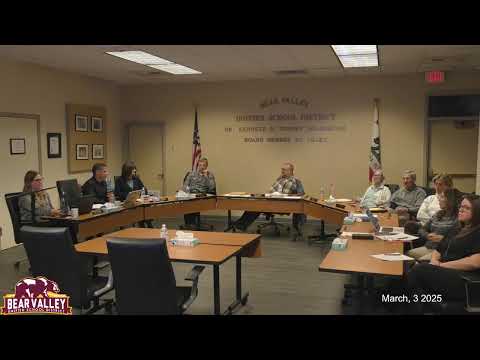
At the board meeting, district business staff presented the second interim financial report and said Bear Valley Unified can meet its financial obligations for the current and the following two fiscal years, maintaining a "positive certification" for 2024–25, while warning of planned multiyear deficit spending.
The district reported enrollment of 2,160 in October and 2,193 on the P-1 count in December, with average daily attendance (ADA) near 91 percent. Presenter Jess (business services staff member) said increases in LCFF and federal revenues — including a larger-than-expected CSI (Comprehensive Support and Improvement) apportionment — raised current-year revenue. Jess said the district received about $1,200,000 in RDA (redevelopment) receipts this cycle, and noted that RDA receipts are restricted to facilities projects.
Key figures presented: - Ending unrestricted fund balance revised downward from approximately $13.1 million to $12.6 million after audit restatements; - Current-year planned deficit of $534,000; - Projected deficit of $3.3 million in 2025–26 and about $1.0 million in 2026–27 under current assumptions; - Unassigned and appropriated balance of $1.3 million in the current year, falling to $115,000 and $28,000 in the two out years under the district’s multiyear projection.
Jess said part of the revenue increase was a larger CSI apportionment and higher RDA and interest receipts; on expenditures the district budgeted one-time and restricted program spending (for example an approximately $418,000 increase tied to CSI grant expenditures and various one-time capital purchases). Capital outlay increases included kitchen infrastructure purchases (salad bar unit) and science lab renovation closeouts; capital purchases also included plow blades for maintenance vehicles and a purchased golf cart for stadium access.
On staffing, presenters described a planned “rightsizing” through attrition: reduction assumptions include five certificated full-time equivalents next year and four the following year, plus three instructional aides over the subsequent two years. The presenter characterized this as a plan to reduce ongoing staff costs primarily through attrition where possible.
Board members questioned specific expenditures and contracts, including a recurring transportation payment to Redlands Unified for students from parts of the district who attend secondary school outside the district boundaries; staff said they will research and report back with details. Presenters reiterated that some revenue streams are one-time and restricted, and warned that spending ongoing salaries from one-time funds would make future deficits worse.
No formal budget action or vote was recorded during the presentation; staff said they would return with additional detail as questions are resolved.