Get Full Government Meeting Transcripts, Videos, & Alerts Forever!
Get email alerts on the Manure Spreading topic
No spam. Unsubscribe anytime.
Marathon County committee hears broad public comment on proposed winter manure-spreading restrictions
Summary
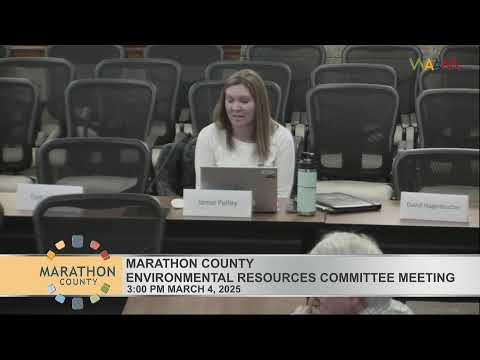
Jake Loggin Hahn, chair of the Marathon County Environmental Resources Committee, opened a March meeting segment by moving agenda item 6(a)(3) — continued discussion of potential amendments to the county animal-waste ordinance — up in the order of business and made clear the session was for information and committee discussion only, not a final decision.
Jake Loggin Hahn, chair of the Marathon County Environmental Resources Committee, opened a March meeting segment by moving agenda item 6(a)(3) — continued discussion of potential amendments to the county animal-waste ordinance — up in the order of business and made clear the session was for information and committee discussion only, not a final decision. “This is not an item that will be up for decision making today. This is purely educational and up for committee discussion,” he said.
Why it matters: committee members, staff, conservation partners and a dozen members of the public addressed the proposal because county staff and outside stakeholders say winter manure spreading can mobilize phosphorus and contribute to harmful algal blooms in waterways such as the Big O’Plains reservoir. Farmers and farm organizations warned about the cost and practical impacts of a countywide winter ban, while conservation and watershed stakeholders urged stronger controls, monitoring and buffers.
Public comment and farmer concerns
Dozens of people signed up to speak. Dean Beck, Towne Easton chairman, said forcing smaller dairies to build storage would increase spring hauling and damage local roads and could push some small operations out of business. “I do not want to have our small dairies go out of business,” Beck said.
Lionel Wisniewski, chairman of the Town of Reid Park, said his town held a meeting with its five largest dairy operations and came away favoring stronger control measures combined with cooperative permitting and verification of acreage and spreading quantities. “We came away with solid cooperation from all the members. So dialogue is hugely important here,” Wisniewski said.
Several farmers described how they use manure to support vegetable growers and organic production and said a straight countywide ban on February–March spreading would be unaffordable for many small operations. James Edis, a small dairy farmer from the Town of Houston, said a proposed countywide prohibition on liquid/slurry manure in February and March would force many small farms to build costly storage and could cost “up to $250,000 for a temporary pit.” Randy Wolcouch, who farms and rents land to Hmong growers, said his manure is integral to those vegetable operations and not stackable after auger discharge, so a blanket winter ban would end his ability to keep animals.
Other public commenters raised additional concerns and data requests. James Gunnerson described strong odors from paper-mill byproducts spread on lands near his home and urged testing of soil and well water. Kevin Schmiedke and others urged staff to test other sources of phosphorus and salts — airport brine, landfill leachate and paper-mill residues — rather than focus only on manure.
Stakeholder positions
Dwight Tull, Marathon County Farm Bureau director, said the Farm Bureau supports conservation standards and nutrient management plans (NMPs) but cannot endorse a countywide ordinance that requires storage without accurate cost estimates or full stakeholder involvement. He said only 22 of 50 dairy farms without storage currently have NMPs and urged making NMPs universal and enforceable.
Ben Niffenegger, representing the Valley Improvement Company (which manages the Big O’Plains dam), urged county action to reduce phosphorus loading. John Kennedy, vice president of the Big O’Plains Citizens Organization, noted long-standing study and remediation efforts and said nutrient loading from the landscape — whether agricultural or otherwise — is the driver of water-quality problems in the reservoir.
Staff report and analysis
Kirsty (Conservation staff) and Matt (Conservation staff) presented a follow-up analysis requested at the committee’s prior meeting. Their work estimated that, for two months (February and March), dairies that currently lack storage could generate roughly 9,000,000 gallons of manure. Staff identified about 94 idle storage sites countywide and concluded, from permit records and aerial imagery, that about 44 of those may be initially usable; those 44 hold an estimated combined storage volume of roughly 25,100,000 gallons. Staff cautioned these were tabletop estimates and that they had not yet contacted owners of the idle storages to determine availability.
Staff said they have held many public meetings and received letters from organizations and landowners. They reported strong community interest in nutrient management planning and vegetative buffers and recommended forming a multi-stakeholder work group to develop practical, implementable options. Kirsty told the committee she had asked corporation counsel whether written comments could be accepted; counsel confirmed the committee could receive written submissions and staff said public comment on this proposal would remain open through April 1.
Committee discussion and direction
Committee members generally supported further stakeholder work rather than moving immediately to a countywide ban. Several supervisors said a work group, clearer testing data and a timeline tied to achievable measures (for example, increasing nutrient-management-plan adoption and considering buffers) would be more effective than an immediate, countywide two-month prohibition. Supervisor Kroll suggested stakeholder meetings through spring and early summer and a November policy decision to allow budget planning if the committee advises new funding.
Formal action
No ordinance change or vote on substantive amendments occurred at the meeting. The committee voted to accept and file the staff presentation and to request that staff compile public comments received (in-person and written) and to form a stakeholder work group; staff were directed to return with updates at a later meeting. The committee also confirmed public comment for this item would remain open through April 1. (No formal ordinance vote was taken.)
What’s next
Staff will continue stakeholder outreach, compile written and oral comments, and convene a proposed work group of farmers, conservation interests, watershed partners and local officials to explore options including NMP expansion, flexible/targeted storage requirements, buffers and monitoring. The committee will revisit recommendations at a future Environmental Resources Committee meeting.
Ending
Committee Chair Jake Loggin Hahn closed public comment when no further speakers remained and moved the meeting to the next agendized business. The ordinance remains under study; a formal vote will occur only after additional stakeholder work and committee deliberation.