Get Full Government Meeting Transcripts, Videos, & Alerts Forever!
Get email alerts on the Groundwater Quality topic
No spam. Unsubscribe anytime.
Marathon County well survey: 1,001 private wells tested; just over 11% exceed nitrate drinking-water standard
Summary
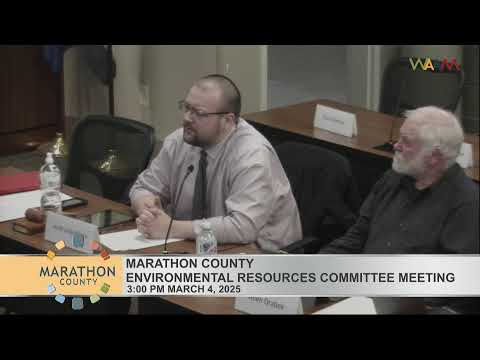
Marathon County reported results from a two-year private-well testing program that collected samples from 1,001 wells across the county in 2023 and 2024 and found that just over 11% of samples exceeded the federal and state nitrate drinking-water standard of 10 milligrams per liter.
Marathon County reported results from a two-year private-well testing program that collected samples from 1,001 wells across the county in 2023 and 2024 and found that just over 11% of samples exceeded the federal and state nitrate drinking-water standard of 10 milligrams per liter.
The test program, conducted by county staff with laboratory analysis performed by a state-certified lab in Stevens Point, mailed sample kits to participants who self-collected and dropped them at county collection points. The county aggregated results on a public dashboard and provided individual results to each participant. The data will be used to inform Marathon County’s updated groundwater plan and targeted outreach.
County presenter Kevin said the program was designed in part because private wells are not subject to the routine monitoring that public water systems receive. “There could be years or decades in between testing,” Kevin said, noting that since 2014 new wells are required to be tested for bacteria and nitrate and wells that undergo pump or well work are required to be tested for bacteria, nitrate and arsenic.
Why it matters: Private wells are the responsibility of homeowners, and elevated nitrate presents health risks to infants and pregnant women. Kevin said levels above 10 milligrams per liter are unsuitable for infants and women who may become pregnant and urged avoidance of long-term consumption above that level.
Key findings and methods - Sample size and timing: 1,001 private wells from outreach to more than 2,000 well owners; sampling conducted in two phases (eastern Marathon County in 2023 and western Marathon County in 2024). Kits were mailed to participants; county staff transported samples to the lab. - Spatial coverage: County staff displayed results on a map aggregated to roughly 40-acre grid cells. The county said coverage was generally good but sparser in county forests and wildlife refuges. - Nitrate: About 45% of samples were at or near natural background (less than about 1 mg/L); roughly 55% showed evidence of land-use impact (levels above background), and just over 11% exceeded the 10 mg/L drinking-water standard. Kevin said the county’s exceedance rate is modestly higher than statewide expectations, which he cited as “8 to 10%” for private wells statewide. - Sources and controls: Kevin listed likely sources as agricultural fertilizers, lawn fertilizers, septic systems (including properly functioning systems), animal wastes, and biosolids applications. He said well construction (for example, casing depth) and soil drainage strongly influence nitrate concentrations; shallower or better-drained soils are more prone to nitrate leaching. - Arsenic: Arsenic in groundwater is largely natural, Kevin said. About 2% of sampled wells exceeded the 0.01 mg/L standard; the presenter recommended arsenic testing for private wells because the risk is low but measurable. - Manganese: Roughly 20% of samples had manganese at levels that may cause aesthetic problems such as black or brown staining; about 6% exceeded the health-advisory level cited in the presentation (0.3 mg/L), which Kevin noted has been associated in some studies with neurological effects at long-term, high exposures. - Chloride: No direct human-health thresholds were discussed for chloride, but the presentation flagged chloride as a land-use indicator (sources include potash fertilizer, septic systems and water-softening brine); higher chloride levels were often found near urban areas and road-salt–treated corridors. - Pesticides: The presentation focused on a screening test for atrazine breakdown products (DACT/diaminochlorotriazine). DACT was detected in about 1% of samples. Kevin noted that DACT is the most common pesticide-related detection in Wisconsin groundwater and that if DACT is elevated, Department of Agriculture, Trade and Consumer Protection (DATCP) may fund follow-up testing. - DATCP follow-up: Kirsty (county staff) said DATCP follow-up testing on DACT-positive wells was limited: “I think we had maybe 2 total DACT positives from DATCP testing… I think that it may be about 25 tests,” and she cautioned the numbers were from memory.
County tools and next steps The county built a public dashboard that allows users to explore parameters by municipality, view box plots of parameter distributions and, for participants, pull up individual results using a project ID number assigned during recruitment. Kevin said the dashboard intentionally does not identify specific properties.
Lori, a Conservation Planning and Zoning staff member, said the results will feed Marathon County’s updated groundwater plan and that staff plan additional outreach and education. The county said it is reconnecting landowners to available funds (including federal ARPA-derived resources now available in Wisconsin) to help remediate wells that test high and is considering low-cost, ongoing monitoring options such as cycling sampling across parts of the county each year. Lori also said the county is watching neighboring Chippewa County’s community well refill station pilot as a potential option if mitigation for individual wells proves infeasible for some households.
Public reaction and committee response Committee members asked about the dashboard, data access for participants and how well construction information influenced results. Kevin said wells with deeper casings that draw older groundwater tended to have lower nitrate. Committee members, including Rick, thanked county staff and outside partners for the effort; multiple members described the project as “impressive.”
Limitations and caveats - The presentation noted incomplete well-construction records for many wells, limiting some analyses. Kevin said the county will use statistical modeling to predict concentrations in under-sampled areas. - Pesticide testing is selective and expensive; the county tested only a limited set of pesticide breakdown products, so detections do not rule out the presence of less-tested compounds.
Contacts and data access County staff said the dashboard is public and that participants who received project ID numbers can pull up individual results. Presenters encouraged residents with concerns to contact county staff for follow-up testing and to ask about funding options.
The presentation and data give Marathon County officials a baseline to target outreach and future monitoring while highlighting that private-well owners bear responsibility for ongoing testing and mitigation.