Get Full Government Meeting Transcripts, Videos, & Alerts Forever!
Get email alerts on the Travel Policy topic
No spam. Unsubscribe anytime.
Bonner County workshop narrows travel-policy draft; commissioners agree on several wording and process changes
Summary
Bonner County commissioners and staff met in a workshop to revise the county’s travel and vehicle-use policy, informally agreeing to remove an "elected officials" applicability line, clarify who may operate county vehicles, and tie reimbursements to the most cost‑effective practical mode of travel.
Bonner County commissioners and county staff spent a workshop session reviewing a draft travel policy, agreeing on multiple edits and sending several items for follow-up rather than final adoption.
The workshop, called to discuss updates to the county’s travel and vehicle-use rules, produced informal consensus on removing a line that would have required elected officials to follow the policy, tightening language on who may operate county vehicles, and making reimbursements subject to the least-expensive practical mode of travel.
The revisions matter because the travel policy governs when the county pays mileage, per diem, lodging and other expenses and also touches insurance, workers’ compensation and safety requirements. Participants repeatedly cautioned that some matters—post-accident testing and DOT-specific procedures—are covered by separate workers’ compensation, drug-and-alcohol and safety policies and should be aligned rather than duplicated in the travel policy.
Early in the discussion, juvenile-detention staffer Devin Simmons asked that the policy’s exception for sheriff’s deputies be extended to Justice Services when the department transports nonemployees as part of normal duties. “I was going through the policy ... non employees may only ride in county vehicles with prior approval, and then there’s an exception ... for the sheriff’s department employees during work hours,” Simmons said, asking that Justice Services be added to the exception.
Commissioner Doncke recommended consolidating several proposed paragraphs on nonemployee riders and authorized drivers into one clearer paragraph to avoid internal contradictions. “Replace those 3 paragraphs with a single comprehensive thought about that topic,” Doncke said, arguing the draft created “some lack of clarity or even maybe a little bit of inconsistency.”
Legal and operational boundaries were a recurring theme. A county attorney or county legal advisor noted that commissioners can set general personnel and reimbursement rules but that the board may lack authority to micromanage other elected officials or internal enforcement actions. Participants agreed to remove the line that explicitly required elected officials to follow the draft and to change references so the policy applies to “offices” and “departments” as appropriate.
On post-accident testing and the draft’s $1,000 threshold for triggering post-accident procedures, participants agreed to remove the dollar amount and instead refer incident-handling to workers’ compensation and the county’s drug-and-alcohol policies. Sheriff Wheeler said his office requires immediate breath or blood tests at the scene and that a 24-hour window would not meet his operational need; the group agreed to mirror the sheriff’s language where workers’‑comp and DOT rules apply.
Participants also debated who may operate county vehicles. Several speakers recommended replacing the word “employee” with broader but controlled language such as “authorized personnel” to permit volunteers or preapproved nonemployee drivers in limited circumstances, subject to fleet availability and insurance confirmation. Christian, a county staff member involved in risk or fleet oversight, flagged insurance coverage concerns and advised confirming coverage before authorizing nonemployee drivers.
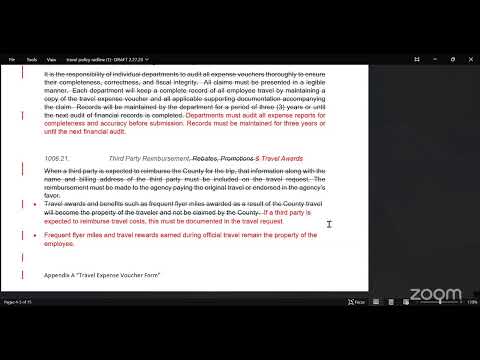
On reimbursement, the group agreed the policy should limit county payouts to the most cost-effective practical mode of travel—commonly tied to IRS- or GSA-based reimbursement guidance—while preserving department-head discretion for rare circumstances. One participant summarized the approach as: employees “will only be reimbursed for the most cost effective mode of travel available.” Clarissa Costa noted using a personal credit card for airfare can save the county on baggage fees and still be reimbursed.
Lodging, direct billing and conference blocks received attention. Staff said some hotels already agree to direct-bill the county; attendees encouraged staff to secure block rates early to avoid higher last-minute costs. The group recessed discussion of some lodging-edge cases to the lodging subsection of the draft.
The workshop also addressed routine administrative items: receipts should be attached to reimbursement requests in Munis, rental-car collision-waiver upsells should not be purchased, assigned take-home vehicles are reportable as a taxable fringe benefit (with limited exceptions such as the sheriff’s vehicles), and the permanent assigned-vehicle list should be reviewed annually as part of the budget process.
Other agreed edits included removing a paragraph that duplicated workers’ compensation requirements, simplifying the language on accommodations for employees with disabilities (with HR involvement for ADA documentation), and clarifying per diem rules so that no meal per diem is payable for non-overnight travel. The group said hourly-pay and FLSA-related questions should be handled in coordination with HR and existing FLSA rules.
No formal vote was recorded in the workshop. Staff said they will draft an updated policy that incorporates the workshop directions, align post-accident language with workers’ compensation and the sheriff’s policy where required, and return the revised draft for further review.
The workshop adjourned at roughly 2:54 p.m.