Delaware Department of Correction presents $468 million FY26 budget; officials highlight staffing gains, tablets, body‑worn camera pilot and treatment expansion
Loading...
Summary
The Department of Correction told the Joint Finance Committee that the governor’s FY26 recommended operating budget totals about $468 million and continues to prioritize safety, rehabilitation and workforce retention.
The Department of Correction told the Joint Finance Committee that the governor’s FY26 recommended operating budget totals about $468 million and continues to prioritize safety, rehabilitation and workforce retention. Commissioner Tara Taylor presented the budget overview and described recent investments and program changes aimed at improving security and reentry services.
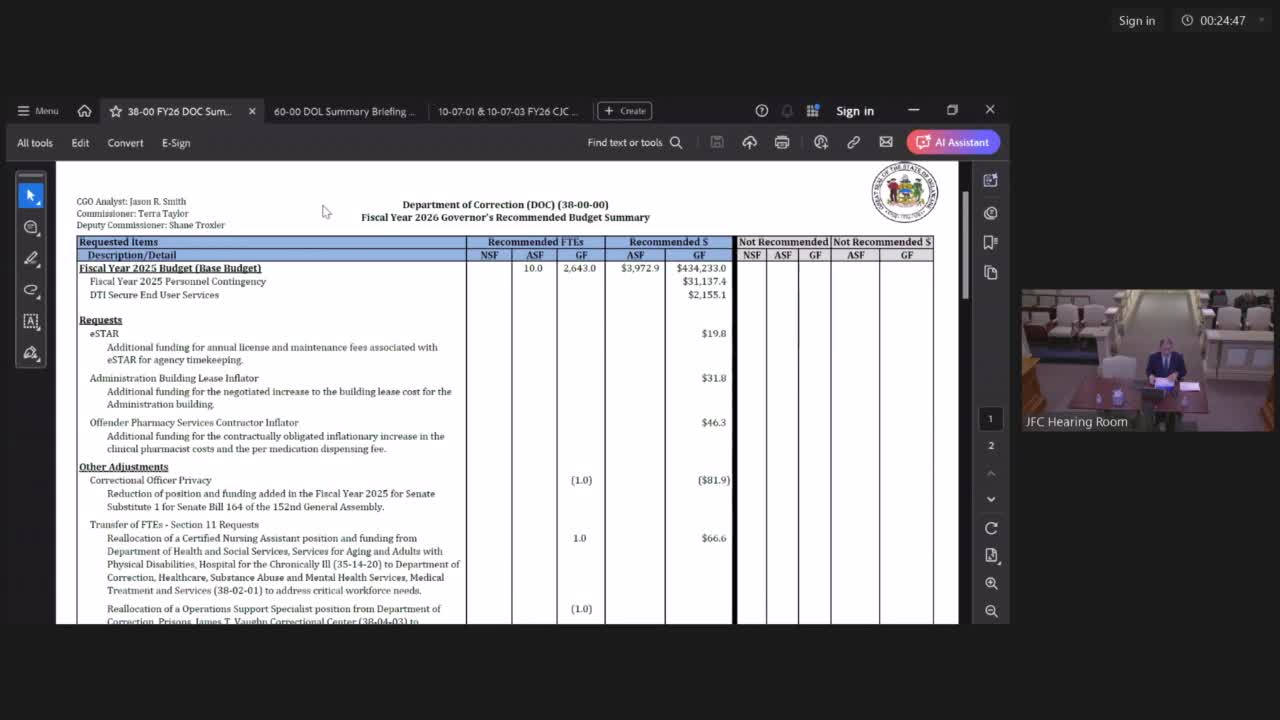
The budget presentation combined routine maintenance items and a series of “door openers” and one‑time requests. The department’s FY26 personnel contingency was listed at roughly $33 million; operating line items highlighted included negotiated lease increases, a pharmacy inflation allowance and $312,800 recommended for additional licensing and cloud storage related to a body‑worn camera pilot. Jason, a department budget analyst, walked committee members through the line‑items and supplemental requests.
Why this matters: DOC accounts for the largest share of the state corrections system budget and nearly three‑quarters of its operating budget is personnel costs. Small changes to licensing, technology or pay can materially affect operations across level‑4 and level‑5 facilities and on community supervision caseloads.
The department said recent operational steps have reduced vacancy-driven overtime and supported a modest decline in officer vacancies. Commissioner Taylor said the department’s leadership is “laser focused on three top priorities: safety and security, recruitment and retention, rehabilitation.” She also pointed to national accreditation achievements, new tasers, upgraded radios and expanded facility cameras as recent improvements.
Tablet, education and vocational programs: DOC leaders described the fall deployment of tablets to incarcerated people statewide “at no cost to taxpayers.” Officials said tablets will be used to expand virtual educational content, vocational coursework and treatment programming. The department also reported equipment purchases for prison trades programs (embroidery, HVAC charging, tire equipment) and said it expanded the Road to Recovery substance‑use treatment beds and launched a certified peer specialist program and a prison arts/tattoo apprenticeship pathway.
Body‑worn camera pilot: Committee members pressed on a campus pilot for body‑worn cameras. The department said the federal Clearing House committee funded the camera hardware through a grant; the requested state funds are for licensing and cloud evidence storage. The department described the pilot as targeted to correctional officers in high‑risk, community‑involved units — for example certain pretrial, maximum‑security units and road‑crew assignments — and said it is structured as a limited trial to evaluate operational use and storage/licensing needs.
Population and recidivism context: The department and the Statistical Analysis Center presented trend charts showing a multi‑year decline in probation and incarcerated populations. DOC reported historically lower population counts in level‑4 and level‑5 facilities compared with earlier decades and cited a three‑year return‑to‑prison recidivism rate under 9 percent for the most recent 3‑year span used by the department’s metrics.
Questions from committee members focused on implementation details: where body‑worn cameras would be used, how the department is using tablets to support literacy and formal education (including coordination with the Department of Education on curriculum), the status of vocational offerings and the department’s staffing analysis. Deputy Commissioner Shane Troxler said a recent staffing analysis used the National Institute of Corrections tool and indicated the department is reviewing staffing patterns across facilities; he also said some positions had been reclassified to meet operational needs.
What’s next: Committee members asked for follow‑up data on education vacancies, literacy measurement, use of tablet audio books, and outcomes from the Road to Recovery program. Department officials said some evaluations of treatment programs were underway and that they would provide additional materials to the committee.
Ending note: The department invited members to visit facilities and emphasized that personnel costs remain the dominant budget driver. The budget presentation concluded with the department asking the committee to consider the recommended operating and one‑time funding adjustments that support the pilot programs and staff retention efforts.