Get Full Government Meeting Transcripts, Videos, & Alerts Forever!
Get email alerts on the Livestock Stock Restriction topic
No spam. Unsubscribe anytime.
Yakima County discusses forming stock‑restricted advisory committee to review 1986 boundaries
Summary
County staff proposed a three‑month advisory committee to revisit stock‑restricted area boundaries set in 1986; commissioners asked for broader agricultural representation and clarity on the committee’s legal scope under RCW 16.24.
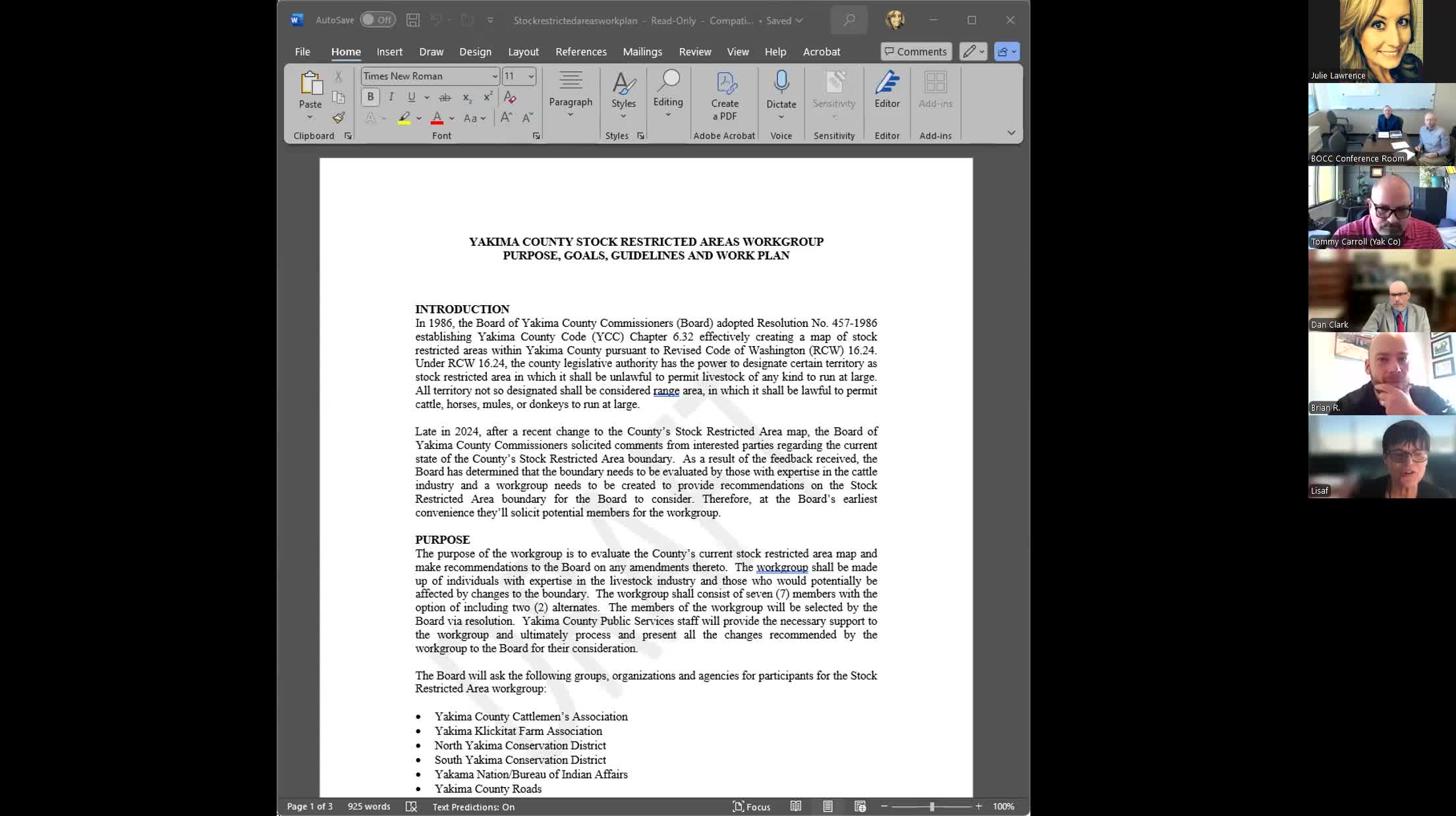
Yakima County planning staff presented a draft work plan on March 3 proposing a stock‑restricted advisory committee to review the county’s stock‑restricted area map (Yakima County Code chapter 6.32). Staff said the board’s prior adjustments to the map in 2024 led to public comment and that the board directed staff to seek local expertise on the boundaries.
Planner Lisa (last name not specified) told the board the committee would be formed under state law and asked commissioners to approve membership and a three‑month schedule. “The goal of the work group is very simple. It’s basically, developing for the board’s consideration a proposed boundary for the stock restricted area map,” Lisa said.
Legal scope and membership: staff said RCW 16.24 grants the county authority to designate areas where it is unlawful to allow livestock to run at large; that statutory framework constrains what the committee can recommend. The proposed core membership included representatives from the Cattlemen’s Association, the Yakima Klickitat Farm Association, the North and South Yakima Conservation Districts, a representative from the Yakama Nation or Bureau of Indian Affairs, county roads, and the Washington State Department of Transportation, plus two alternates. Planning staff said the committee would attempt consensus recommendations but that if consensus cannot be reached they would forward a majority recommendation to the board.
Commissioner feedback: several commissioners asked for changes before finalizing the work plan. One commissioner said the Cattlemen’s Association should have more seats and suggested adding at least three cattle producers rather than one to ensure producers felt fairly represented. Another commissioner suggested adding the tree fruit industry and other non‑livestock agricultural interests. Board members also discussed whether state Department of Transportation needed full membership or could participate as a consulting party; county roads staff supported DOT involvement because of state highways running through affected areas.
Process limits: staff and counsel warned the committee’s scope is limited to mapping boundaries because RCW 16.24 defines the county’s authority; other neighbor‑to‑neighbor dispute remedies or alternative processes would require legal review before the county could act. Lisa said the 1986 map had been drawn around irrigation district boundaries and that the statute prescribes the process for designating stock‑restricted areas.
Next steps: commissioners asked staff to return with a revised membership list that adds additional cattle producer representation and non‑livestock agriculture input. The board agreed to revisit the draft at the March 10 work session to allow Commissioner McKinney, who was excused on March 3, to participate.
The board did not take a final vote to form the committee on March 3 and asked staff to bring a revised proposal to the next work session.