Get Full Government Meeting Transcripts, Videos, & Alerts Forever!
Get email alerts on the Water Rights topic
No spam. Unsubscribe anytime.
County to test selling SEED water rights to support farmworker housing after Ecology policy change
Summary
Yakima County staff will draft a purchase‑and‑sale agreement to test using county‑held water rights for a proposed Borton Fruit project (296‑bed H‑2A housing), and commissioners agreed to pursue a public hearing and terms that could include forfeitable earnest money; the step is framed as a trial pending a larger county water‑bank effort.
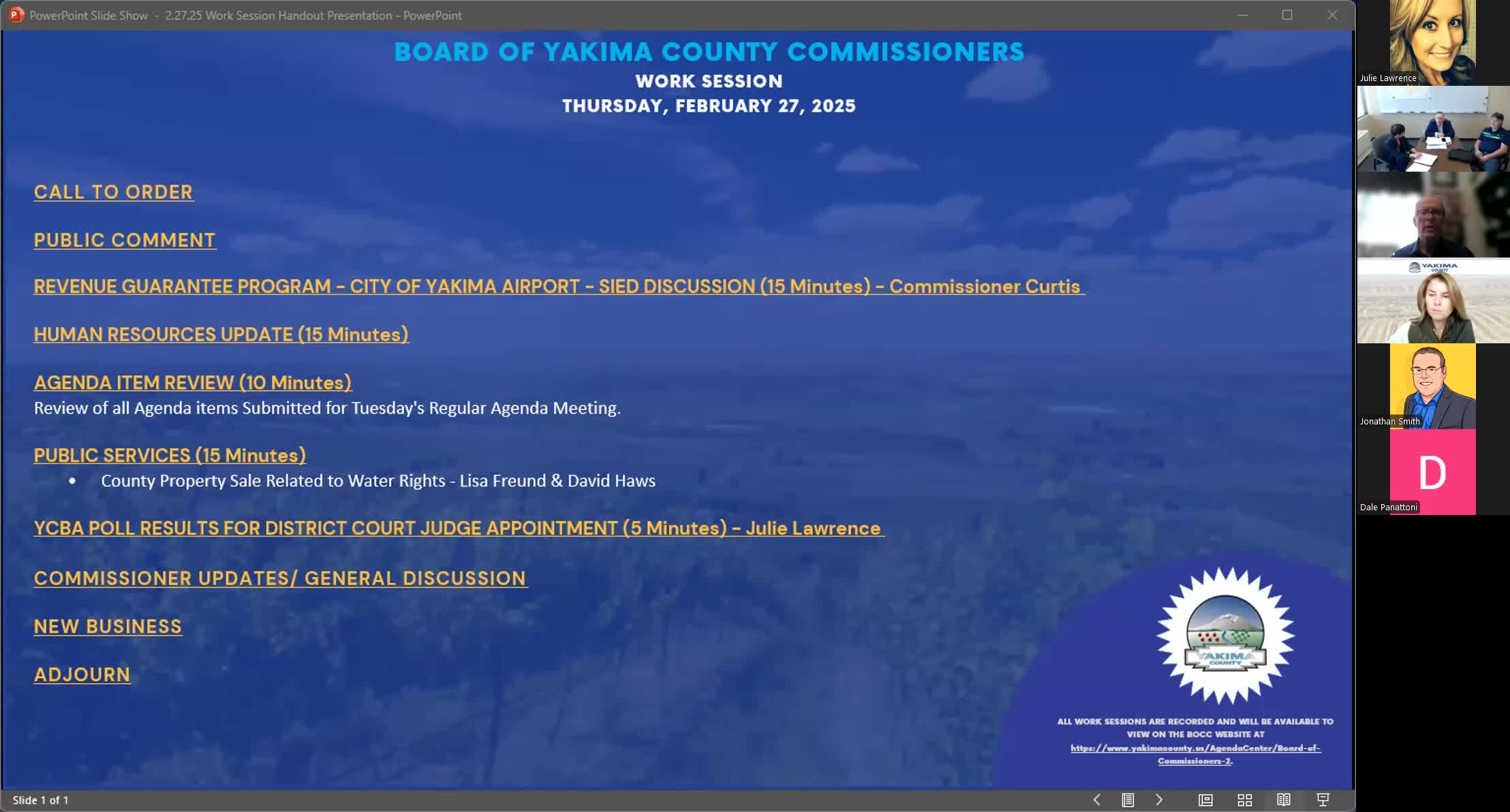
Yakima County commissioners directed staff Feb. 27 to move forward with drafting a purchase‑and‑sale agreement that would allow a private developer to acquire county‑held water rights to support a proposed farmworker (H‑2A) housing project.
County Public Services staff presented the matter as a “test case” prompted by a recent change in the Washington State Department of Ecology’s interpretation of rules governing exempt wells and municipally defined water uses. The change requires developments with more than 15 connections, or that serve more than 25 people for 60 days per year, to be treated as municipal uses for Ecology permitting — a designation that typically requires a transferred, permitted water right rather than reliance on exempt wells.
Lisa, a county public‑services official, and Joel, the county’s subject‑matter expert on water rights, described a proposal from Borton Fruit to use county water rights to enable construction of two 296‑bed H‑2A farmworker housing units. Joel said the county already holds water in quantities that match typical development needs and that a sale or transfer could avoid protracted, costly outside searches for water rights.
Joel recommended a legally robust purchase‑and‑sale agreement with conditions tying any transfer to a completed development permit, while allowing the buyer sufficient property interest to proceed with Ecology’s water‑transfer steps before final deed conveyance. He also suggested a forfeitable earnest‑money deposit to deter speculative applications.
Why it matters: County staff and several commissioners said the Ecology policy shift could affect many future rural developments that previously relied on exempt wells. Using the county’s existing water portfolio as a managed resource — and ultimately operating a county water bank — could shorten permitting timelines and preserve development options for housing and other permitted uses.
Next steps and limitations: Commissioners gave staff consensus to prepare a purchase and sale template, to schedule the required public hearing for a county asset sale, and to include clear parameters (eligibility, required permits, earnest money and transfer conditions). Staff noted the county’s formal water‑bank grant application must be signed by June 30, 2025, to secure state funds that would support broader program development. Commissioners and staff emphasized this is a trial approach and that additional applicants could come forward only if they meet Ecology’s municipal‑use criteria.
Ending: The board directed staff to proceed with drafting contract terms and to return with public‑hearing scheduling and a draft agreement for future consideration.