Get Full Government Meeting Transcripts, Videos, & Alerts Forever!
Get email alerts on the Drones topic
No spam. Unsubscribe anytime.
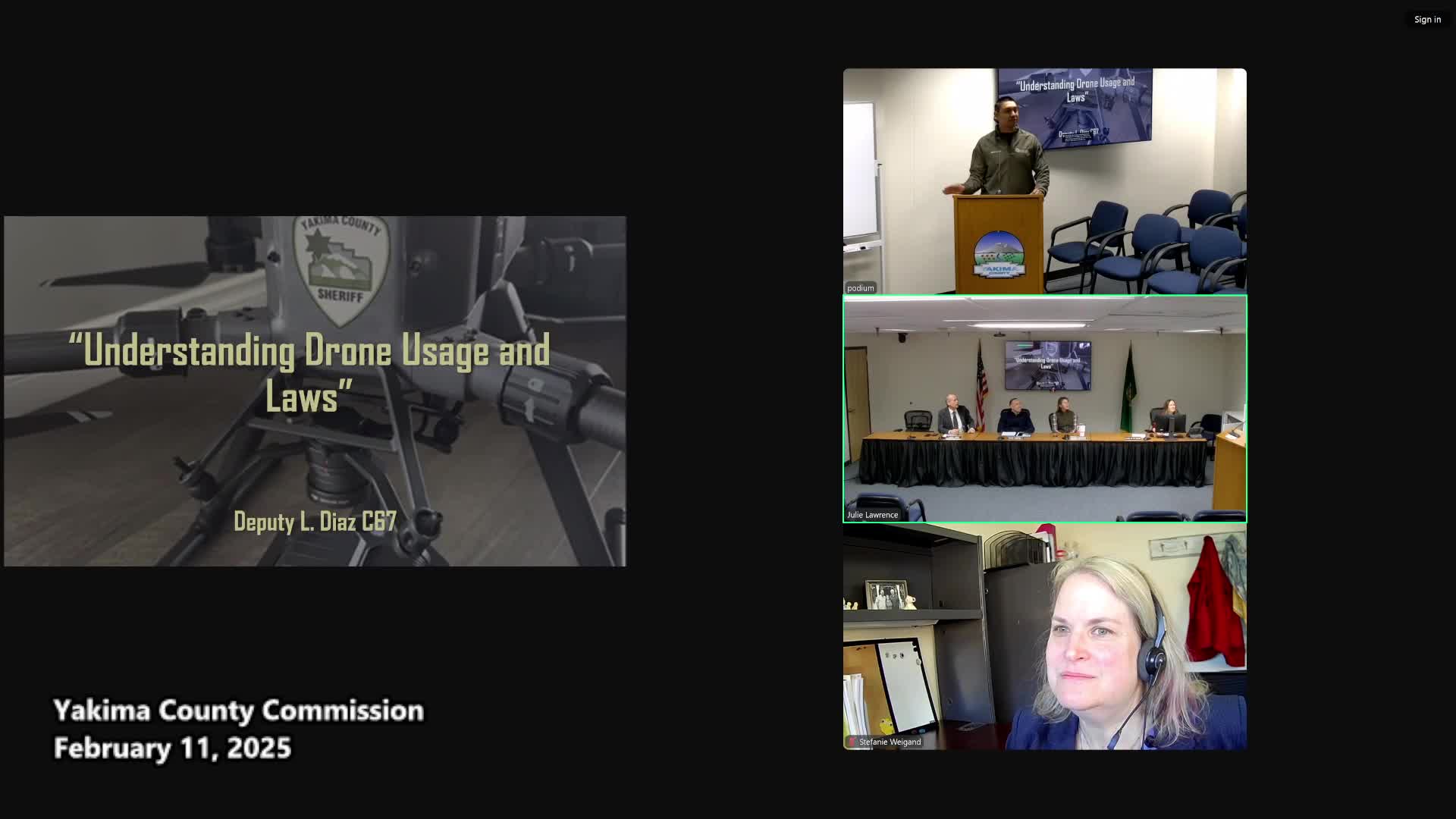
Yakima County deputy briefs commissioners on drone rules, privacy and enforcement
Summary
At the Feb. 11 Yakima County Commissioners meeting, Deputy Diaz of the Yakima County Sheriff’s Office presented federal and state drone requirements, privacy limits and enforcement options, and recommended steps residents should take if they believe a drone is violating the law.
Deputy Diaz of the Yakima County Sheriff’s Office told the Board of Yakima County Commissioners on Feb. 11 that federal and state rules govern most drone operations, and that the county currently has no broad, county-specific drone ordinance.
Diaz said the Federal Aviation Administration requires registration and a remote pilot certificate for drones weighing more than 0.55 pounds (about 250 grams), and that licensed pilots must be at least 16 years old. He said drones generally must remain within the operator’s visual line of sight, must not exceed 400 feet above ground level without an FAA waiver, and must display anti‑collision lighting. Diaz added that operators must keep drones away from aircraft and obtain air‑traffic authorization before entering controlled airspace near airports.
The presentation explained state privacy and criminal statutes that can apply when a drone records people in private spaces or hovers over private property. Diaz warned that flying a drone in a manner that enables surveillance into homes or other private areas can lead to criminal trespass or cyber‑harassment charges under state law, and in some cases to federal charges. He also noted that it is a federal crime to shoot down or intentionally disable a drone.
Commissioners asked whether Yakima County should adopt local drone rules. Diaz said some larger jurisdictions have added restrictions for specific locations such as state parks or government sites, but Yakima County currently relies on FAA and state rules; local parks or airports may have their own limits. He highlighted local no‑fly areas mentioned in the presentation, including the Yakima Training Center and areas near Yakima Airport, and noted a five‑mile notification zone around the airport where operators should contact air traffic control.
On reporting and enforcement, Diaz advised residents to video record an offending drone and, when possible, identify where it lands; he said law enforcement can track registered drones via the FAA/Drone ID system and can seek search warrants to retrieve footage from a drone’s storage if needed. Diaz said the sheriff’s office has received a small number of calls about suspected misuse since last year, including incidents that frightened livestock, and that state RCWs provide tools for charging unlawful conduct when evidence is available.
Diaz also described FAA waivers the sheriff’s office uses for night operations and for in‑vehicle piloting during deployments; he said civilians may apply for waivers for certain operations. He urged operators to follow FAA and state rules, to avoid flying near law enforcement operations, and to contact the Sheriff’s Office, Yakima Police Department or Parks and Recreation with questions.
The presentation closed with a reminder that small recreational drones under the 0.55‑pound threshold do not require FAA registration or a pilot certificate but still must follow privacy and safety rules.
Deputy Diaz emphasized: “Your max altitude is 400 feet above ground level,” and advised residents to “record the drone” if they believe it is violating privacy or trespass laws. He also warned, “Do not shoot drones down or attempt to knock drones down because you could get charged federally.”