Get Full Government Meeting Transcripts, Videos, & Alerts Forever!
Get email alerts on the Insurance Payments Lienholders topic
No spam. Unsubscribe anytime.
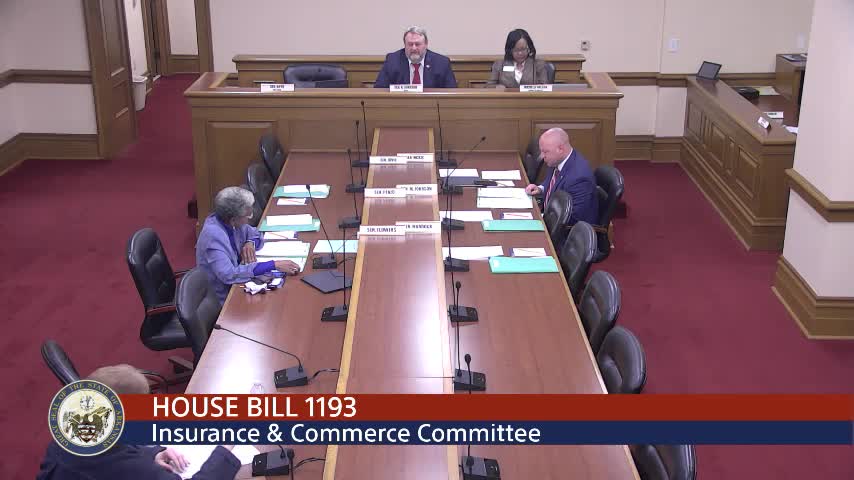
Committee approves amendment and advances bill letting insurers send payment to repair shops in limited cases
Summary
The committee adopted an amendment and passed House Bill 1193 as amended to allow insurers to issue payment without a lienholder's name in certain circumstances: no in‑state physical presence for the lienholder, damage under $2,500, or payment made directly to the repair facility for the amount of repairs.
Representative Kavanaugh introduced House Bill 1193 to the Senate Insurance & Commerce committee and said the amendment "does some clarifying language" to ensure that where a lienholder has no physical presence in the state, the lienholder would not need to be on an insurance payment under certain conditions.
Under the bill as amended, a perfected lienholder's name need not appear on an insurance payment if any of the following apply: the lienholder has no physical location in the state, the vehicle damage is less than $2,500, or the insurer pays a repair facility directly for the amount of necessary repairs.
Senator Stephanie Flowers said she had been contacted by auto repair shops and raised concern about the $2,500 threshold, saying "that's not a lot of money when you talk about a repair." Representative Kavanaugh replied that the bill's three conditions are narrowly written and that the customer's name can still appear on a check; the amendment aims to protect repair facilities and reduce loss for perfected lienholders in instances where checks are issued directly to consumers and later cashed.
Sponsor testimony and committee discussion described examples in which insurers issued a payment to a customer—for example, $10,000—then later determined the vehicle was a total loss valuing at $20,000. In such cases, witnesses said lienholders sometimes face losses or must sue customers when the lienholder's name did not appear on earlier payments. The bill's sponsor argued the measure would reduce that kind of litigation by ensuring lienholder protections in specified cases.
The committee adopted the amendment (motion to adopt the amendment announced by Senator Matt McKee) and later approved the bill as amended. Committee discussion recorded no registered opponents in the provided excerpt.
The bill now advances from committee; supporters said the measure balances repair-shop payment practices, lienholder protections and consumer interests by limiting the exception to three defined circumstances.