Get Full Government Meeting Transcripts, Videos, & Alerts Forever!
Get email alerts on the Stormwater Management topic
No spam. Unsubscribe anytime.
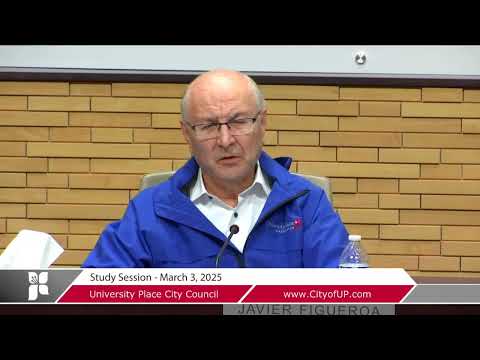
Council staff present 2025 stormwater management update; public hearing set for March 17
Summary
City staff briefed the University Place City Council on the required 2025 update to the city's Municipal Stormwater Management Program, including a new section on underground injection control wells and a planned public hearing and adoption resolution on March 17.
City staff on Monday presented the annual update to University Place's stormwater management program and invited public comment ahead of a March 17 public hearing and planned adoption by resolution.
Public Works Director Jack Ecklund and NPDES coordinator Todd Smith told the council the update reflects current permit requirements under the city's Municipal Stormwater (NPDES) permit and adds a new section to document compliance with the state's underground injection control (UIC) well program. Smith said the UIC section addresses dry wells and other infiltration systems that state law requires cities to register and manage.
The update lists 12 program elements the city must implement as a condition of its permit: stormwater planning; public education and outreach; public involvement; mapping and documentation; illicit-discharge detection and elimination; runoff controls for development; stormwater management for existing development; source control for existing development; operation and maintenance; monitoring, reporting and recordkeeping; and UIC-well compliance. Ecklund said staff trimmed nonrequired appendices from the public draft and linked to supporting documents on the city website to make the document shorter and easier to use.
Smith described the city's outreach plans for 2025, including Natural Yard Care webinars scheduled for April in partnership with the Pierce County Health Department and other agencies, and a continuing public-awareness effort tied to the Puget Sound Starts Here campaign. He also said the city participates in a regional monitoring and assessment program (a joint option under state guidance) rather than running a fully independent monitoring program; that regional effort was described as costing on the order of $20,000 in recent years.
Council members asked for implementation details. Councilmember McCluskey asked how source-control inspections work; Smith said staff maintain a business inventory of about 280 sites with potential to pollute and perform roughly 40'to'50 inspections per year (about 46 last year). Inspections typically take 20'to'45 minutes, Smith said, and follow-up is scheduled when problems are found. Ecklund outlined a progressive-enforcement approach that begins with education and informal follow-up and escalates to civil penalties in the city's code if necessary; Smith said the code allows penalties beginning at $500 and, for severe or uncorrected violations, fines up to $10,000 per day.
Ecklund invited the public to review the draft program at cityofup.com and to submit comments to Todd Smith. The public comment period closes March 17; a public hearing will be included on the March 17 council meeting agenda, after which staff plan to return with a resolution for formal adoption.
The update was presented as a study item and requires no immediate council vote. Staff said they will accept written comments through March 17 and expect to bring a resolution adopting the program to the council on that date.