Get Full Government Meeting Transcripts, Videos, & Alerts Forever!
Get email alerts on the Stadium Transition Area Housing topic
No spam. Unsubscribe anytime.
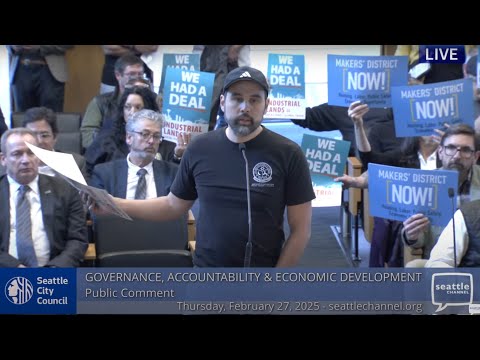
Committee advances bill to allow housing in stadium transition area over port objections
Summary
The Seattle Governance, Accountability and Economic Development Committee voted 3-2 on Feb. 27 to recommend that the full City Council pass Council Bill 120933, which would allow residential uses in the Stadium Transition Area Overlay District and remove a 200-foot buffer from major truck streets.
The Seattle Governance, Accountability and Economic Development Committee voted 3-2 on Feb. 27 to recommend that the full City Council pass Council Bill 120933, a measure to allow residential uses in the Stadium Transition Area Overlay District and to remove the urban-industrial 200-foot buffer from major truck streets.
The committee recommendation is nonbinding and will be forwarded to the full council for final consideration. Chair Sarah Nelson told the panel that "Our committee vote is a recommendation to full council. That's what it is. It is non binding on the counsel" and noted the vote does not itself change land use.
The bill would amend Seattle Municipal Code sections 23.74.002 and 23.74.008 to permit housing in the overlay district. Council Central staff analyst Lish Whitson summarized technical points: the change would remove the existing prohibition on housing in the Stadium Transition Area Overlay District, eliminate the 200-foot limit on housing near major truck streets within the urban industrial zone, and was studied in the Industrial and Maritime Final Environmental Impact Statement (FEIS) published in 2022. The FEIS analyzed a preferred alternative that included up to 990 housing units in the stadium-area study footprint.
Supporters at the meeting argued the proposal would create workforce housing, small spaces for independent light industrial businesses, and union construction jobs. Councilmember Nelson and several building trades witnesses said the project would include project-labor protections and long-term affordability requirements that were studied in the EIS.
Opponents — led by maritime stakeholders, port officials and many longshore and trucking representatives — urged the committee to reject the measure. Port of Seattle Commissioner Fred Feldman, testifying for port interests, said the port is evaluating its legal options and argued the change would remove key mitigations from the EIS. Feldman said, "We're exploring our legal options if you continue to pursue this unfortunate effort" and warned the conversion of industrial land would undermine the port's mission.
State Representative Julia Reed told the committee she joined 30 other state lawmakers in a letter opposing the bill and said, "Maintaining good paying jobs in our maritime industrial economy generates economic activity for a lifetime and for generations in the entire region." Representatives of the Northwest Seaport Alliance, shipping companies and farm and seafood exporters told the committee that industrial lands near deepwater terminals are limited, regionally important and difficult to replace.
Committee discussion recapped the legislative history: the FEIS was published in 2022 and the proposal first transmitted to council in April 2023. Several speakers and councilmembers described competing views about whether earlier stakeholder agreements constituted a binding deal; Chair Nelson and others said differences in how stakeholders read the FEIS and subsequent negotiations explain why parties on both sides believe they were promised different outcomes.
The committee recorded a formal recommendation motion moved by Chair Sarah Nelson; the clerk called the roll. The recorded vote on the committee recommendation was: Rivera — yes; Solomon — yes; Hollingsworth — no; Kettle — no; Chair Nelson — aye. The motion carried 3–2. The committee chair said the recommendation and accompanying legal questions will be forwarded to the full council and that the Office of the City Attorney would prepare additional legal analysis before final council action.
What happens next: the committee recommendation will be placed on the City Council agenda for full consideration. Councilmember Kettle and others noted the possibility of further legal challenges and urged more study of maritime and freight impacts. Councilmember Kettle also described additional infrastructure and environmental remediation work in the area — including King County wastewater planning and a multi-billion-dollar remediation footprint in the Duwamish area — and said those factors affect project feasibility and public cost.
The committee vote does not itself change zoning. Any final change requires a full council vote and, if enacted, would be implemented under the conditions and standards described in city code and the FEIS.