Get Full Government Meeting Transcripts, Videos, & Alerts Forever!
Get email alerts on the State Legislation topic
No spam. Unsubscribe anytime.
OIR briefs Seattle council on mid‑session status of public safety, housing and climate bills
Summary
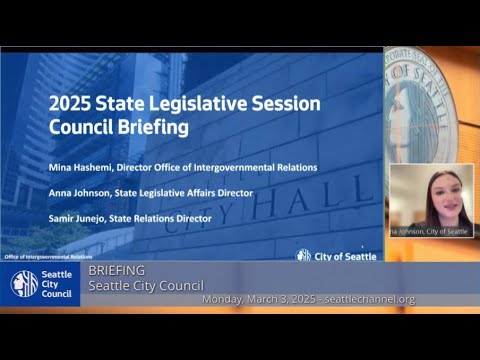
Anna Johnson of the Office of Intergovernmental Relations updated the council on the 2025 Washington legislative session’s mid‑point, summarizing the status of dozens of state bills the city is tracking and flagging near‑term cutoffs and budget pressures.
Anna Johnson, state legislative affairs director in the Office of Intergovernmental Relations (OIR), told the Seattle City Council on March 3, 2025, that the 2025 Washington Legislature had reached roughly the halfway point of its 105‑day session and that many bills of interest to the city remain active.
The briefing outlined bills affecting public safety, housing, climate and transportation and explained the calendar pressures: a fiscal committee cutoff had just passed and the next major deadline for bills to move from their original chamber is March 12. Johnson said certain revenue and “NTIB” bills needed for the budget timeline will come later and that city staff are tracking them closely.
Why it matters: the legislation OIR tracks could change local authority, revenue options and grant availability for Seattle departments. Council members used the briefing to ask clarifying questions about specific bills and local impacts.
Key items OIR reported to council: • Public safety and criminal justice: Johnson said multiple public‑safety bills remain active, including a weapons‑restrictions measure for parks and public buildings (identified in the briefing as Senate Bill 5098) and proposals to create new grant and funding mechanisms for law enforcement and co‑response teams (e.g., Senate Bill 5060 and House Bill 2015). She told the council these measures are in chamber rules and, in some cases, ready for floor action but may need changes to meet Seattle priorities.
• Court and juvenile matters: House Bill 1112 (allowing municipal pro tem judges to live outside city limits) was described as having passed the originating chamber and awaiting hearings in the opposite chamber. Johnson said sex‑offense and juvenile interview provisions (Senate Bill 5052) and other victim‑support measures were moving in committee or in rules.
• Housing and homelessness: Johnson identified several housing‑related bills still moving, including a measure that would create options for a local real‑estate excise tax for affordable housing (House Bill 1867) and proposals to change covenant homeownership eligibility and make some loans forgivable (House Bill 1696). She said the state budget reductions under consideration could affect next steps.
• Tax and budget: Johnson summarized the governor’s budget reduction proposal (a multibillion‑dollar package requiring agency cuts) and noted county and local revenue bills being tracked, such as local property‑tax options and proposals tied to councilmanic authority for public‑safety sales taxes. She reiterated that some tax measures are contingent on constitutional changes or further budget negotiations.
• Climate and utilities: Johnson said recycling reform (House Bill 1150 / Senate Bill 5284) and a clean fuels update (House Bill 1409) continue to move. She also identified a bill expanding joint‑use authority for consumer‑owned utilities (House Bill 1253), which could affect City Light and other city programs.
Johnson answered council questions about the vehicle noise‑camera pilot (now narrowed to a pilot limited to jurisdictions above a population threshold and set to sunset in 2028), the mechanics of the public‑safety sales tax proposal, and the state’s fiscal timeline. She closed by noting floor activity would be heavy in the coming week and offered to follow up with additional details when asked by council members.
The council asked for follow‑up on several topics Johnson flagged, including details about funding mechanics for the public‑safety sales tax and the noise‑camera pilot’s reporting requirements; Johnson said OIR would provide more documentation to council offices.