Get Full Government Meeting Transcripts, Videos, & Alerts Forever!
Get email alerts on the Transit Reliability topic
No spam. Unsubscribe anytime.
Committee asks Metro to report on unplanned trip cancellations and rider notifications
Summary
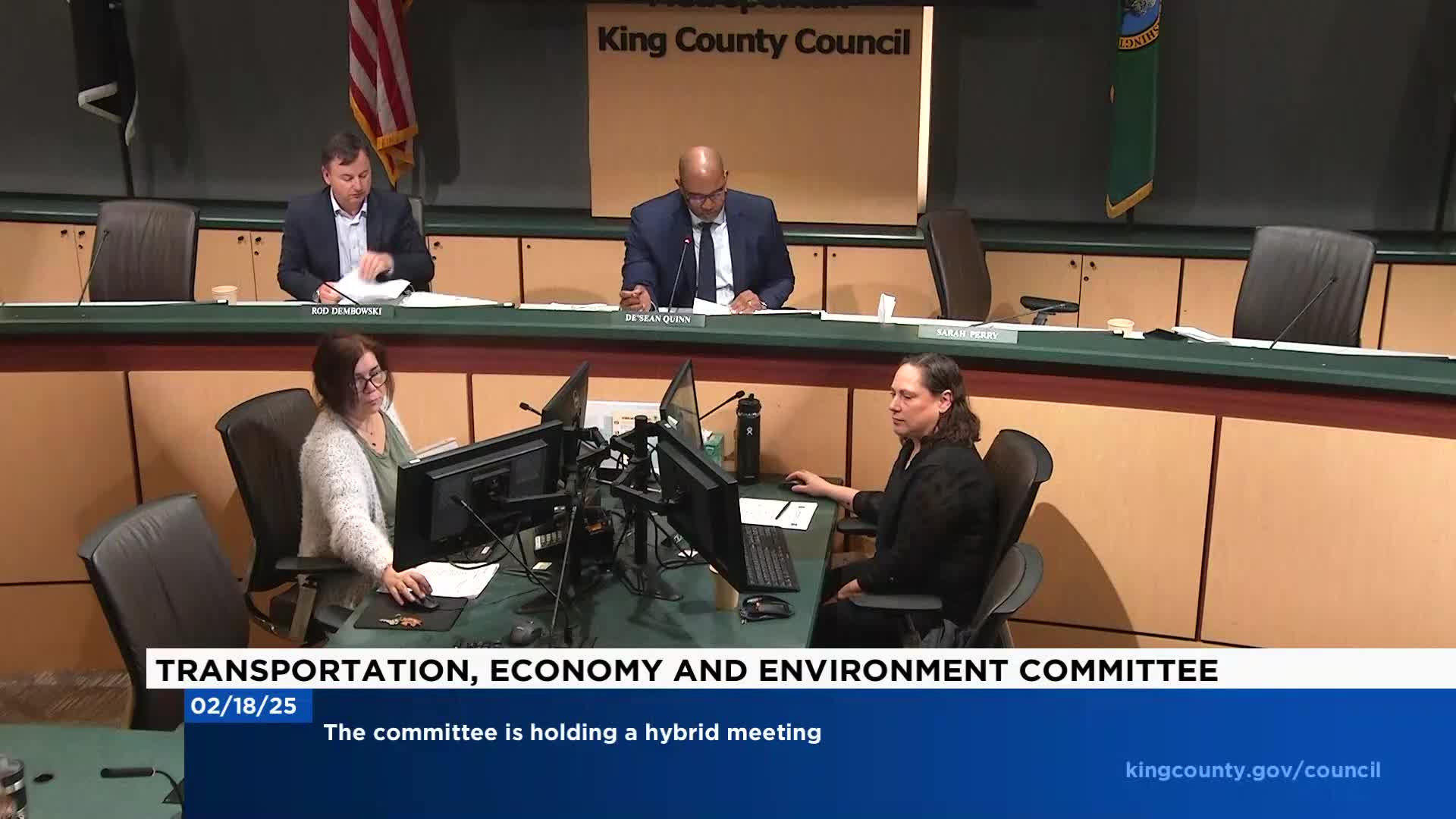
The committee voted Feb. 18 to forward a motion requesting Metro report on unplanned trip cancellations (so-called “ghost buses”) in the 2025 system evaluation report, provide real-time rider notification practices, and brief the committee and regional transit committee on options to include trip-delivery metrics in the service guidelines.
On Feb. 18 the Transportation, Economy and Environment Committee voted to forward a motion requesting that King County Metro provide more transparent reporting and rider notification about unplanned trip cancellations — trips that are planned but do not run — and to study whether trip-delivery metrics should be part of Metro’s adopted service guidelines.
Council Central staff explained that unplanned trip cancellations differ from schedule reliability problems (late buses) because the trip never occurs: reasons include operator shortages, unavailable buses, or mechanical failures. Staff said Metro’s current trip-delivery target is 99.7% of planned trips, which Council Central staff illustrated against a 11,500-daily-trip baseline: at 99.7% delivery that equates to roughly two to three dozen canceled trips per day; by contrast, a staffing crisis and a fleet recall in 2022–23 reduced delivery to about 93.2% (an earlier period in which the packet said several hundred daily trips were canceled).
The motion (Proposed Motion 2025-0558) requests three items: (1) add an appendix to the 2025 system evaluation report summarizing unplanned trip cancellations for fixed-route bus service; (2) ensure riders receive real-time notifications of unplanned cancellations and brief the committee at the next two quarterly general-manager reports on how riders and third-party apps are being informed; and (3) brief the committee and the regional transit committee by Feb. 8, 2026, on options for including trip-delivery metrics in the adopted service guidelines ahead of the next guidelines update.
Committee members asked Metro staff about data availability and benchmarking. Metro said it can report cancellations by route, block and base, and that the agency tracks cancellations daily and in monthly business reviews. Councilmember Perry asked staff to include, as part of the reporting conversation, benchmarking versus comparable U.S. transit systems and a count of riders affected by canceled trips (for example, cross‑tabulating canceled trips with route ridership) so the committee can see both the number of canceled trips and the scale of people impacted; Councilmember Balducci said she would work with Perry on a final amendment language for full council.
The committee voted to forward the motion with a due-pass recommendation; members said they intend to work with Metro on the specific reporting formats and on additions such as benchmarking and rider-impact estimates prior to final council action.