Get Full Government Meeting Transcripts, Videos, & Alerts Forever!
Get email alerts on the Transit topic
No spam. Unsubscribe anytime.
Committee approves Metro East Link connections restructure and asks for fall 2027 review
Summary
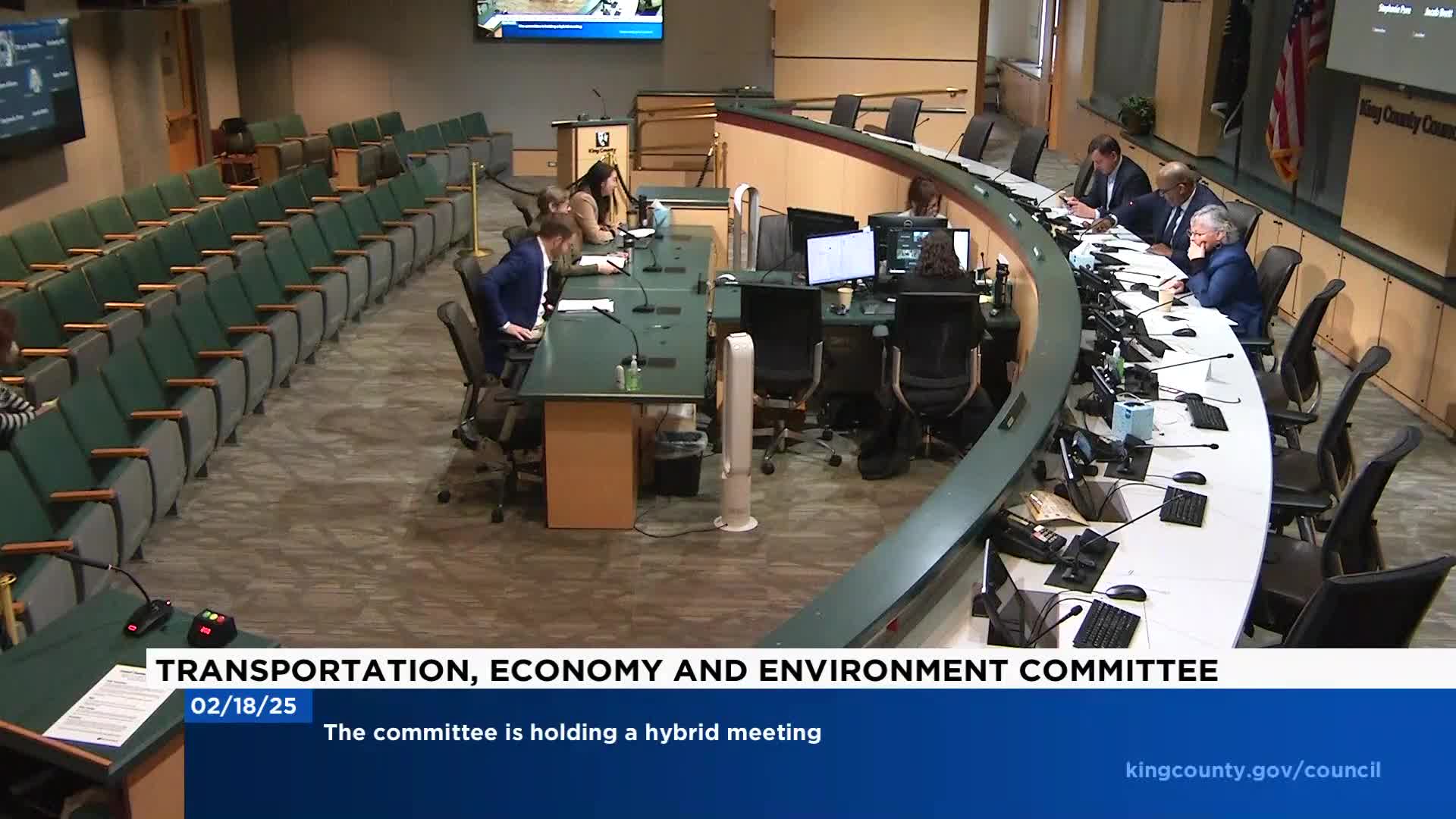
The committee voted Feb. 18 to forward proposed ordinance 2025-556 approving a major Metro bus-network restructuring coordinated with Sound Transit’s East Link expansion; members adopted an amendment asking the executive to report back on ridership trends and performance by the fall 2027 service-change window.
On Feb. 18 the Transportation, Economy and Environment Committee approved and forwarded to the full council, with a due-pass recommendation, a proposed ordinance (2025-556) that would authorize a large Metro bus-network restructure coordinated with the full opening of Sound Transit’s 2 (East Link) line.
Committee staff described the proposal as one of the largest Metro service restructures in recent memory, affecting dozens of routes and creating eight new routes while replacing or revising many others to integrate bus service with new light-rail stations. Mary Bergenon of Council Central staff told the committee the restructure was developed through multiple phases of public engagement (spring 2021–spring 2022, plus a 2024 check-in) and is intended to bring suspended pandemic service hours back in a restructured network that prioritizes faster regional connections, new weekend and evening hours in many places, and better transfers to light rail.
Graydon Newman, who leads Metro’s service-planning group, said the network scope covers 21 jurisdictions and nearly 850,000 residents in the project area. Staff said the restructure would add about 160,000 annual service hours to the system overall, with an initial 33,000 service hours planned for 2025 at an estimated 2025 cost of $7.8 million, offset in budget materials by about $700,000 in additional fare revenue already built into the 2025 budget. Metro planners said frequency increases, added weekend and night service on selected routes, and several brand-new two-way connections would be part of the proposal.
Committee staff and Metro supplied equity analyses alongside Title VI compliance materials. The staff equity impact review estimated the restructure would add frequent-transit access for about 24,000 people living in equity-priority areas (a roughly 14% increase) and identified community assets that would gain new transit connections. The Title VI analysis, prepared to satisfy federal civil-rights reporting requirements, reported no disproportionate burden on low‑income populations and no disparate impact on minority populations for the routes in the study area.
Councilmembers asked detailed questions about equity scoring, Title VI methodology, and how Metro would phase implementation as Sound Transit opens stations. Several members said the scale and complexity — “pulling on spaghetti strands,” in one members’ phrasing — make it important to monitor outcomes once the network is in the field. Councilmember Balducci moved an amendment asking the executive to engage with Sound Transit, Bellevue, Kirkland and other partners to review how the restructured service performs and to report back via a letter by the fall 2027 service change; the committee adopted the amendment and then passed the ordinance and forwarded it with a due-pass recommendation. Committee members noted the ordinance would not be placed on the council consent agenda so members could speak to it at full council.
The ordinance and the amendment together authorize Metro to implement route changes in stages tied to station openings (the packet referenced a Marymoor Park and Downtown Redmond station opening in spring with the full line later in the year) and require continued monitoring and operational-capacity review before each implementation phase.