Get Full Government Meeting Transcripts, Videos, & Alerts Forever!
Get email alerts on the Environmental Health On Site Sewage topic
No spam. Unsubscribe anytime.
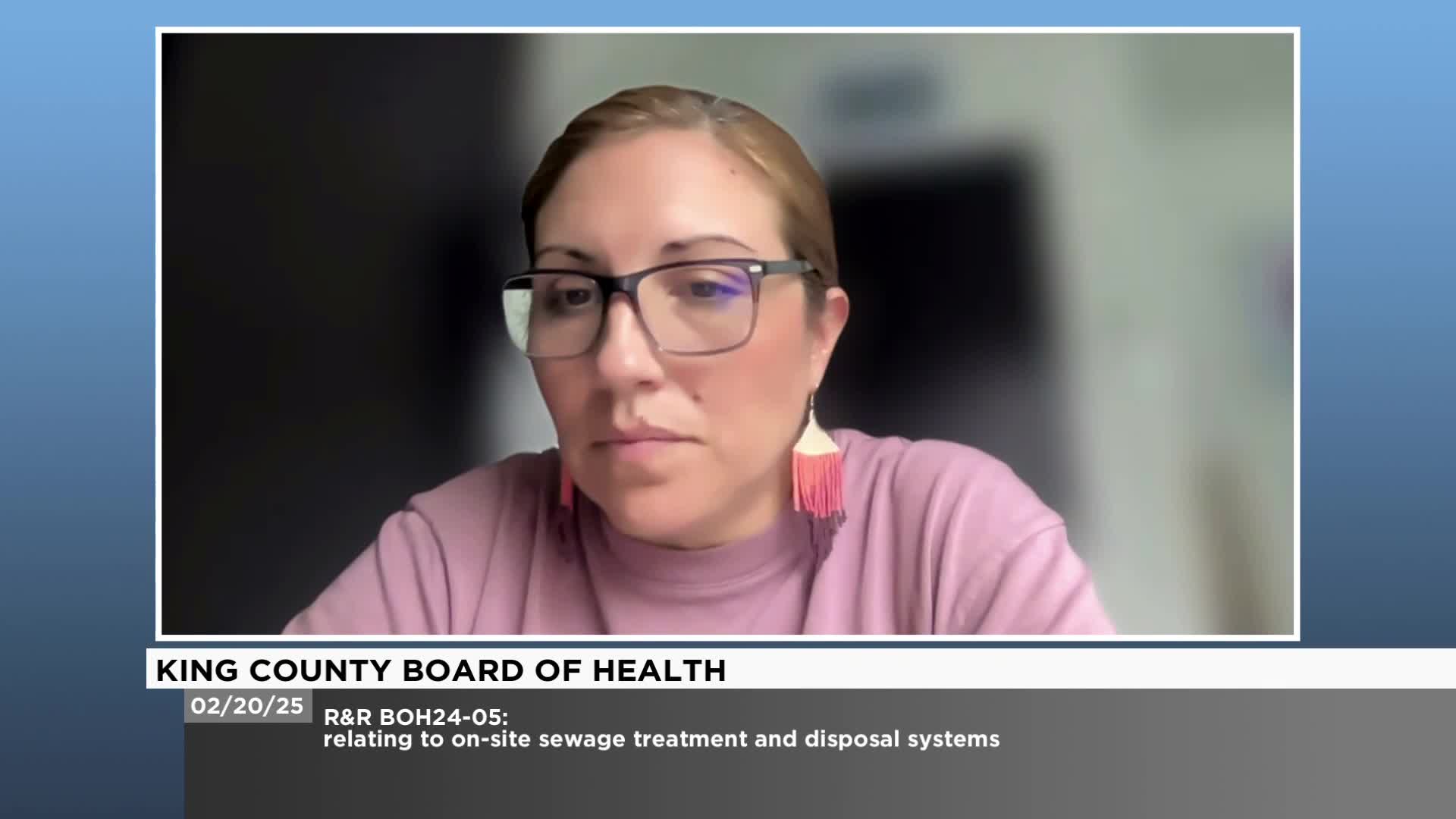
King County Board of Health adopts updated on‑site sewage rules after technical amendments
Summary
The Board of Health adopted amendments to on‑site sewage treatment and disposal rules (R&R BOH 24‑05) after public comment and staff briefings; the board passed two technical amendments and approved the final rule by roll call.
The King County Board of Health on Feb. 20 adopted revised rules and regulations governing on‑site sewage treatment and disposal systems (R&R BOH 24‑05), including technical corrections the department said fix formatting, restore an omitted definition and correct an erroneous setback distance.
The rule update, which staff and the board described as largely technical, follows a public hearing and an extensive public comment period. Public Health Seattle King County staff said the changes aim to meet new state requirements while reducing costs and simplifying permitting pathways that can act as barriers to compliance for property owners.
Board members and staff emphasized outreach and education for septic owners, and staff said they will publish a plain‑language summary of the changes and a communications plan that uses newsletters, library partners and community groups to explain how the revisions affect property owners.
Public commenters raised concerns about financial burdens on residents who must repair or replace systems, proximity to sewers in urban areas, minimum lot sizes and the need for better public information on system maintenance. Several callers who identified themselves as members of technical advisory groups and community associations praised staff engagement and asked that the county target responses to problem areas rather than impose blanket requirements.
Megan Jackson, on‑site sewage program supervisor, told the board that the county is expanding education resources and has applied for grants to support outreach and potential financial-assistance options, while acknowledging gaps remain in available programs.
After staff described Striking Amendment S1 as exclusively technical corrections, the board adopted S1 by voice vote and then adopted Title Amendment T1 (to align the title with the amended content). The final roll call on R&R BOH 24‑05 as amended recorded 11 ayes and 2 no votes; the clerk announced the item adopted.
What changed and why it matters: Public Health staff said the revision updates county code to align with recent state requirements, clarifies construction and maintenance provisions, and adjusts program oversight where risks warrant added oversight. Staff emphasized that no new fees were imposed in this package and that the substance of the rules was unchanged by the technical amendments.
Next steps: Public Health Seattle King County will publish a summary of the adopted changes, distribute guidance to the septic industry and partner with libraries and community organizations to reach homeowners. Staff said they will also clarify how members of the public can report unpermitted on‑site sewage construction.
Votes at a glance: The board adopted R&R BOH 24‑05 as amended (Striking Amendment S1 and Title Amendment T1). The clerk reported the final tally as 11 ayes, 2 no votes (two named no votes were recorded in the roll call) and the item adopted.