Get Full Government Meeting Transcripts, Videos, & Alerts Forever!
Get email alerts on the Work Zone Safety topic
No spam. Unsubscribe anytime.
Committee backs bill to allow doubled fines in defined mobile work zones
Summary
House Bill 15-96 would define "mobile work zone" and permit officers to double fines in those zones; sponsor and Highway Police chief said the measure aims to protect maintenance crews, while committee preserved officer and judicial discretion.
House Bill 15-96, sponsored by Representative Trey Steinle, would establish and define a "mobile work zone" and allow fines to be doubled in those zones to improve safety for roadway maintenance workers.
Representative Trey Steinle, District 2, told the committee: "what this will do is this will allow us to double the fines in a mobile work zone." He described typical scenarios — two-lane highways with crews patching potholes — and said the bill would require a bright, prototype sign on the rear of the truck for a doubled fine to apply. Steinle and witnesses emphasized the doubled fine would remain subject to officer discretion and judicial review; Steinle said judges may throw out a doubled fine if they determine it is not warranted.
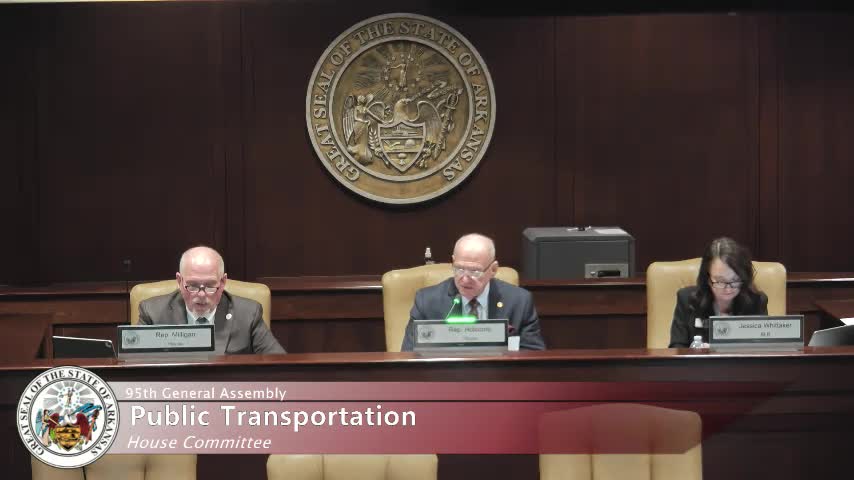
Jeff Holmes, chief of the Highway Police Division at the Arkansas Department of Transportation, testified that enforcement would mirror current work-zone enforcement: "Basically it would it would work just like work zones now. You know, the officers would be present, and enforce speed and traffic laws." Holmes confirmed the department does not retain the fine revenue.
Committee members debated whether the statute should require ("shall") an automatic doubled fine or preserve discretion ("may"). Representative Steinle and Chief Holmes advocated maintaining discretion so officers and judges can consider context. No amendments were adopted during the hearing. Representative Steinle moved to pass; the committee approved the motion by voice vote.
The bill’s sponsor said the measure is intended to protect roughly 2,000 maintenance workers and to be implemented alongside RDOT training and driver-training manual changes referenced in testimony.