Get Full Government Meeting Transcripts, Videos, & Alerts Forever!
Get email alerts on the Behavioral Health Crisis Response topic
No spam. Unsubscribe anytime.
King County expands mobile crisis teams and opens STAR Center partnership with DESC
Summary
King County and the Downtown Emergency Services Center told the Health, Housing and Human Services Committee the county has expanded its mobile rapid response crisis teams to 27 and is integrating those teams with a new behavioral-health shelter, the STAR Center, to provide short-term stabilization and pathways to care for people with acute psychiatric and substance-use conditions.
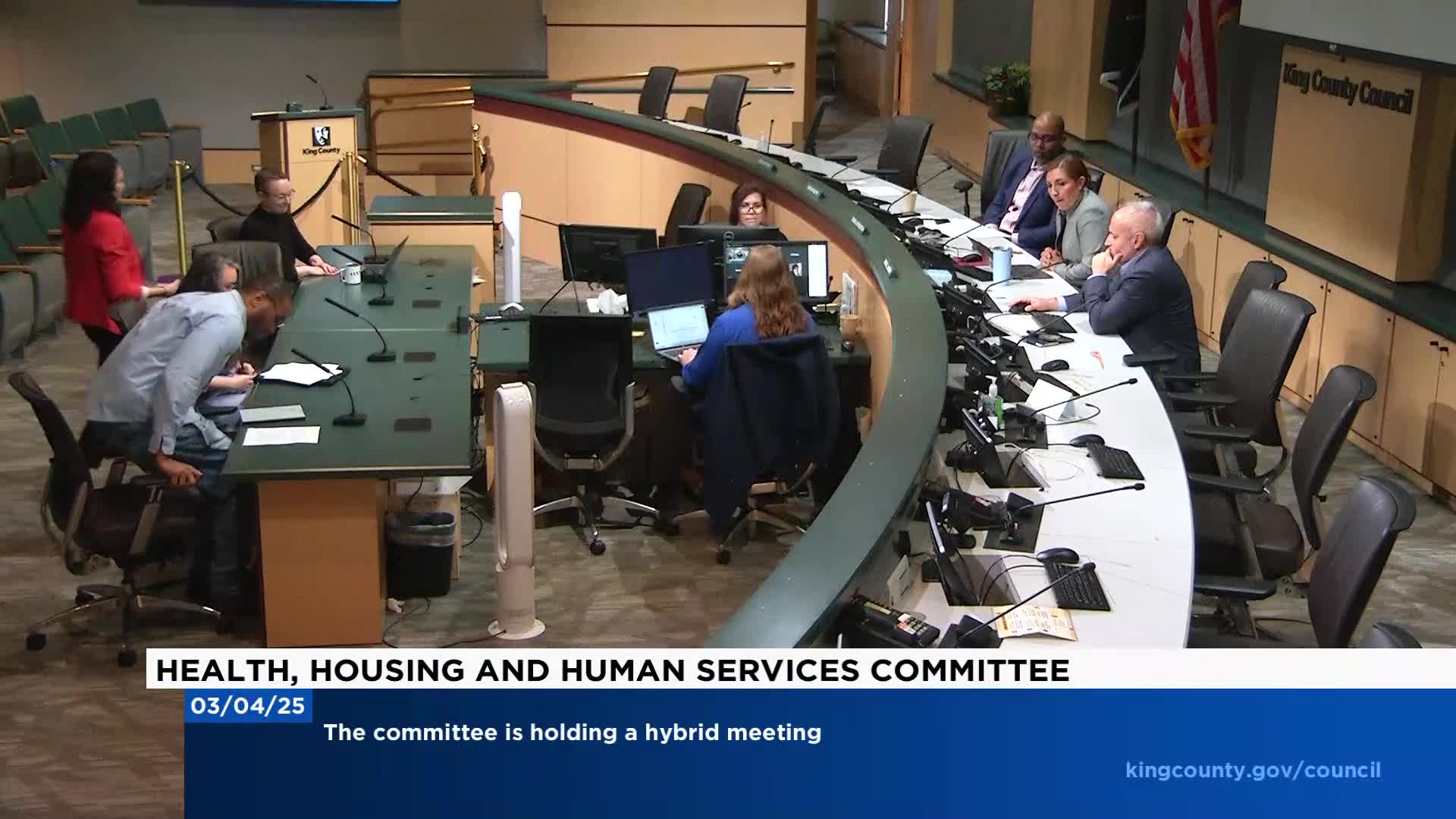
King County and the Downtown Emergency Services Center (DESC) described an expanded mobile crisis response network and the integration of new shelter-based behavioral-health services at the STAR Center during a Health, Housing and Human Services Committee briefing.
Department of Community and Human Services (DCHS) officials said the county is now supporting 27 mobile rapid response crisis teams operating 24/7 across three geographic areas (Central, South and Northeast). Kelly Ryder, director of DCHS, said the expansion is funded in part by the Crisis Care Centers levy and other state and local dollars, and that the county has committed significant staffing and managerial resources to maintain the new capacity.
Katrina Plowinski, clinical director of DESC’s mobile response division, described the STAR Center (Stability Through Access and Resources) as a time-limited, 24/7 noncongregate shelter with an explicit behavioral health focus for people with severe and untreated psychiatric and substance-use disorders. "By providing a safe place for individuals in crisis to stabilize and access care, STAR reduces the impact of unmanaged behavioral health symptoms on public spaces," Plowinski said.
Why it matters: County and DESC staff said the integrated model links 988 crisis dispatch, mobile rapid response teams, homeless outreach teams and the STAR Center to provide on-the-spot de-escalation, short-term stabilization and pathways to longer-term care and housing. Officials said the model aims to reduce repeated emergency responses and to give people a trauma-informed, low-barrier alternative to traditional congregate shelters.
Key figures and services described to the committee
- Mobile response expansion: county officials said levy and other funds brought the program total to 27 teams (10 new teams added), supported by approximately 60 FTEs and a larger $22 million total investment referenced for mobile rapid response including levy and other funds; the county’s levy contribution for initial mobile crisis investments was $3.5 million.
- Coverage and dispatch: Crisis Connections (the regional 988/behavioral-health crisis dispatcher) triages calls and deploys mobile teams operated by DESC, Sound and other providers. Officials said teams are being deployed across Central, South and Northeast geographic areas and operate in shifts to ensure 24/7 coverage.
- Outcomes in early months: DESC reported that since the December launch of the expansion it had responded to 409 calls; 335 of those resulted in face-to-face contact and about 71 cases (roughly 21 percent of face-to-face contacts) resulted in placement at a crisis respite or shelter.
- STAR Center design and services: DESC said the STAR Center will be staffed with mental health professionals (including mental health practitioners and a behavioral-health intake specialist), HOST (Homeless Outreach Stabilization and Transition) teams, and DESC mobile response teams sited to enable rapid intake and enhanced clinical services at the shelter.
Committee discussion and concerns
Councilmembers asked how the county is communicating when to call 988 and how the public should use the crisis line; DESC and DCHS staff urged callers to use 988 when they observe someone in crisis and said Crisis Connections will triage and recommend responses, including guidance community members can follow themselves when appropriate.
Councilmembers also pressed for clarity on capacity and the post-response continuum: DESC said teams offer "flex and follow-up" — outreach and consented follow-up contacts to help connect people to continuing services. DCHS officials said additional steps remain: expanding housing options, opening residential-treatment beds (an RFP was described as forthcoming), and coordinating with the state on long-term care capacity.
Workforce and sustainability
Committee members and DCHS acknowledged workforce retention as a core challenge for sustaining the response. DCHS said it committed roughly $16.8 million in 2024–2025 levy-related awards to behavioral-health workforce supports across 37 providers and is collecting wage data to inform future stabilization investments. Council members and DESC urged continued investment in wages, training and staff supports to reduce turnover and maintain service continuity.
Next steps and follow-ups
- Continue tracking response-time metrics and capacity across dispatch and teams; DCHS and Crisis Connections will provide updates on timeliness and utilization. - DESC and DCHS will continue to coordinate STAR Center openings, referrals, and how STAR integrates with coordinated entry and housing prioritization. - The committee requested additional briefings on workforce stabilization programs and on RFP outcomes for residential-treatment capacity.