Get Full Government Meeting Transcripts, Videos, & Alerts Forever!
Get email alerts on the Emergency Medical Services Funding topic
No spam. Unsubscribe anytime.
Choctaw County meeting erupts over proposed change to ambulance funding and 911 dispatching
Summary
Residents, medical providers and county officials debated a proposed bill that would change how the county's 1¢ sales tax for emergency medical services is used and would move EMS dispatching to the county 9-1-1 center. Commissioners agreed to meet with EMS and 9-1-1 officials and said the proposed bill would be pulled for further review.
County commissioners, medical professionals and residents clashed at a Choctaw County Commission meeting over proposed legislation to change how the county’s 1¢ sales tax that subsidizes emergency medical services is used and to place EMS dispatching under the county 9-1-1 center.
The debate centered on a draft bill that, as described in public remarks during the meeting, would reduce the EMS sales-tax subsidy by 50% and shift dispatch authority to Choctaw County 9-1-1. The proposal prompted multiple public comments in support of Choctaw County EMS and sharp questioning from commissioners about the ambulance service’s finances and long-term operations.
Why it matters: The 1¢ sales tax has been a significant revenue source for Choctaw County EMS since 1994. Changing the structure of that funding or who controls dispatching could affect staffing, response procedures and budgets for EMS, 9-1-1 and other county services.
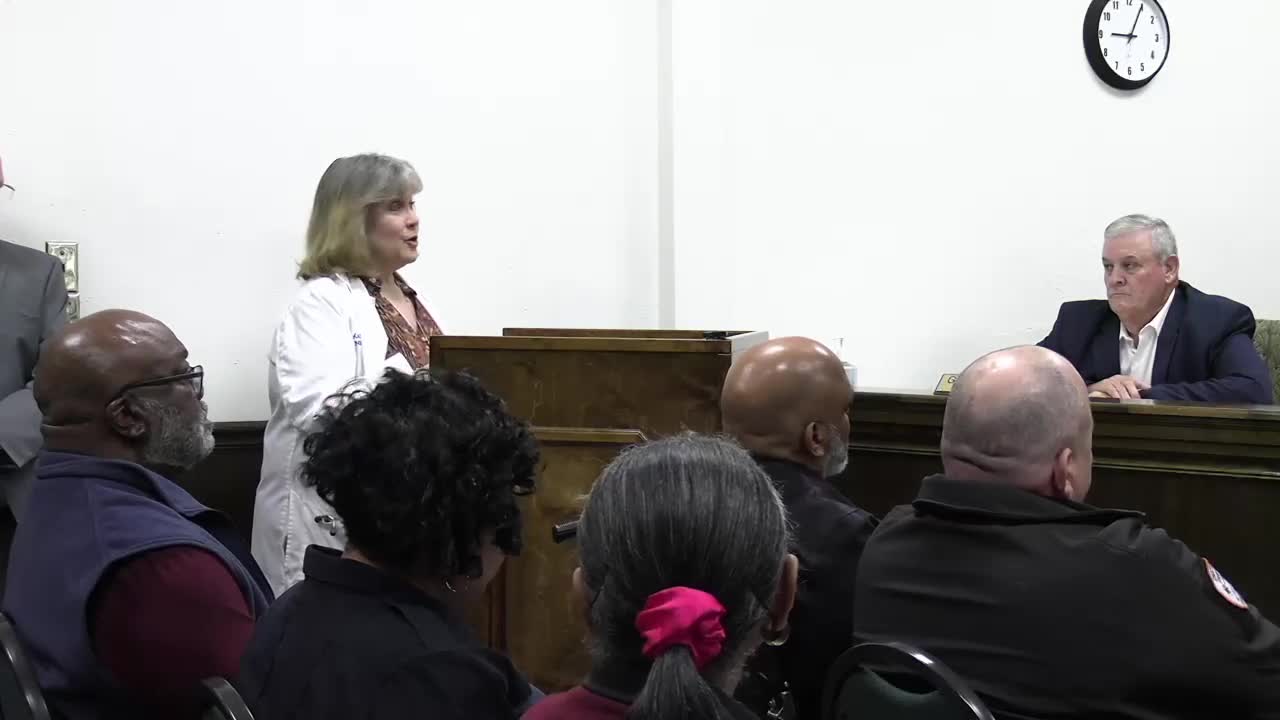
Physician Catherine Hensley told commissioners she and other clinicians rely on the ambulance service to move critically ill patients to higher-level care, saying, “We depend on this ambulance service to get our people to where they need to be.” The county commission chairman (name not specified in the record) repeatedly emphasized support for the ambulance crews while questioning whether tax revenue and EMS assets should change expected subsidy levels. The chairman read figures he said were from EMS financial statements as of Dec. 31, 2024, including a bank balance of $3,235,514.82 and total 2024 revenue of $3,418,951.41; he cited revenue line items of $40,916.22 from patient payments, $561,532.10 from Medicare/Medicaid, $510,051.18 from private insurance and $2,137,611.20 from the 1¢ sales tax, and he cited 2024 expenses of $2,914,002.45. The chairman also said those figures left what he described as a substantial surplus and questioned whether the proposed subsidy could be reduced without harming service.
Choctaw County E‑9‑1‑1 leadership and the county’s dispatch director urged caution about any change that would reduce their operating capacity. The 9‑1‑1 director said the dispatch center is already understaffed and that last year the center had worked with EMS under an agreement in which EMS pledged $200,000 for dispatching; the director said she returned this year to request the same contribution and found the EMS board declined to continue it. The director said she had hired additional dispatchers based on the prior pledge and that, without funding, the dispatch center could be forced to reduce staffing to one dispatcher per shift.
Multiple speakers from the ambulance board and EMS staff said they were not consulted before the proposed bill became public. An EMS board representative said the board learned of the bill through social media and local news coverage and called the lack of communication among EMS, E‑9‑1‑1 and the commission a major cause of the conflict.
Commissioners did not vote on the substance of the bill. Several commissioners said they planned to meet promptly with the ambulance board and E‑9‑1‑1 leadership to review the financials and operations and to try to reach a local solution. Commissioners also told the audience they expected the county’s legislative delegation to remove or delay the draft bill while local discussions continue; one commissioner said, “that bill will be pulled out,” and asked staff to work with stakeholders on revisions before any legislative filing proceeds.
What remained unresolved: Participants raised differing comparisons to other counties’ EMS subsidies and questioned what level of service could be maintained at lower subsidy levels. EMS board members argued Choctaw County provides some of the state's better ambulance coverage and asked the commission to avoid reductions that would create gaps in service. 9‑1‑1 staff said the center needs sustainable funding to meet dispatch workload and training requirements.
Next steps: Commissioners asked county staff to coordinate a public meeting with EMS board members and 9‑1‑1 leadership and to share EMS financial audits and budgets with the commission and stakeholders prior to that meeting. Commissioners and EMS representatives also said they would ask the county’s legislative contacts to withdraw or delay the draft bill while local review is completed.
Ending: The exchange underscored strong local support for emergency responders and revealed significant disagreement about communication and oversight. Commissioners said they want a negotiated, public review of budgets and operations before any legislative change is advanced.