Get Full Government Meeting Transcripts, Videos, & Alerts Forever!
Get email alerts on the Right Of Way Acquisition topic
No spam. Unsubscribe anytime.
Council rejects purchase of land for Lloyd Lane extension after safety, cost and priority concerns
Summary
A 4.13‑acre vacant‑land contract to secure right‑of‑way for a proposed Lloyd Lane extension failed after split council debate. Proponents said buying the parcel protects future mobility planning; opponents cited safety concerns at the proposed connection and competing priorities for city funds.
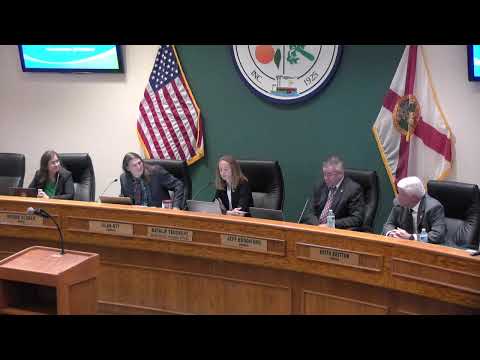
The Oviedo City Council voted down a vacant‑land purchase contract for about 4.13 acres intended to secure right‑of‑way for a future Lloyd Lane extension, rejecting resolution 4578‑25 after a divided roll‑call vote on March 3.
City staff described the site as north of East Franklin Street and east of County Road (CR) 426, with roughly 2.43 acres of wetland and approximately 0.5 acres of 100‑year floodplain within the 4.13‑acre tract. Staff presented two alignment concepts: a straight connection that avoids wetland impact but would require a deviation from city roadway spacing standards, and an alignment that crosses about 0.1 acres of wetland and carries an FDOT‑based construction estimate of about $2.38 million (the wetland mitigation line item was shown at roughly $50,000). The vacant‑land purchase price cited in the presentation was $400,000; staff additionally asked for a $25,000 budget amendment to cover due‑diligence costs if council approved the contract.
City Manager Brian Cobb explained the parcel’s place in the city mobility and multimodal plans and said an initial funding strategy would use general‑fund balance with potential later reimbursement from mobility fees and fourth‑generation sales‑tax revenues if funds remain after higher‑priority sales‑tax projects are funded.
The resolution drew sharp council debate. Mayor Mary Sladek opposed the acquisition, calling the proposed connection “a blind corner” that would not increase tax‑generating development along the new road and describing safety and fiscal concerns. “This is a $3,500,000 project waiting to happen, and I think it does not make any sense,” she said during debate, citing a county safety study and existing paved alternatives for drivers.
Council Member Butterford supported acquiring the land now, saying land prices rise and the city rarely gets such an opportunity; Butterford noted proceeds from the sale of a previous city asset could fund the acquisition and argued that owning the right‑of‑way preserves future options.
Council Member Ott and others raised questions about whether the connection would meaningfully improve access for students or relieve traffic without expensive intersection upgrades such as signalization (staff estimated a signal would cost about $750,000). Several council members said even if the city bought the land it would likely not build the road immediately and that construction estimates could rise over time.
The roll call vote recorded: Mayor Mary Sladek — Nay; Council Member Butterford — Aye; Deputy Mayor Teukert — Nay; Council Member Britton — Aye; Council Member Ott — Nay. The mayor declared the motion failed.
Why this matters: Securing right‑of‑way can protect future mobility projects from development that would block planned corridors, but the purchase would obligate the city to a project with multi‑million‑dollar construction costs, potential wetland mitigation, and possible design deviations from the land‑development code. Council split on whether the long‑term mobility planning benefit outweighs near‑term fiscal and safety concerns.
Staff said the vacant‑land contract includes a 60‑day due‑diligence window with appraisal, environmental and wetlands review and that the agreement anticipates the city processing lot aggregations and easement work if it proceeds later. Because the motion failed, no purchase, due diligence work or budget amendment will proceed on this parcel at this time.