Get Full Government Meeting Transcripts, Videos, & Alerts Forever!
Get email alerts on the Community Safety topic
No spam. Unsubscribe anytime.
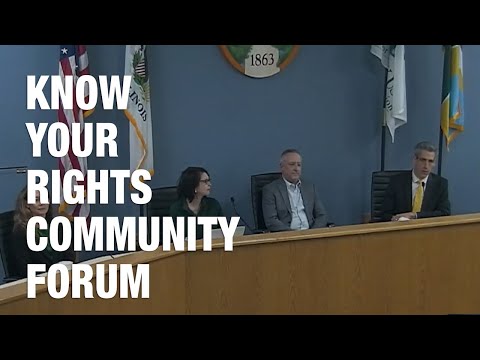
Evanston officials offer know-your-rights training, temporary guardianship steps for immigrant families
Summary
The Moran Center and Evanston officials gave a step-by-step know-your-rights and safety-planning session, covering warrants, how to appoint temporary guardians for children, emergency contacts, and police policies on immigration inquiries and detainers.
Moran Center staff and Evanston officials led a community session on how immigrant residents can prepare if federal civil immigration enforcement occurs, including steps for safety planning, temporary guardianship for children and clarity on what local police will and will not do.
Megan McClung, managing attorney with the civil legal team at the Moran Center for Youth Advocacy, gave the practical legal guidance. McClung said, “If an officer comes to your door, any officer, you do not open the door. Teach your children to not open the door. And what you want to do is ask the officer to slide a valid judicial warrant under your door.” She emphasized that a valid warrant must be signed by a judge, include the person’s name, and identify the property to be searched, and that ICE forms claiming to be warrants do not count.
McClung walked through a seven-step safety plan she said is posted on the Moran Center website, MoranCenter.org. Key steps she outlined include identifying an emergency contact; designating a temporary guardian for children; memorizing emergency phone numbers; sharing key information only with trusted individuals; and keeping essential documents—such as birth certificates, passports, medical records and property titles—in secure, accessible locations. She noted the temporary guardianship uses an Illinois statutory form that requires one parent’s signature, two witnesses to the parent’s signing, and the designated guardian’s signature. She warned that only the English version of the statutory form is legally valid, though translated copies are provided for understanding.
McClung said the Moran Center provides limited immigration legal services focused on youth and directed attendees to other resources listed on the Moran Center website, including the Illinois Coalition for Immigrant and Refugee Rights hotline at (855) 435-7693 and referrals to organizations such as the National Immigrant Justice Center and the Resurrection Project.
Commander Scott Safir of the Evanston Police Department addressed the department’s role and limits. Safir said the department’s roughly 40 sworn officers and support staff are bound by city ordinance and Illinois law and that immigration status “has no bearing on how we adhere to these goals.” He stated plainly: “The Evanston Police Department will not stop, arrest, search, or detain based solely on the belief that a person is in The United States illegally.” Safir added the department will not honor civil immigration detainers, will not transfer individuals to ICE custody without a federal criminal warrant, and will not provide ICE access to nonpublic areas of the police department.
Safir referenced guidance from the Illinois attorney general and a fact sheet from the International Association of Chiefs of Police to note that state-level guidance and national policing organizations support local decision-making about participation in immigration enforcement. He said the department’s policies require officers not to ask about immigration or citizenship status during routine contact, including traffic stops, calls for service, and encounters with witnesses.
Organizers encouraged residents to use the Moran Center safety-plan form, give copies to trusted contacts and schools where appropriate, and save digital photos of documents on phones for quick access. The session closed with presenters reiterating local legal protections and available referral resources.