Get Full Government Meeting Transcripts, Videos, & Alerts Forever!
Get email alerts on the Housing topic
No spam. Unsubscribe anytime.
Ogden council approves $1 million transfer to RDA; funds earmarked to help purchase Aspen House property
Summary
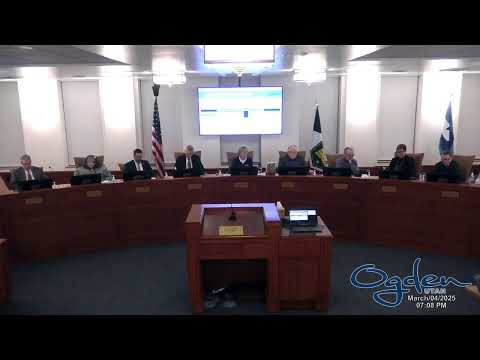
Ogden City Council and the Ogden Redevelopment Agency on March 4 approved moving $1 million from BDO lease revenue into the Quality Neighborhoods Fund and RDA budget; staff said the funds could be applied to the purchase of the Aspen Cove (Aspen House) property pending further council action.
Ogden City Council and the Ogden Redevelopment Agency on March 4 approved a pair of measures to move $1 million from BDO lease revenue into the city’s Quality Neighborhoods initiative and redevelopment budget, a transfer that staff said could be used to cover the cost of purchasing the Aspen Cove (Aspen House) property if the council later approves the real-estate transaction.
Justin Sorensen, a city staff member who presented the budget item, told the council: “It’s not $100,000 in the packet, it’s actually a million,” noting a figure on the slide was incorrect and the item was intended to advance funding that had been planned for the next fiscal year into the current year. The council adopted the city ordinance (proposed ordinance 2025-8) by roll call vote; a subsequent Redevelopment Agency resolution (proposed resolution 2025-2) recognizing and budgeting the transfer also passed by roll call.
Why it matters: the funds were described by staff and some council members as money previously earmarked for the Quality Neighborhoods fund that the city could apply toward purchase of the Aspen Cove property. Public commenters emphasized the need for more housing for people experiencing homelessness and urged the council to act. City and county officials said they had recently negotiated to avoid further conflict and to preserve intergovernmental relationships while pursuing housing solutions.
During the public hearing, residents and nonprofit leaders urged action on homelessness. Carrie Wayne said the public needs “an open conversation” and noted the emotional toll of homelessness on children and families. Marcus Carr, who identified himself as a nonprofit leader, said the problem of people sleeping in vehicles and tents was growing and urged coordinated resources: “We have to get these children and these parents off the street,” he said. Heath Sato, a city resident, urged clearer communication about the plan and the role of county and state actions, saying he did not feel the public had been fully informed.
Robert (Bob) Hunter, who identified himself and later spoke as a longtime local public-service participant, said the state legislation referenced in earlier discussions would not have taken effect before May 7 and that Weber Human Services did not use that legislation as leverage. Hunter said the county, city and nonprofit partners had agreed to keep working collaboratively despite the project’s setbacks and that some funding (which he estimated at about $600,000 in ARPA money) would be lost under the revised timeline.
Mayor Nedoskie addressed council members and the public, acknowledging miscommunication around who the proper contacts were at the Weber Housing Authority after a change on Jan. 1 and defending steps taken when city leaders felt “backed into a corner” by funding timelines. He said he had discussed options previously presented by the housing authority’s board chair, and that the purchase option was one possible path to keep the housing authority whole. The mayor said he regretted any lack of clarity but stood by actions taken to protect the city’s interests and emphasized that the parties had since met and reached a more collaborative place.
Council members and staff said the transfer does not by itself finalize a property purchase. Council Member Trebrica (as listed in the meeting roll call) cautioned that the city “hasn’t determined that we’re using it for that cost” and said a transmittal for a real estate purchase would come back to the council next week for consideration. Council Member Ritchie moved to adopt the ordinance; Council Member Blair seconded. The roll-call vote on the city ordinance recorded seven ayes and no nays. On the RDA side, Board Member Ritchie moved the resolution; Board Member Hyer seconded, and the resolution passed by roll call with seven ayes.
Votes at a glance: Proposed ordinance 2025-8 (city budget amendment) — motion by Council Member Blair, second by Council Member Graff; roll-call vote: Blair (aye), Trabrica (aye), Graff (aye), Myers (aye), Ritchie (aye), Vice Chair Hyer (aye), Chair White (aye). Outcome: approved. Proposed resolution 2025-2 (RDA budget recognition for Quality Neighborhoods) — motion by Board Member Ritchie, second by Board Member Hyer; roll-call vote recorded all ayes. Outcome: approved.
Next steps: staff said the city will transmit a real-estate purchase item for council consideration, expected the following week, before any purchase is finalized. The council and mayor also flagged ongoing coordination with the county and housing authority, and speakers noted that some grant timing (including ARPA-related monies) had been affected by the delay.
The meeting also included public comment on homelessness, civic acknowledgments and a brief RDA hearing on the same budget action. The city ordinance and the RDA resolution both passed the evening of March 4, 2025, and any use of the $1 million toward Aspen Cove/Aspen House would require subsequent council approval.