Get Full Government Meeting Transcripts, Videos, & Alerts Forever!
Get email alerts on the Illegal Dumping Enforcement topic
No spam. Unsubscribe anytime.
Fall River committee asks corporation counsel to tighten illegal-dumping fines and enforcement tools
Summary
The Ordinance and Legislation Committee discussed gaps between the city’s litter/dumping fines and the actual cost to remove waste. Members asked Corporation Counsel to revise city code and a fee schedule and referred the matter for legal drafting and clarification of enforcement options including criminal restitution.
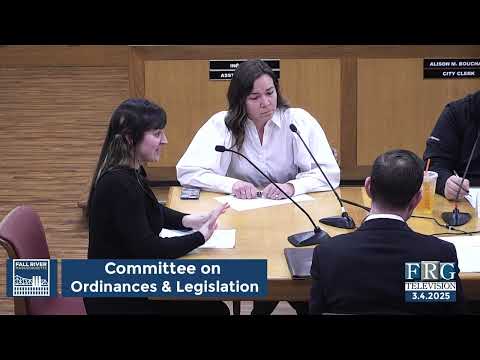
Fall River’s Ordinance and Legislation Committee voted to refer the city’s littering and illegal-dumping ordinance language to Corporation Counsel after a wide-ranging discussion about enforcement, fines and costs to remove dumped materials.
Councilor Raposa, chairing the discussion, said committee members and staff concluded that existing fines in city code are too low to deter illegal dumping. "I think my colleagues on that committee agreed that the fines are too low regardless," Raposa said. Committee members and public-safety staff described examples—dumped tires and construction debris—that carry a real disposal cost far above the typical $300 municipal fine.
Al Olivera, director of city operations, told the committee the city bears significant disposal costs for construction debris and tires; he estimated a single trip to a disposal facility could cost "$4,500" depending on material and hauling. Deputy Chief Orr described the department’s preference for criminal charges in many dumping cases, citing Massachusetts law as enabling fines and restitution. "We usually go the criminal route which is, Mass General chapter 270, section 16," Orr said, noting criminal cases allow courts to require restitution for the city’s removal costs.
Corporation Counsel (Attorney Rumsey) told the committee that the existing littering ordinance in city code is aimed largely at minor littering (for example, a tossed cup), and that separate provisions or a clearer fee schedule would help the city distinguish a single littering act from larger-scale illegal dumping. "Littering is one thing, and I think dumping is generally charged…we could add another article to the ordinances that deal with dumping per se," Rumsey said.
Council members suggested options for mayoral or departmental steps: (1) attach a fee schedule or scale of fines to the ordinance that ties specific categories of dumped material to graduated fines and costs, (2) make clear that the city can recover actual disposal costs in addition to fines, and (3) use covert or fixed cameras and citizen video to help enforcement. The committee also discussed the Copacat Reservoir watershed ordinance, which already allows higher fines and specific enforcement tools to protect the water supply.
After discussion, the committee voted to refer the city code language and the draft concepts to Corporation Counsel for redrafting and recommended the counsel consider a clearer fine schedule, explicit language about recovering disposal costs, and cross-references to criminal restitution procedures.
The committee also requested that city operations and the water department review signage and visible deterrence in the Copacat reservation area and that the police department provide information on recent enforcement actions so the city can track restitution outcomes.
No changes to fines or criminal procedures were adopted at the meeting; the item was referred to Corporation Counsel for additional drafting and legal review.