Get Full Government Meeting Transcripts, Videos, & Alerts Forever!
Get email alerts on the Air Service Woodring topic
No spam. Unsubscribe anytime.
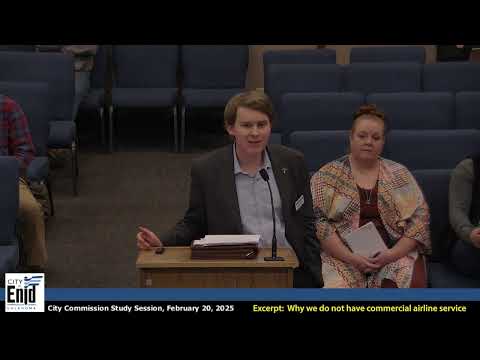
City airport official: commercial service at Woodring unlikely without subsidies
Summary
An airport official told the Mayor and Board Commissioners that regular commercial passenger service at Woodring is improbable unless subsidized, citing low annual ridership, airlines' minimum capacity needs and high operating constraints.
An airport official told the Mayor and Board Commissioners that regular commercial passenger service at Woodring is improbable without federal or local subsidies, noting low local ridership and airlines' operational requirements.
The official said the airport handled roughly 1,000 commercial passengers a year when it had scheduled service — about three travelers per day — and that modern commercial airlines typically require about a 70% passenger load to make routes viable. “I'm not going to say it's impossible, but, I, I would honestly say improbable,” the airport official said during the meeting.
Why it matters: local attempts to restore scheduled flights would likely require a subsidy or an external guarantee for carriers. The official described how small regional aircraft typically seat about 30 passengers, meaning airlines would need to fill roughly 21 to 23 seats daily to reach the 70% threshold. Without assurances of sustained demand or a subsidy program, carriers generally will not add new stops.
At the meeting the official cited the federal Essential Air Service program as the primary mechanism that historically brought commercial flights to smaller communities. They also pointed to a nearby example: Stillwater, where a city and university fund guarantee helped attract and sustain scheduled service. The airport official said, however, that those guarantees have not frequently been drawn on in practice.
The official also discussed broader industry economics, saying commercial airlines operate on very thin margins — recalling that a good year may yield about a 2% profit — and that airlines tend to expand service only when demand or financial guarantees justify the risk. “They're not looking to expand unless they have insurances that they're gonna meet that demand, or there's going to be money set aside to compensate them for the lack of that demand,” the official said.
Meeting remarks included references to travel routes from Denver to Enid and Dallas as anecdotal examples of regional air travel patterns, but the discussion did not include any formal motions or commitments by the Mayor and Board Commissioners to pursue specific subsidy arrangements.
The discussion concluded without a decision; any future action to restore or pursue scheduled commercial service at Woodring would require further staff study and likely outside funding or participation in federal programs such as the Essential Air Service program.