Get Full Government Meeting Transcripts, Videos, & Alerts Forever!
Get email alerts on the Set Gillnet Cooperatives topic
No spam. Unsubscribe anytime.
House committee hears broad support for HB 117 to preserve cooperative set gillnetting
Summary
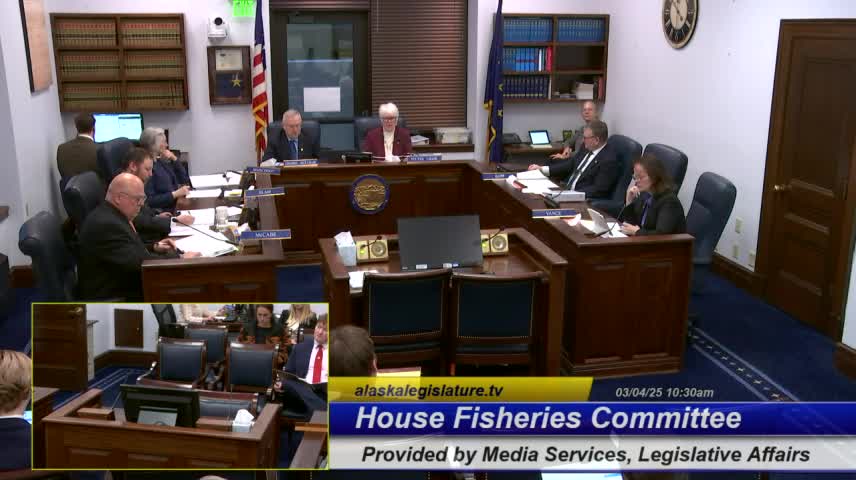
House Special Committee on Fisheries Chair Louise Stutes convened the committee on March 4, 2025, in Juneau to consider House Bill 117, which the committee says would preserve the traditional practice of family and small‑group set gillnet operations allowing commingling of catches and one permit holder to deliver fish on behalf of a cooperative.
House Special Committee on Fisheries Chair Louise Stutes convened the committee on March 4, 2025, in Juneau to consider House Bill 117, which the committee says would preserve the traditional practice of family and small‑group set gillnet operations allowing commingling of catches and one permit holder to deliver fish on behalf of a cooperative.
Supporters told the committee the bill responds to a recent enforcement interpretation that they say would require each permit holder to keep and deliver fish from their permit separately. "This legislation would preserve a traditional model for salmon set net operations by continuing to allow small groups, often families in rural Alaska, to work cooperatively, commingle their fish, and have one permit holder deliver on behalf of the group," Matt Greening, staff to the House Fisheries Committee, said during the bill presentation.
Why it matters: Testimony from rural fishermen and local organizations stressed that the practice is central to safety and the economic viability of remote shore‑based fisheries, where operators rely on small skiffs, limited hold space and tenders that may be many miles away. Kevin Fisher, a 35‑year set netter from the Alatek District, said the new interpretation led to at least one citation last year and could put small family operations out of business. "This really feels like an attack on our small fishing operations," Fisher said.
Committee staff described the proposed language as a clarification, not a new exception. The bill directs the Board of Fisheries to establish regulations to register a set gillnet permit fishing as part of a cooperative and "specify how a set gillnet permit holder must report fish harvested when fishing cooperatively with other permit holders," Matt Greening said. He described the bill language as intentionally broad to allow input from law enforcement, the Commercial Fisheries Entry Commission (CFEC), Alaska Department of Fish and Game (ADF&G), stakeholders and the public.
Testimony and concerns: Multiple witnesses — including Eric O'Brien of Kodiak, Adelia Myrick of the Northwest Setnetters Association, Bob (Robert) Murphy of Kodiak, Lisa Gabriel of Kenai, David Fleming of the East Miami District, and Kristen Sterling of Pilot Point — told the committee that commingling is routine and important for safety, crew availability and maintaining local permit access. "Keeping our crew back to the beach safe is our number one priority, not separating fish," Lisa Gabriel said, describing operations from small 22‑foot skiffs.
Several members of the committee asked how quickly implementing regulations could be in place if the bill were enacted. Committee staff and members noted the Board of Fisheries' schedule likely would not allow rulemaking before the upcoming season and said the legislature could work with the Department of Public Safety (DPS) on enforcement discretion while regulatory steps occur. "We have support for it that we can work with the Department of Public Safety potentially to not issue fines while this is going through the process," Matt Greening said, while noting DPS had not committed to that course.
Process and next steps: The committee set HB 117 aside to return to it on Thursday, March 6, for public testimony and invited written comments to house.fisheries@akleg.gov. Committee members emphasized they expect further drafting and stakeholder input before final language is adopted.
Ending: Proponents described HB 117 as intended to preserve longstanding family‑based cooperative practices and local access to permits in remote communities; opponents were not represented in the invited testimony at this meeting. The committee will take public testimony on March 6 and may amend the bill based on stakeholder feedback before advancing it further.